
You are reading an excerpt from our free but shortened abridged report! While still packed with incredible research and data, for just $20/month you can upgrade to our FULL library of 50+ reports (including this one) and complete industry-leading analysis on the top crypto assets.

Becoming a Premium member means enjoying all the perks of a Basic membership PLUS:
- Full-length CORE Reports: More technical, in-depth research, actionable insights, and potential market alpha for serious crypto users
- Early access to future CORE ratings: Being early is sometimes just as important as being right!
- Premium Member CORE+ Reports: Coverage on the top issues pertaining to crypto users like bridge security, layer two solutions, DeFi plays, and more
- CORE report Audio playback: Don’t want to read? No problem! Listen on the go.
RAI
RAI, a decentralized stablecoin backed by Ethereum (ETH), presents a unique solution to the challenges faced by traditional stablecoins. Unlike other stablecoins, RAI operates on a reflex index rather than a pegging mechanism, allowing it to adapt to prevailing supply and demand conditions. RAI's dynamic target price, known as the Redemption Price, is fundamental to its stability.
RAI’s key characteristics are
- It is not a fiat-backed stablecoin like USDC and USDT
- It emphasizes decentralization by utilizing ONLY ETH as collateral
- It has a floating peg and uses a “Reserve redemption” to help maintain its price stability
Similar to Maker, users deposit ETH (into SAFEs, akin to Maker vaults) and take out loans in RAI. However, there is a notable distinction: RAI directly alters the redemption price, while DAI applies an interest rate to balances. For DAI, the redemption price is consistently set at 1 USD.
The primary function of RAI is to serve as a less volatile version of ETH, which can be used as collateral in lending protocols or as reserve assets in DAO treasuries. RAI adjusts its value according to market price fluctuations resulting from interactions between SAFE owners and RAI holders. It employs a dynamic target price referred to as the Redemption Price.
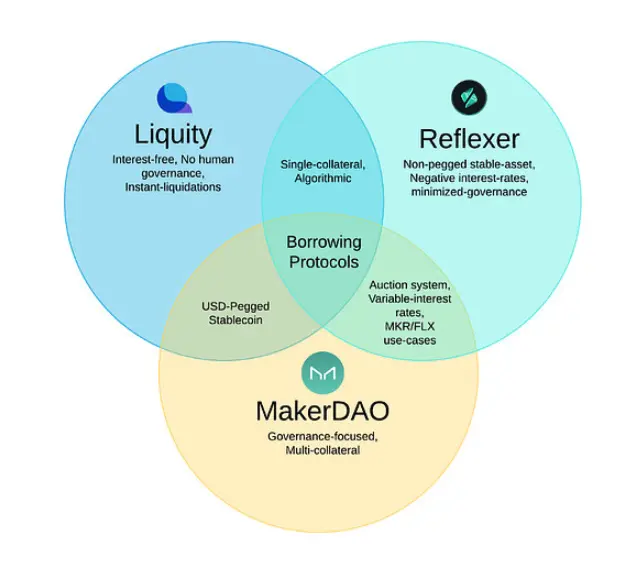
How RAI Works
Reflexer Finance (RAI) introduces an innovative stablecoin system that relies on a reflex index instead of a conventional pegging mechanism, as seen in other decentralized stablecoins. The reflex index is driven by prevailing supply and demand conditions and is neither pegged to a specific value nor backed by a vault.
Two primary parties are involved in the RAI system: SAFE users who mint RAI by lending their ETH and RAI holders. Depending on the supply and demand dynamics, both parties are incentivized to either mint RAI or redeem their assets. This balance keeps the system stable and well-adjusted to market conditions.
While FLX token holders, representing the speculative token, play a less critical role, it is essential to understand the motivations of RAI holders and RAI lenders.
- RAI Holder: An individual or entity that possesses RAI tokens.
- RAI Lender: A participant who deposits ETH into a "SAFE" smart contract. They can then withdraw RAI up to a specified value of the deposited ETH (e.g., with 1 ETH equaling 100 RAI, depositing 10 ETH allows withdrawal of up to approximately 667 RAI). Lenders can recover their deposited ETH by repaying their RAI debt.
There are two primary motivations for becoming a RAI lender:
- Going long on ETH: Depositing 10 ETH and withdrawing 500 RAI, for instance, results in a position worth 500 RAI with 10 ETH of exposure, thus fluctuating 2% for every 1% change in ETH price.
- Arbitrage: Borrowing RAI to invest in a fiat-denominated asset that appreciates faster than RAI creates the potential to profit from the difference.
The protocol employs a liquidation mechanism closely resembling Maker's, albeit with a few unique enhancements. One notable addition is Liquidation Protection, which allows SAFE users to establish a safety pool, or "Saviour," containing Uniswap LP tokens or ETH. In situations where the SAFE falls below the liquidation ratio, the liquidator must initially add collateral from the user's Saviour to the SAFE. This innovative feature, exclusive to Rai, enables SAFE users to avert liquidation without compromising capital efficiency. Additionally, the system utilizes Dampened Oracle Prices, receiving collateral prices from Oracle Feeds and medianizing the data to eliminate extreme values.
The medianized values pass through the Oracle Security Module, which imposes a one-hour delay before prices are published, and proceed into a Dampened Security Module that restricts value changes between two consecutive price feed updates. Furthermore, the system offers alternative governance-whitelisted Oracle Feeds, such as Chainlink and Uniswap TWAP.
A lending protocol guided by the redemption rate motivates users to repay their debts or borrow from the pool. To borrow from the RAI protocol, users need to lock their assets within the protocol and mint a stablecoin.
RAI's value is determined by the redemption rate, ensuring that it remains in sync with the prevailing supply and demand conditions, as opposed to being pegged like DAI. The RAI system connects to a price feed mechanism and updates the redemption price whenever a price update is received for the approved collateral types.
RAI posits that its system was the initial design proposed by MakerDAO for DAI. This unique approach offers users a broader range of rewards and the potential for greater market adaptability.
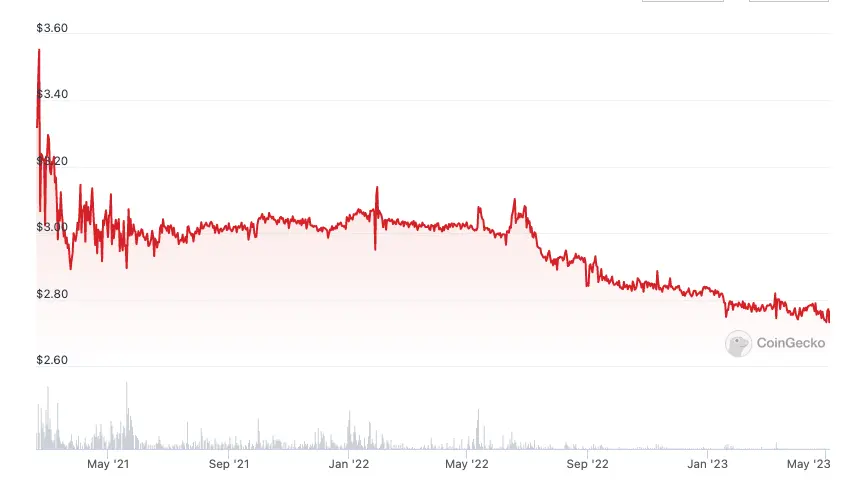
RAI price over time.





