If you want more cryptocurrency analysis including full-length research reports, trading signals, and social media sentiment analysis, use the code "Publish0x" when subscribing to CryptoEQ.io to make your first month of CryptoEQ just $10! Or just click the button above!
Solana has employed an inflationary, uncapped supply model for its on-chain economic system. The economic model is established by incentivizing validators to stake SOL, Solana’s native token on the network. The SOL token can be utilized on the network in five distinct ways:
- Power decentralized applications (dApps)
- Making payments
- Paying network fees
- Providing network security through staking
- Facilitating network governance
The Solana protocol reduces the SOL supply by eliminating 50% of total transaction fees while the remaining 50% is paid out to the network’s computing infrastructure providers (validators) who are incentivized to stake SOL tokens. Since fee revenue reduces supply while fees paid to stakers create an incentive for holding the token, these economics underpin SOL’s fundamental value model and make the digital token a productive capital asset.
As a result of Solana’s revenue-based supply reduction mechanism, the future total supply of SOL is unknown. While the total SOL supply will vary depending on network revenue, the rate of new token issuance is programmed into the Solana protocol through a predetermined inflation rate and long-term inflationary schedule.
Economic Incentives
Protocol-based inflationary rewards are distributed to validators from a determined “global supply inflation rate” in which the inflation rate is on a predetermined schedule. For this schedule, Solana offers three distinct terms to understand their model:
- Initial Inflation Rate: The predetermined starting inflation rate in which the token issuance rate can only decrease
- Dis-inflation Rate: The rate at which the inflation rate itself is reduced
- Long-term Inflation Rate: The rate that the Solana protocol is expected to hold over time to promote economic stability
Presently, the Solana Foundation has established the parameters for the inflationary model with an initial inflation rate of 8%. This rate is set to decrease by a rate of 15% per year until the inflation rate reaches a long-term rate of 1.5%. It should be noted that any of these parameters are subject to change and do not include other token supply impactors.
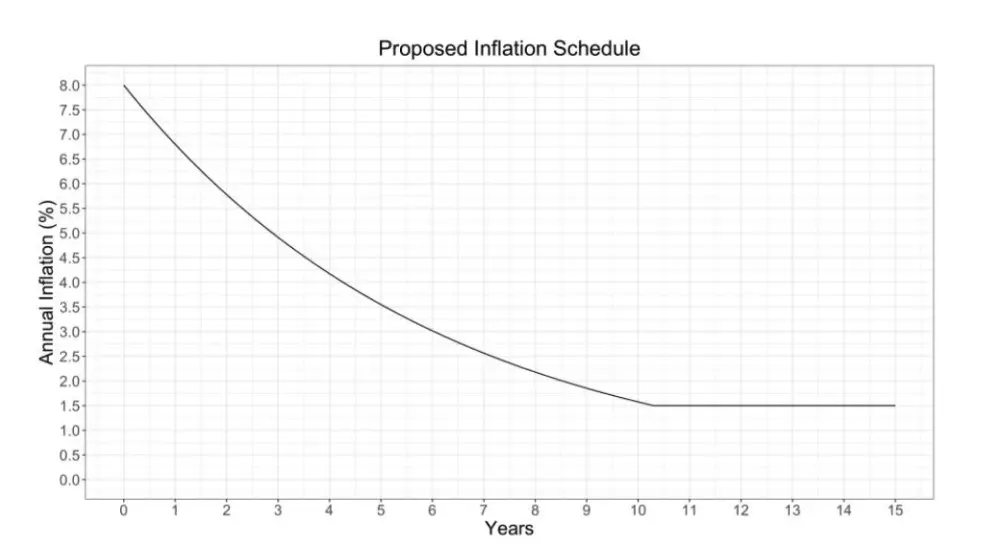
The current proposed inflation schedule for SOL on the Solana network, per Solana Documentation
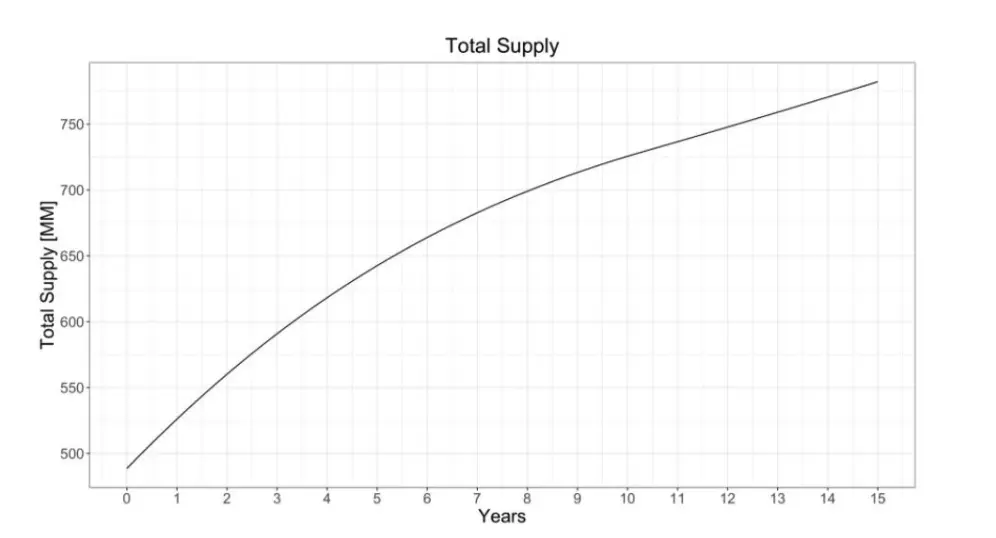
The current estimated total supply growth for SOL on the Solana network, per Solana Documentation
Validators staking on the Solana network should expect their annual staking yield percentage to gradually decrease over time until it also arrives at a stable rate. For the SOL that is not staked, the dilution percentage will increase over time as that SOL is not receiving awards. In other words, staking negates dilution.