

If you want more cryptocurrency analysis, including full-length research reports, trading signals, and social media sentiment analysis, use the code "Publish0x" when subscribing to CryptoEQ.io to make your first month of CryptoEQ just $10! Or simply click the button above!
Access the full report here.
Bridge Type by Transfer Mechanism
Lock-and-Mint
Some bridges use off-chain validators/verifiers and a lock-and-mint solution to overcome the communication barriers between separate L1 blockchains. The validators are responsible for the assets and functionality of the system. They're third-party actors introducing new trust assumptions unique to the validator set. Practically speaking, lock-and-mint is similar to an automated bank; they manage transactions in a more centralized, trust-based manner.
You lock your assets on the source chain, minting a synthetic/wrapped “equivalent” token on the new chain. All networks have a native token, and any other network can issue its own version of that token by “bridging” the asset. This system's security depends on the bridge and network of validators that validate transfers. This bridge type is currently the most common, despite being the most vulnerable. For instance, wBTC (wrapped Bitcoin available on Ethereum) is the largest bridge by TVL, with ~$5 billion of value locked up in the bridge. In this instance, centralized company BitGo serves as the sole validator set and is responsible for all users' TVL. Even Ethereum itself can be wrapped to become wETH.
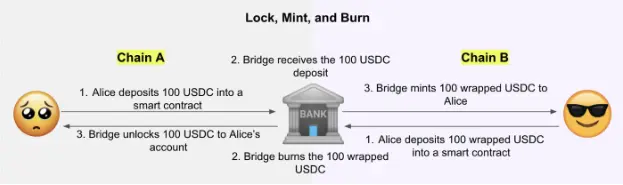
We can distinguish lock/mint bridges that don’t depend on external liquidity from swap bridges. Swap bridges are dependent on external liquidity suppliers (typically having permissionless AMMs on both sides or a set of whitelisted LPs). Bridges that implement atomic swaps are a subtype of swap bridges. They may constitute an altogether different group as they're relatively unique.
Atomic swaps
An atomic swap is when peers can swap one asset for another directly; the ‘atomic’ means the trade is all of nothing, in the sense that one party can’t end up with all of the tokens. An example of a cross-chain atomic swap would be trading ETH for BTC. Hashed Time Lock Contracts (HTLCs) are a common means of implementing atomic swaps. HTLCs are time-bound, condition-based contracts that facilitate the trustless swapping of one token for another.
Atomic stops are a mechanism for taking liquidity from one side of two chains and exchanging it for liquidity from the other. They're straightforward to deploy over several chains and preserve many key trust reduction aspects of the underlying chains, but they can't be used for broad message forwarding.
Liquidity Providers
Liquidity bridges enable value transfers across chains with the help of liquidity pools. Liquidity Providers (LPs) act as a third party between two chains by creating liquidity pools on both chains and helping to facilitate the transactions by ensuring adequate liquidity exists (for a fee). Validating cross-chain swaps on liquidity bridges occurs on both the source and destination chains.
Cross-chain swaps via liquidity pools are an alternative to transporting an asset across chains. In a cross-chain swap, no assets travel between chains; instead, they're "traded."
For example, you have funds on Chain A but want to get them to chain B. Liquidity Provider that already possesses the same asset on Chain B will offer to exchange it for your assets on Chain A (for a fee).
This design works seamlessly, provided:
- it's well capitalized
- it's sufficiently decentralized
- it's efficiently re-balanced, and
- LPs have enough incentives to keep ample liquidity available on both sides of the bridge.
As discussed, locally-verified systems leverage the underlying blockchains’ validator set in a cross-chain swap. In a locally verified liquidity network, rather than the entire validator set of both chains verifying a transaction, just two validators (one from each side) verify the counterparty on the other chain.
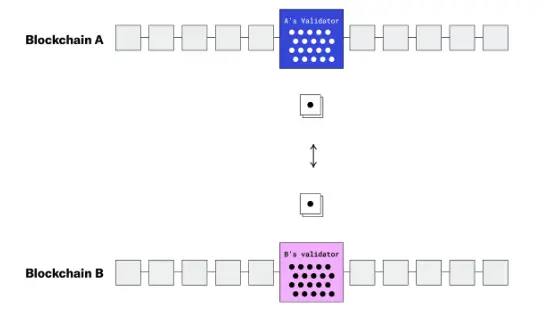
The validators function as “routers” for the liquidity networks that:
- hold the liquidity pools on each chain
- verify each other (the counterparty), and
- facilitate the atomic swaps.
With bridges utilizing liquidity providers, most bridge risk lies with the LPs, not users, since they have funds at risk in the pools. Bridge users care most about speed and liquidity, while LPs are most concerned about volume and security (how they earn fees and protect them, respectively).





