
Ethereum and NFTs
Spencer Randall: “So if you look at Bitcoin… [Bitcoin] has a real first mover advantage. It’s a market leader in digital store value use case. And so with Ethereum, it is the clear market leader for general purpose smart contracts. And as a clear market leader, it is the go to for NFT’s. So I look at it more like validation of its use case, right? This use case for digital assets beyond simply a digital store value, which is what the markets really decided Bitcoin is. So there are competitors to Ethereum, of course, but as you said, Simon, Ethereum is the standard.”
The NFT sector had its best month in February 2021. The Top 3 NFT marketplaces are NBA Top Shot, OpenSea, and CryptoPunks. These were good for a combined trading volume of $342 million.
The NFT sector had its best month in February 2021. The Top 3 NFT marketplaces are NBA Top Shot, OpenSea, and CryptoPunks. These were good for a combined trading volume of $342 million.
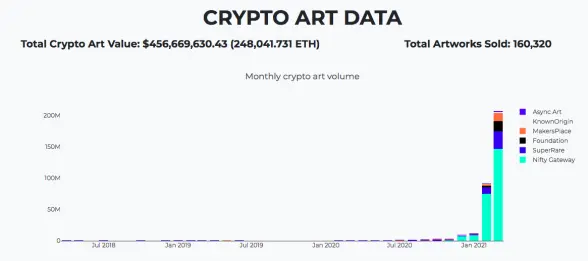
Image credit: https://cryptoart.io/data
20 of the top 25 NFT marketplaces are on the Ethereum blockchain, with the one glaring exception being the market leader, NBA Top Shot, on the Flow blockchain. Flow is a new blockchain from Dapper Labs, the famed dApp developer that got its start with CryptoKitties on the Ethereum chain in 2017. As Ethereum has become the de facto nexus for NFT commerce, several large marketplaces have emerged. The biggest Ethereum-based NFT marketplaces include Nifty Gateway, SuperRare , Rarible, and OpenSea.
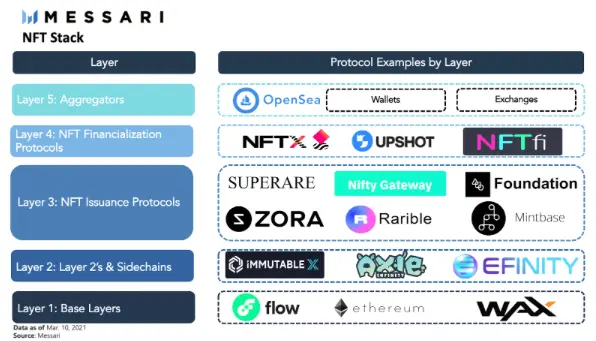
While Ethereum hosts the lion’s share of NFT volume and projects, there are several other NFT standards emerging. Binance Smart Chain (BSC) is very similar to Ethereum and Ethereum’s Virtual Machine, and is compatible with the ERC-721 token standard. Beyond BSC, Cosmos is developing an NFT module that can be leveraged as part of the Cosmos SDK.
The Corporate Impact of NFTs
Steve Symington: “We saw Jack Dorsey and Square go out there and spend $297 million dollars for majority stake in TIDAL, a music streaming business. Jack Dorsey said, I think TIDAL is a lot more than just streaming. And I think the new focus of something like that is to find ways to allow individual artists to better support their work. And NFT’s are sort of a natural translation of that.”
Does the general public value NFTs? Is there something behind all this hype? I think the market has proven yes.
- Beeple sells an NFT for $69 million
- Beeple sells $6.6M worth of NFTs on Christies
- Why an animated flying cat with a pop-tart body sold for $600,000
- NBA Top Shot leads NFT explosion with $230M in sales
- $90M of on-chain NFT sales in February
- Grimes auctioning off 10 pieces of NFT digital artwork
Is there more to NFTs than unique JPEGs and digital art? Also, yes.
- 3LAU sells $3.6M NFT in a tokenized album sale
- EulerBeats could overturn the music industry and birth a record label DAO with its DeFi economics
- NFTs for copyrights: why non-fungible tokens could transform who gets paid for music rights
- NFTs and esports, a match made in heaven
NFTs could prove disruptive to digital art, music, concert ticket sales, collectibles, esports, and anything looking for a unique representation in a trustless, digital format. Nearly anything can be tokenized or NFT’d, enabling cryptographically-secured ownership of a unique digital item and allowing for an order of magnitude of improvement on the ability to capitalize on otherwise difficult-to-realize value. A digital representation allows for increased liquidity, fractionalized lending, user as collateral, or just buying and selling. Additionally, as is always the case for emerging technologies, novel and exciting use cases have yet to even be imagined!
Meitu Purchases ETH
Spencer Randall: “Ethereum can make sense. You know, it is a digital store of value amongst other things. So when you look at it, Meitu, what’s interesting is about a 60/40 split, right? So they actually allocated more to Ethereum than Bitcoin. So not only do they allocate to Ethereum, they actually allocated a heavier weighting to Ethereum. I think that’s very interesting. Why? I think it’s the same way as Bitcoin, in this case. It’s a hedge.”
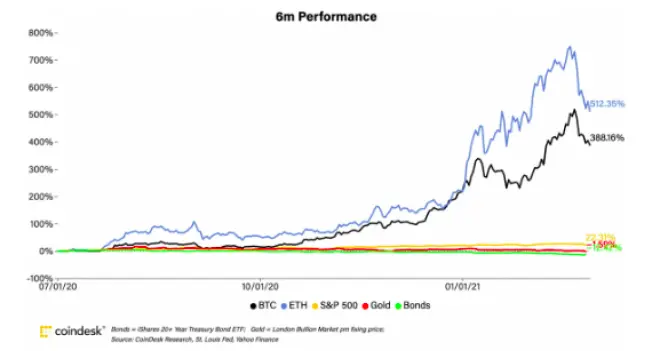
Brooks Vaughan: “I think one thing we’re seeing here is the death of the traditional portfolio where you’re 40% bonds. It’s very hard for people to hold bonds while watching disruptive innovations take off. There’s just a massive amount of money to make in this space. And so you’ve got a lot of eyes turning towards crypto and saying, “Hey, you know, if I just put 5% of my portfolio in crypto, I can outperform anything I’ve done over the past 10-20 years.” And so it’s hard to ignore that.”
Meitu purchasing Ether with corporate funds is a landmark moment as they are the first large-scale company to do so. The purchase was noteworthy enough on its own, but purchasing more ETH than BTC certainly got the Bitcoin bulls scratching their heads. Before trying to understand why, first let’s consider whether there is a meaningful difference in a portfolio when adding BTC versus adding ETH.
Last week, Meitu announced that it bought another 16,000 ETH and 386 BTC. In total, the company now has ~$50 million in ETH and ~$40 million in BTC. The purchases were made under the terms of a board-approved investment plan that allows the company to invest in up to $100 million in cryptocurrencies.
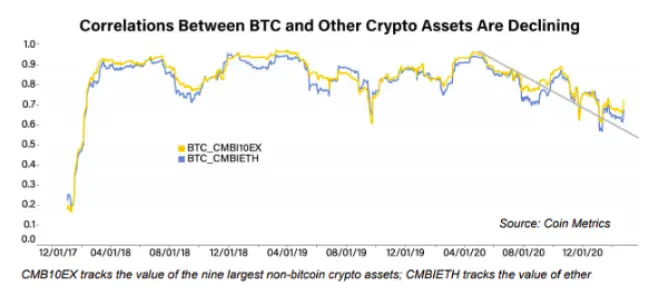
Because Ether is the second largest crypto asset by market capitalization and trade volume, it is the obvious next candidate for institutional investors to consider when looking to diversify into cryptocurrencies. While the correlation between BTC and ETH remains quite high (~0.7), it has declined over the last 6 months; previously, it was generally in the 0.8-0.9 range. This decline reinforces the argument for diversification within the crypto asset class, as do the incredibly independent project visions, implementations, and ultimate use cases for the two assets.
Many institutional investors see Bitcoin as a store-of-value play, i.e. “digital gold.” Conversely, Ether is viewed more as a technology play or commodity play similar to “digital oil.” Both analogies fail to fully represent ETH’s value, but do highlight the difficulty in explaining the asset in traditional terms. A crypto-novice requires new mental models when considering the effects of adding crypto to one’s portfolio.
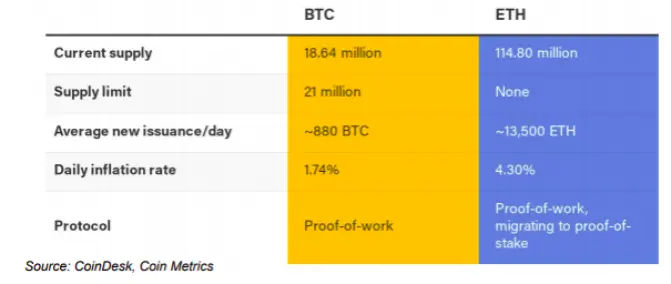
ETH is essential for users wanting to interact with dApps, DeFi, or NFTs built on Ethereum. As Ethereum adoption increases and there is a greater demand to transact on the blockchain, the value of ETH is expected to rise as well.
Portfolio Allocation and Yield in Cryptocurrencies
Brooks Vaughan: It’s hard for me to even invest in real estate right now,if I can park my crypto and earn 8-12% on it. You know, it’s just low risk and easy way to make 8-12%. But as far as allocating your portfolio, one thing to consider is if you’re not investing some of your portfolio in disruptive innovations, you’re falling behind.”
More and more companies are allowing crypto investors to earn interest on their crypto holdings. Opportunities exist via centralized and decentralized solutions with different risk profiles and trade-offs for each. Some crypto lending services offer tremendous yields (as high as 8.6%) on the USDC coin, which has very close parity to the US dollar. That said, others may pay out in the crypto that is deposited. So, if that particular crypto falls in value in comparison to USD, a holder may lose purchasing power, even with the added interest.
A few of the centralized solutions with their interest rates are below. Users should always do their own research. There is no such thing as a risk-free return. Users need to be comfortable with potentially handing over control of their funds, company insolvency risk, rehypothecation of funds, variable lock up periods and interest rates, and so on.
Remarkably, the space has matured significantly in just a few short years. During the hype cycle of 2017, these options did not exist, but now many users have yet another reason to keep their money in crypto as many of the returns are superior to those found in the legacy banking system.





