
Airdrops in General
In the ever-evolving world of the Web3 ecosystem, airdrops have gained traction as a prominent marketing strategy employed by project teams to amplify awareness of their initiatives, foster early participation, and attract new users. Additionally, airdrops present an enticing opportunity for users to acquire complimentary cryptocurrency assets. However, the intricacies of successful airdrop campaigns warrant careful examination to ensure optimal outcomes.
An airdrop, in essence, involves the distribution of free tokens by blockchain projects to their user community. Airdrops serve multiple purposes, including incentivizing and rewarding early supporters, attracting new users, expanding the project's community, and circumventing potential legal issues. The tokens can be distributed pre or post-announcement, depending on the project's strategy.
While airdrops present a multitude of benefits, it is crucial to understand the potential value that can be derived from them. The estimated all-time high (ATH) values for various airdrops have demonstrated that these distributions can deliver significant returns. As such, those with portfolios under $10,000 are advised to focus on farming airdrops, using multiple wallets to receive airdrops multiple times.
Eligibility for airdrops can be somewhat elusive, as each project has unique criteria for distribution.
Cryptocurrency users can qualify for an airdrop by meeting specific requirements set by the project team conducting the airdrop. While the eligibility criteria may vary between projects, there are several common prerequisites that users can fulfill to increase their chances of qualifying for an airdrop:
-
Hold specific tokens or NFTs: Some airdrops require users to hold a certain amount of the project's native token or NFTs in their wallet for a specific period before the airdrop snapshot.
-
Wallet activity: Maintain an active wallet with regular transactions, as some projects may require a minimum wallet activity to qualify for their airdrops.
-
Community participation: Engage in the project's community by joining their social media platforms, such as Twitter, Discord, or Telegram, and actively participate in discussions and events.
-
Beta-testing or test-net usage: Projects in their development phase may reward users who contribute to the testing of their platform or products by providing valuable feedback and reporting bugs.
-
Governance involvement: Participate in the project's governance system by voting on proposals, submitting proposals, or engaging in other governance-related activities.
-
Trades and liquidity provision: Some airdrops may require users to have a history of trading or providing liquidity on decentralized exchanges (DEX) associated with the project.
-
Project creation or contribution: Creating projects, tools, or sub-projects on top of a protocol or infrastructure that does not yet have a token can make users eligible for airdrops once the token is launched.
-
NFT minting: Minting or holding specific NFTs associated with the project could be a criterion for eligibility in some cases.
-
Grant donations: Donating to grant initiatives on platforms like Gitcoin may qualify users for airdrops, as projects may reward those who contribute to the development of the ecosystem.
-
Running nodes or validators: Operating a node or validator for a project's testnet or mainnet can make users eligible for airdrops, as this demonstrates a commitment to the project's growth and stability.
-
Register for airdrops: Some projects may require users to sign up on their website or complete specific tasks, like filling out a form or completing a KYC (Know Your Customer) process, to qualify for the airdrop.
It is crucial to stay informed about upcoming airdrops by following reliable sources and project announcements. Users should also be cautious about potential scams and security risks, using multiple wallets and never exposing their primary wallet's seed phrase. By actively participating in the cryptocurrency ecosystem, users can maximize their chances of qualifying for airdrops and reaping the benefits they offer.
Celesita's TIA
Celestia's native currency, TIA, plays a pivotal role in the architecture of what is posited as the inaugural modular blockchain network. Developers harness TIA to transact on Celestia, particularly for data availability—a fundamental requirement for rollup developers who must submit PayForBlobs transactions to the network, incurring a fee denominated in TIA.
The philosophy underpinning Celestia is the simplification of blockchain deployment, mirroring the ease of smart contract creation. This modular paradigm eliminates the immediate need for developers to introduce a new token for launching their blockchain, streamlining the initial phases of rollup deployment.
In a practice reminiscent of Ethereum, developers may choose to leverage TIA not only as a medium for covering data availability costs but also as a gas token and currency, expediting the launch process. This approach allows them to concentrate on the development of their applications or execution layers without the immediate pressure to issue a new token.
Celestia operates on a proof-of-stake consensus mechanism, utilizing the Cosmos SDK framework. This setup enables users to contribute to network security by delegating their TIA holdings to validators, thereby earning a share of the staking rewards. Furthermore, TIA staking grants the community a decisive role in Celestia's decentralized governance, including voting on network parameters and managing the community pool, which accrues 2% of block rewards.
Celestia's economic model is structured around transaction fees generated from the processing of transaction batches by various rollups. The fee mechanism is designed to mirror Ethereum's with a dynamic base fee that undergoes a burn process, along with a tipping system incentivizing validators to prioritize transactions. Validators also benefit from token issuance associated with the creation of new blocks.
From the user's vantage point, the fee structure on execution rollups is anticipated to include the operational cost, data availability publishing cost, and a margin for profit, which is likely to be bundled into a single fee. This fee will also incorporate a congestion charge, expected to be relatively lower due to decreased network congestion.
Revenue streams for the settlement layer are derived from settlement contract fees paid by rollups for finalization services and fees for bridging services, as Celestia will facilitate trust-minimized bridging between rollups.
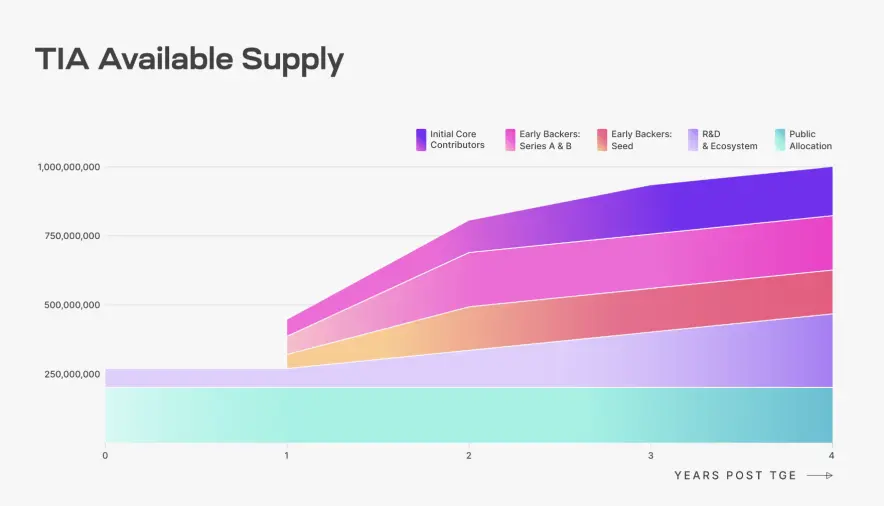
In terms of tokenomics, TIA is set to experience an initial inflation rate of 8% in its first year, with a deceleration of 10% per annum until it stabilizes at a permanent inflation floor of 1.5% annually. This inflationary model is intended to incentivize network participation and security in the network's nascent stages.
The Halloween Airdrop
The recent launch of Celestia, a modular blockchain that professes the ability to scale effectively with an increasing user base, has presented a tepid entrance into the market. In its initial week, the platform reported fewer than 350,000 transactions, despite its robust technical framework designed to handle a greater volume of activity. The transaction count, captured in the four-day span post-release, suggests a gradual user adoption rate.
In a notable event, approximately 190,000 individuals participated in Celestia's airdrop on a recent Tuesday, although the pool of eligible users surpassed 600,000. This resulted in nearly $1 million worth of tokens remaining unclaimed. Celestia's strategic distribution of 60 million tokens through airdrops targeted a diverse group, including active users on Ethereum Layer 2 solutions, stakers within the Cosmos Hub and Osmosis ecosystems, and developers across the cryptocurrency domain. The eligibility snapshot for this airdrop was archived at the outset of the year, on January 1, 2023.
With the mainnet poised to go live, Celestia has announced the creation of a maximum of 1 billion tokens on the network, positioning the airdrop to represent a 6% stake in the total token supply. Despite the subdued initial activity, the Celestia network boasts a compelling annual percentage yield (APY) of approximately 23.39% for validators staking the native TIA token. This yield is considerably more lucrative when juxtaposed with Ethereum's current staking rate of 3.8%, suggesting a competitive edge for Celestia in attracting network validators and stakeholder participation.





