

If you want more cryptocurrency analysis including full-length research reports, trading signals, and social media sentiment analysis, use the code "Publish0x" when subscribing to CryptoEQ.io to make your first month of CryptoEQ just $10! Or simply click the button above!
Why bridge at all?
Three common reasons:
- Higher yields elsewhere: Competing L1s and their dApps offer try to offer higher yields than competitors to bring in users and liquidity.
- Lower fees but same EVM experience: $30 mainnet Ethereum fees can hurt users' ability to make a profit in DeFi so many can bridge over to Avalanche, Polygon, Fantom, etc. to do similar DeFi activities for lower fees. Note, this does come with a security trade-off!
- Wrap or unwrap a native asset. Some exchanges might sell you an ERC20 version of the native token you just bought. If you want to take possession of the actual native token, you may first need to bridge your wrapped version to the native network.
As the number of layer-1s and their ecosystems grow, there is an even greater need for managing composability and interoperability across chains. Cross-chain bridges allow for otherwise siloed ecosystems to interact in a meaningful way - this is analogous to the way new trade routes helped connect otherwise disparate regions, ushering in a new era of knowledge-sharing.
Wormhole, Layer Zero, and other bridging solutions support generalized message passing, allowing all types of data and information, including tokens to be moved across multiple ecosystems — applications can even make arbitrary function calls across chains, enabling them to tap into other communities without having to deploy elsewhere. Other protocols like Synapse and Celer are limited to cross-chain transfers of assets or tokens.
There are a number of L1 ecosystems that connect to the Ethereum network and can host ERC-20 tokens. Some examples are the following:
Layer 1 to Layer 1 Bridges
Layer 1 bridges come in many different forms and perform similar functions with differing approaches. With the substantial growth that alternate Layer 1 (and Layer 0) networks experienced during 2021, there has been a massive increase in transaction value utilizing bridges.
In fact, the demand shock to alt L1s helped drive bridge construction, leading to a significant increase in the available cross-chain bridges available between Ethereum and external blockchains. Total value locked (TVL) across Ethereum bridges is now in the billions of dollars, showcasing how important and vital cross-chain infrastructure is to the entire system.
Avalanche
Avalanche is a layer 1 smart contract-capable blockchain platform that operates over multiple blockchains and subchains to provide fast transaction processing times, a robust consensus engine, and overall user security. Avalanche is considered a direct Ethereum competitor as it has its own network and corresponding ecosystem.
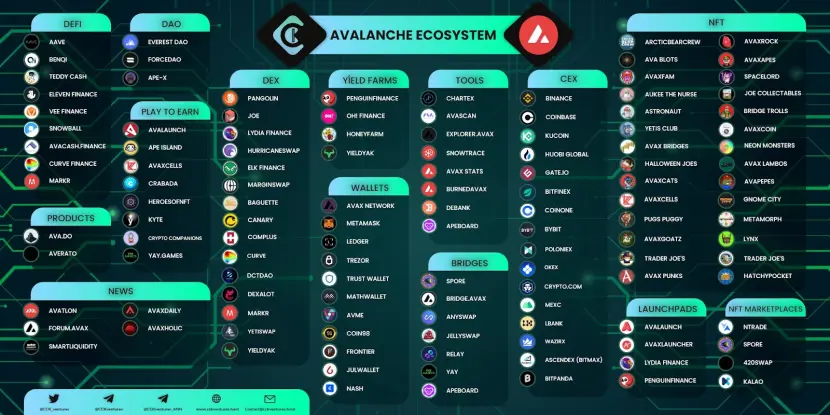
To connect to Ethereum, users can take advantage of the Avalanche Bridge - a bridge that is compatible with ERC-20 and ERC-721 tokens and links to Avalanche’s C-Chain. The bridge uses ChainBridge, a modular blockchain bridge that transfers data and funds.
Usage
Avalanche Rush incentivized top projects to move over to Avalanche and reward their users with industry-leading yield farming incentives. Ethereum-native DeFi projects like Aave, Curve, and Sushi launched on the C-Chain as well as Avalanche copy-cats like Trader Joe, Benqi, and others.
Nearly all of Avalanche’s growth can be attributed to its C-Chain and its EVM-compatibility while also offering lower fees. Ethereum users suffered for most of 2021 with $15+ fees and $100+ trades, making Avalanche’s cheap Ethereum bridge, liquidity mining incentives, and compatibility with multi-chain web3 wallets, like Metamask, a welcomed alternative.
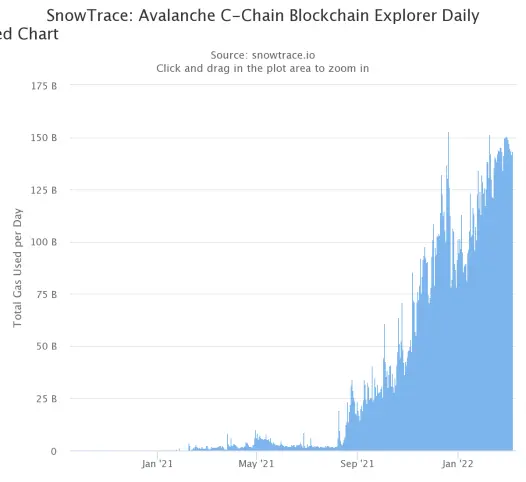
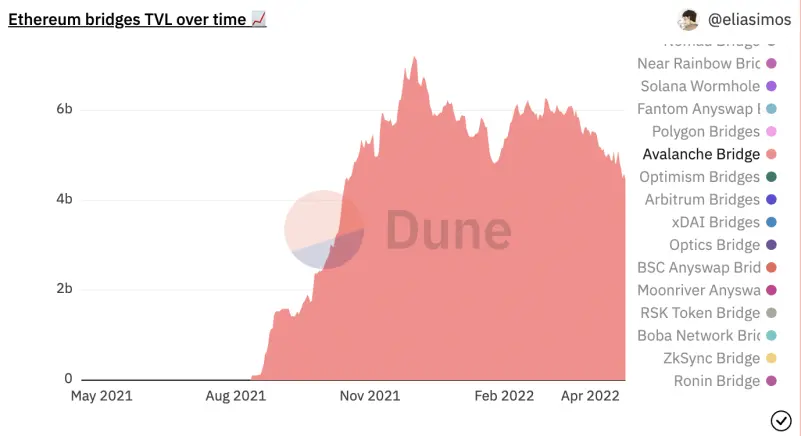
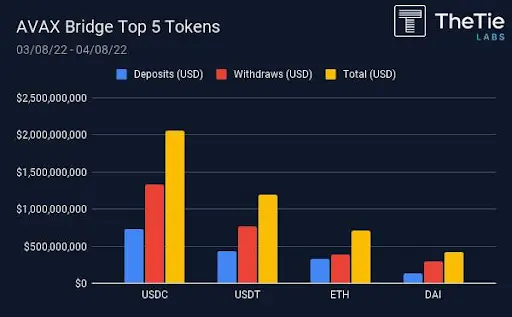
The Avalanche bridge is one of the biggest within the Ethereum ecosystem. It holds close to $5 billion USD in TVL and has seen considerable growth since September 2021. Assets with the highest total value on the bridge include the following:
- WETH / ETH
- USDC
- DAI
- WBTC
- USDT
- LINK
- AAVE
To use the bridge, users simply need to enter the Avalanche Bridge portal and connect a wallet. Avalanche is a two-way bridge, meaning assets can be transferred between Avalanche and Ethereum.
TVL on Avalanche Bridge over time (~$4.6B currently):
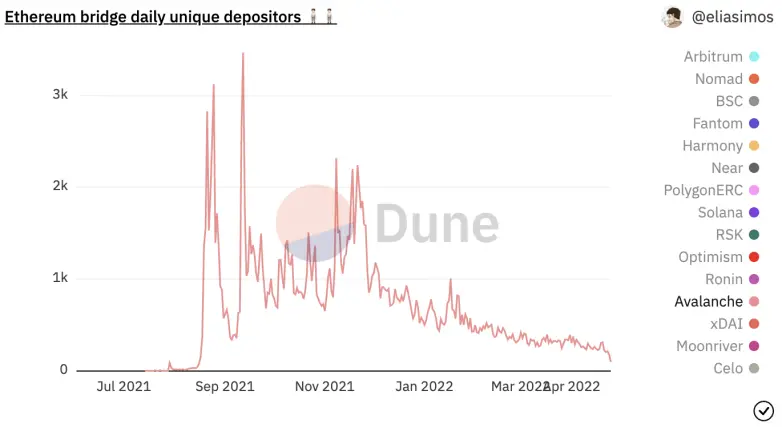
Unique daily bridge depositors over time:
Helpful links





