

If you want more cryptocurrency analysis including full-length research reports, trading signals, and social media sentiment analysis, use the code "Publish0x" when subscribing to CryptoEQ.io to make your first month of CryptoEQ just $10! Or simply click the button above!
Primary Use Case
Fantom’s pivot away from Smart City automation towards DEXs and other DeFi applications speaks to the versatility of EVM-compatible smart contracts. In theory, a blockchain network with low fees and fast time to finality can target any number of diverse use cases. The Fantom Foundation has also, in the past (c.2020), signaled an intent to innovate in the medical industry. One would be forgiven for wondering what use cases Fantom does not plan on solving. The shift towards DeFi applications after DeFi started to take off and gain significant adoption begs the question of what other digitally native opportunity spaces Fantom might attempt to leverage moving forward. Naturally, building DeFi products and services does not necessarily present similar oracle problems as building smart cities, making it easier to develop. Additionally, there is no requirement to reliably and securely interface with many IoT hardware devices.
Fantom is comparable to Avalanche, Cosmos, and Polkadot to various degrees insofar as new dApps and projects building on Fantom can essentially launch their own chain that is natively compatible with the remainder of the Fantom network. Fantom aims to be able to scale to sufficient transactional throughput to be able to support applications reliant on micropayments, such as gaming. It remains to be seen if the Fantom network will have its ambitions tested in practice.
Secondary Use Case
Fantom’s main Secondary Use Case is staking the network’s native token, FTM, to secure the network. Validator nodes in the Fantom network are required to stake 500,000 FTM in order to participate in generating network consensus. In addition to earning block rewards (via the release of tokens from a pre-mined reserve, there will never be more than 3.175 billion FTM), validators also earn a portion of the network transaction fees. Network participants can also delegate their stake to validators, requiring at least 1 FTM. Those staking sufficient FTM, and delegators (who pay a ~15% fee on their rewards to validators), stand to earn rewards for successfully propagating the chain. Fantom’s chain is structured in epochs lasting approximately 4 hours (or 1,000 blocks).
In addition to the transaction fee levied in FTM, which is paid to validators, 30% of each transaction fee is burned. Transactions fees are paid out to validators proportionally to their weight. Stakers, delegators, stand to earn higher rewards the more they stake to validators and can lock up tokens for up to a year in order to maximize their revenue.
Challenges to Adoption
A non-negligible part of the FTM ecosystem was attributable to the cult of personality surrounding core team members and the speculative influence on FTM DeFi products. The news of their departure in 2022 (and again on speculative news of their potential return to DeFi) indicates a less than fully mature protocol and market. Andre Cronje has been described as “The GodFather of DeFi”, having made core contributions to wildly successful projects like Yearn Finance before his involvement with Fantom. Cronje had been working on a Uniswap AMM-inspired DEX, featuring design principles from Curve and OlympusDAO, with Daniele Sestagalli. In January of 2022, a crypto-focused digital sleuth offered reason to believe that Sestagalli’s co-founder of the Wonderland project, Sifu, was in fact, Michael Patryn, the co-founder of QuadrigaCX (the Canadian exchange whose founder ostensibly died in 2019, under unusual circumstances and did so, without sharing the private keys for some ~$190 million of user funds). This apparent revelation seriously discredited many DeFi projects and surely heavily influenced Cronje’s decision to step back from DeFi. Furthermore, there has been speculation that Michael Patryn (aka Sifu) used to go by Omar Dhanani, who was involved in an identity theft ring and pleaded guilty to credit card and identity theft crimes in 2002. Needless to say, the risk of further association with nefarious actors stands to potentially cause Fantom, and dApps on the network, trouble down the line.
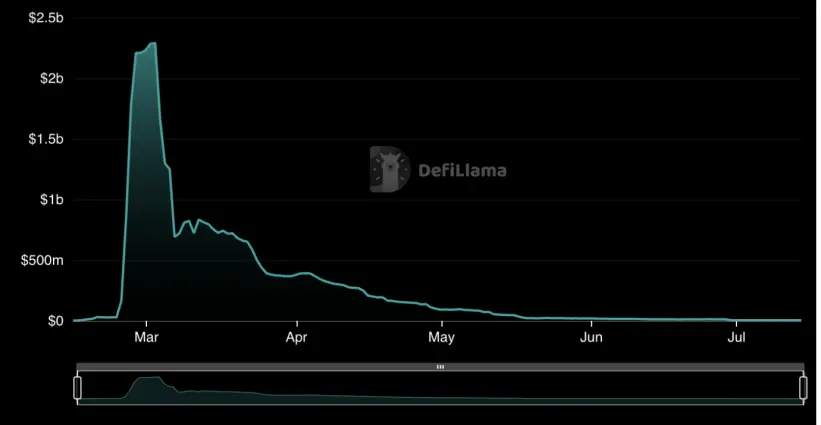
The above-mentioned scandals notwithstanding, the Solidly DEX incorporated some questionable token economics and saw a remarkable collapse from billions of dollars of TVL to almost nothing in a matter of weeks. Solidly was widely reported to have achieved billions of dollars of TVL within 24 hrs of launching, though the DEX was plagued with UX issues and bugs. Solidly borrowed heavily from OlympusDAOs (3,3) meme, which essentially encouraged users to maximize rewards by continuing to stake their assets on the protocol. OlympusDAO also collapsed from billions of TVL to millions around the same time as Solidly was launching, leaving plausible room to believe that Solidly was doomed from the outset, regardless of the core teams’ discrediting associations.
Onerous Full Node Operation Requirements
Running a full validator node of the Fantom network requires staking 500,000 FTM, which has historically required a USD equivalent FMT lockup measured in the millions of dollars, though as of Q3 2022, this represents ~$140,000 (at 1FTM = $0.28). Full node operators are also required to invest in reasonably high-capacity hardware. The Fantom Foundation recommend 4 3.1 GHz vCPUs and at least 1TB SSD storage as the minimum hardware requirements. A validator node can only self-stake tokens up to the 15th multiple of the minimum deposit.





