
You are reading an excerpt from our free but shortened abridged report! While still packed with incredible research and data, for just $20/month you can upgrade to our FULL library of 60+ reports (including this one) and complete industry-leading analysis on the top crypto assets.

Becoming a Premium member means enjoying all the perks of a Basic membership PLUS:
- Full-length CORE Reports: More technical, in-depth research, actionable insights, and potential market alpha for serious crypto users
- Early access to future CORE ratings: Being early is sometimes just as important as being right!
- Premium Member CORE+ Reports: Coverage on the top issues pertaining to crypto users like bridge security, layer two solutions, DeFi plays, and more
- CORE report Audio playback: Don’t want to read? No problem! Listen on the go.
Intro
Aptos is a Layer 1 blockchain network developed by former engineers from the Diem project at Facebook, with a primary focus on scalability. It claims to have the capacity to process up to 10,000 transactions per second, with a target goal of reaching 100,000 TPS. The network utilizes the Move programming language, which has received commendations from developers for its robust security features and user-friendly nature. Aptos aims to construct a multi-faceted blockchain network that addresses several challenges faced by existing blockchain technologies such as Bitcoin and Ethereum. This includes reviving the technology from the Diem project by incorporating the Move programming language to develop a secure, scalable, and adaptable infrastructure. Additionally, the network seeks to achieve high transaction throughput, reduced latency, and verifiable state synchronization in decentralized networks, leveraging the Diem architecture while maintaining broad compatibility with diverse technologies.
The native token, Aptos, is the APT token and is primarily used as a staking/delegation token, although it also serves as the blockchain’s utility and gas fee token. Aptos leverages novel technologies, such as Block-STM, to conduct parallel execution, theoretically forging a path towards high network performance.
Use Case
Aptos is a Layer 1 blockchain network built on the Move programming language with a focus on scalability, reliability, and security. The project is a continuation of the original Diem blockchain project through Meta (formerly Facebook), which was founded in October 2022 by Mo Shaikh and Avery Ching.
Aptos functions through its own native currency, APT, and is being developed by a complementary company called Aptos Labs. By focusing on scalability and throughput, Aptos Labs has claimed that the project can theoretically process up to 10,000 TPS with a target goal of reaching 100,000 TPS without compromising reliability (i.e., network uptime) and security. This is made possible through the implementation of different novel technologies, including that of Block-STM technology.
Value Proposition
The Aptos blockchain’s core value proposition is found within its usability and security innovations. For instance, Aptos allows for the creation and management of multiple independent wallet addresses through a single controlling account. These wallets can't be traced to the controller account, ensuring that the user has complete privacy and autonomy over their blockchain activities. Additionally, Aptos also incorporates a built-in auditing feature known as the Move Prover. The Move Prover is tasked with mitigating potential vulnerabilities in network security by verifying the legitimacy of Move modules deployed on the Aptos blockchain and ensuring the correct execution of the associated smart contracts.
There's a high degree of emphasis placed on delegation as well, giving users flexibility in their overall management and involvement on the Aptos blockchain. Besides the APT serving as a delegation token to validators, Aptos also supports private key delegation that allows for the temporary transfer of control over a wallet to a third party. The third party that the wallet has been delegated to holds a specified level of authority over the wallet, but the original user ultimately has full control and ownership over the wallet and all associated assets.
Overall, these features point to Aptos-targeted blockchain economy participants that are actively looking for an L1 network that favors usability and security over other distinct features.
Competition and Adoption Challenges
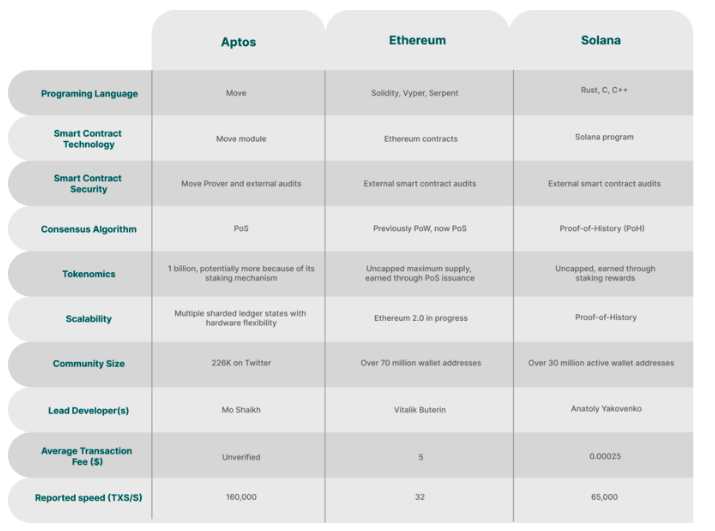
Aptos aims to compete with other established Layer 1 blockchains in what has become a saturated market over the past few years. Launching in 2022, Aptos is significantly behind other comparable competitors in terms of market share, ecosystem development, user acquisition, and more. This includes projects like Solana (SOL), BNB, Cardano (ADA), and Avalanche (AVAX). With the recent successes of L2 projects on Ethereum, Aptos also now has to compete with the likes of Arbitrum, Optimism, and Polgyon’s zkEVM efforts.
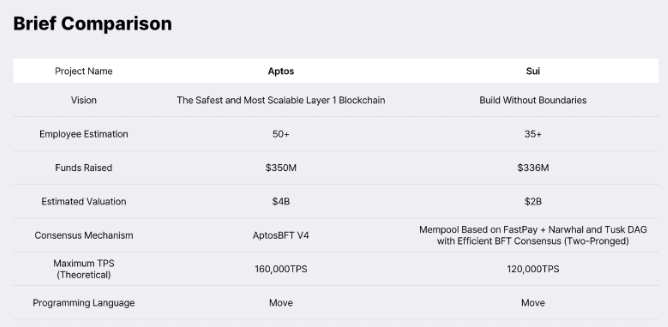
Aptos is also in direct competition with its sister project, Sui, another Move programming language-based project that also stemmed from former Meta developers. Sui Network has had a less explosive entrance into the market of L1 networks but remains a natural competitor all the same.
 Source: Xangle





