
You are reading an excerpt from our free but shortened abridged report! While still packed with incredible research and data, for just $20/month you can upgrade to our FULL library of 50+ reports (including this one) and complete industry-leading analysis on the top crypto assets.

Becoming a Premium member means enjoying all the perks of a Basic membership PLUS:
- Full-length CORE Reports: More technical, in-depth research, actionable insights, and potential market alpha for serious crypto users
- Early access to future CORE ratings: Being early is sometimes just as important as being right!
- Premium Member CORE+ Reports: Coverage on the top issues pertaining to crypto users like bridge security, layer two solutions, DeFi plays, and more
- CORE report Audio playback: Don’t want to read? No problem! Listen on the go.
Account Abstraction (AA)
Account Abstraction (AA) is a new solution to combine user accounts and smart contracts into a single Ethereum account type. AA offers more flexibility in validating transactions on the blockchain by allowing programmable validity to verify and validate any blockchain transaction. Unlike the rigid requirements currently hard coded into the Ethereum protocol, AA enables multi-owner accounts via multisig signature verification, the use of post-quantum signatures, and the removal of signature verification entirely for a public account.
With AA, validity conditions can be programmed in a customizable way into a smart contract on a per-account basis rather than hard coding them into the Ethereum protocol, which would apply to all transactions in a generalized way. One potential use case of AA is auto payments, but the broader goal of AA is to make Ethereum transactions more efficient and customizable by allowing users to deploy an account contract with any of the features described above or other features. Overall, AA represents an important step in the evolution of the Ethereum network by offering greater flexibility and functionality for users.
Account abstraction decouples the entity controlling an account within the Ethereum Virtual Machine (EVM) from the entity with the authority to move assets. This upgrade would turn all accounts into smart contract accounts, which can define their own valid transactions. This would bring programmability to transaction validity rules, allowing smart contracts to determine the effects of transactions and also whether they are valid. The implementation of account abstraction would involve designing an API to define specific functions that would enable smart contracts to act as accounts. Once implemented, Ethereum would become more customizable, flexible, and future-proof.
Benefits/Features of AA and its Risks
The benefits of AA are described in the table below.
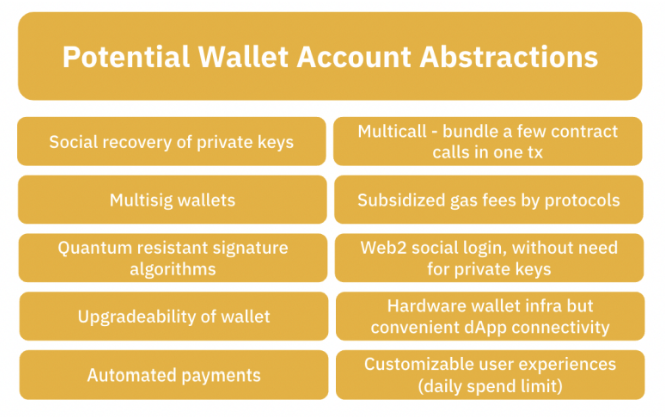 Source: Binance Research
Despite the many pros, like all things, there are tradeoffs/risks associated with AA. Account abstraction wallets are not currently supported at the protocol level and are implemented as smart contracts. While these wallets provide benefits such as improved user experience, the current implementation is not without issues. Firstly, there is a cost associated with deploying a smart contract wallet, and the gas cost for transactions is higher compared to EOA wallets. Secondly, each wallet needs to be audited before it can be used as a replacement for EOAs, as there are security concerns with smart contracts being hacked. Additionally, the infrastructure to support ERC-4337 is not fully established, as it heavily relies on Flashbots, which is specific to Ethereum. Lastly, smart contract wallets can only interact with decentralized applications that have implemented EIP-1271, raising questions about compatibility with other EVM chains. While these issues can be circumvented through Layer 2 networks, established smart contract wallets like Argent have deviated from ERC-4337 to implement protocol-wide changes.
zkSync
zkSync has investigated the benefits and drawbacks of ERC-4337—an instance of account abstraction that does not require changes to the Ethereum protocol. While advantageous in many respects, zkSync decided to diverge somewhat from the Ethereum model to directly embed user experience capacities within its own protocol. This strategy forms a cornerstone of its long-term vision. To this end, zkSync has integrated account abstraction as an inherent feature.
The potential for sponsoring transactions on more economical networks, such as zkSync, is another point of interest. This model could significantly augment the user experience by alleviating the complexities associated with navigating gas markets and handling transactions.
Gelato, a notable player in the field, has innovated an off-chain payment system called 1Balance. Already employed on multiple chains, this solution is favored by Convex for settling their bridge transactions, facilitating management across multiple chains. This service is also accessible on Polygon, where transactions are sponsored by Convex through depositing $USDC with Gelato.
Of particular note is the 1Balance Paymaster system's single-chain feature, enabling sponsors to fully cover user transaction costs. This capability could prove especially beneficial in circumstances such as a Non-Fungible Token (NFT) drop or gaming on zkSync, where all transaction costs are shouldered by users from a single balance. The implementation of account abstraction on zkSync promises to significantly elevate the user experience, particularly when paired with Session Keys.
Another instance of Gelato's utility in the realm of account abstraction is demonstrated by Gnosis's use of the tool in a rollup on Gnosis Pay, where Visa debit card payments settled in Euros are facilitated via a rollup. Notably, a Know Your Customer (KYC) mechanism has been integrated, likely a necessity due to the Visa debit card component. While such a mechanism enhances security, it also potentially gives rise to certain issues, including the emergence of black markets for KYC identities.
Concepts such as rewarding NFTs to users who successfully complete a quest or carry out a specific action—a form of proof-of-work—are gaining traction. Utilizing an oracle or a Gelato Web3 function to authenticate requests, determine a user's DegenScore, and impose rate limits predicated on these identification and authentication methods is a potential direction for development.
While these innovations are being pursued, focus is concurrently maintained on zkSync Era and the strategic development of Hyperchains. The latter represents the ultimate goal envisioned by zkSync. Hyperchains could take the form of zkRollups or a Balium, wherein data is retained off-chain.
In sum, the frontier of cryptocurrency continues to evolve, with innovations such as zkSync and Hyperchains poised to reshape the landscape. As our understanding deepens and technology advances, the limitations of the current Ethereum experience will likely be overcome, leading to more efficient, secure, and user-friendly platforms.





