
Let's dig a little deeper into what separates a "live" altcoin from one that's just a candidate for replacement.
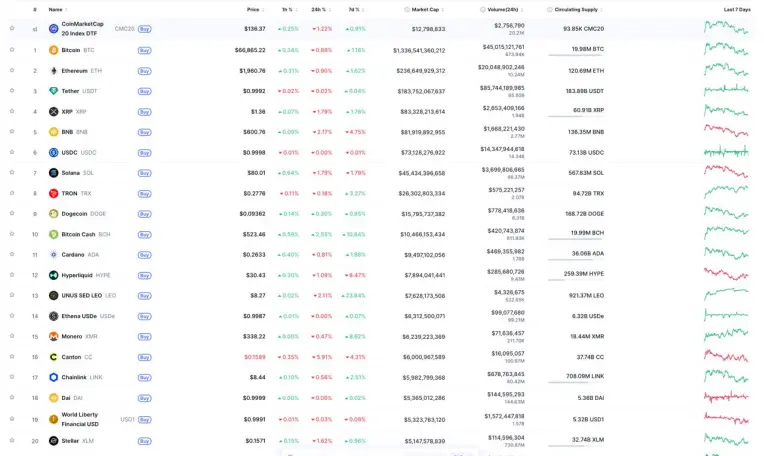
The issue isn't that altcoins are inherently bad. The real problem is that most of them are single-use tools for a specific market cycle.
1. Where is the liquidity flowing?
At the start of a cycle, liquidity is spread widely. In the middle, it concentrates. And by the end, it contracts.
If an asset isn't holding its trading volume, if it's slipping in market cap rankings, or if it's losing ground against Bitcoin and Ethereum, that's the first real signal. It's not expanding with the rest of the market. It's crucial here to look beyond the USD price chart. You need to check its BTC pair, its overall market dominance, and its performance against the TOTAL3 index (the market cap of all altcoins excluding BTC and ETH). If an altcoin can't outperform the broader index during a bullish phase, it's almost certainly not going to survive a bearish one.
2. Is the project evolving, or just marketing?
Looking back at the cycles of 2017 and 2021, the pattern was the same. During the hype, every project is "building the future," but in reality, about 80% are just riding a popular narrative. A living, breathing altcoin is one that's actually growing its ecosystem, expanding its real-world use cases, and attracting institutional or foundational infrastructure. A dead alt, on the other hand, is one that's just changing its roadmap, undergoing a rebrand, or promising a "version 2.0" without expanding its actual influence in any meaningful way.
3. Understanding the founders' incentives.
This is the most uncomfortable point, but also the most important one. Once a token has been distributed, the team has received their allocations, and the market has cooled down, you have to look at the economics. From their perspective, launching a brand new token is often more profitable than trying to revive an old one. Investors might assume the team will "fight" for the project, but the reality is they'll optimize for their own return on investment. It's not malicious; it's simply how incentives work.
4. Market cap at the cycle's peak.
Historically, the altcoins that survive are the ones that, by the market peak, have become large. They're the ones that break into the top rankings and become systematic pieces of the overall infrastructure. As for the rest? At best, they enter a long period of sideways movement. At worst, they face a perpetual 90% drawdown from their all-time highs.
So, how does all of this apply to the current market phase? What we're seeing now is a fragmented altcoin market with constant narrative rotation, an incredibly short attention span, and a deluge of new tokens launching every single week. This isn't 2017, and it's not even 2021. This is a phase where the speed of replacement has multiplied.
That's why my personal approach in this late-stage cycle is to avoid falling in love with ticker symbols. It's about constantly evaluating relative strength, regularly derisking, and, most importantly, understanding that a general market bounce is not the same as your personal portfolio being resuscitated.
The key insight I've taken away from three market cycles is this:
Altcoins are a tool for a specific market phase. Bitcoin is the tool for the entire cycle.






