
Let me remind you that on Saturday, bitcoin reacted sharply to the imposition of tariffs against Mexico and Canada. Trade wars began on February 1, and the stock market was closed.
Bitcoin, as the only open asset, became a platform for expressing sentiment — investors, unable to hedge on the fund, simply merged positions in the crypt.
It's a reaction to uncertainty. No one knows what the new tariffs will lead to, how it will affect the economy and global trade, so the first reaction is to dump risky assets.
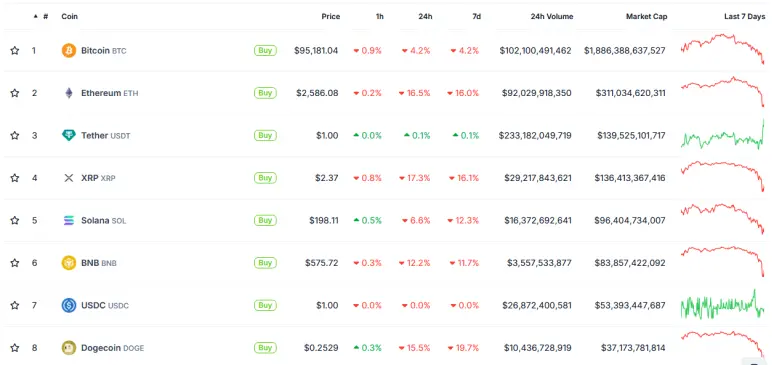
It continued on Sunday.
It happens that on weekends the crypt merges on fears, and on Monday the funds show that nothing critical has happened.
This may be the case now, but if uncertainty remains, we may see a spill over on both the S&P 500 and NASDAQ.
Now about the behavior of bitcoin
In relation to the entire market, it behaves like a risky asset — investors get rid of it as a more volatile instrument. But the situation is different inside the crypto market: bitcoin is perceived as a protective asset.
This can be seen in the growth of dominance. Alts are suffering more, and liquidity is flowing into BTC.
And this once again confirms a simple truth: in order for the alt-season to begin, investors must be willing to take on additional risk. And for this, free liquidity is needed.
Until the Fed softens policy, turns on QE, and creates conditions for capital to flow into more speculative assets, bitcoin will continue to attract core liquidity. Especially in times of uncertainty, like now.
So far, everything looks exactly like this.






