
It’s often said: "Bitcoin is impossible to predict."
That’s only half true — and it’s that very half that makes it a bullish asset over the long term.
If you dig deeper, the key here is the Hurst exponent.
This is a metric that shows whether a market has a "memory."
H = 0.5 — random walk
H > 0.5 — persistence (trends tend to continue)
H < 0.5 — mean reversion (movements decay)
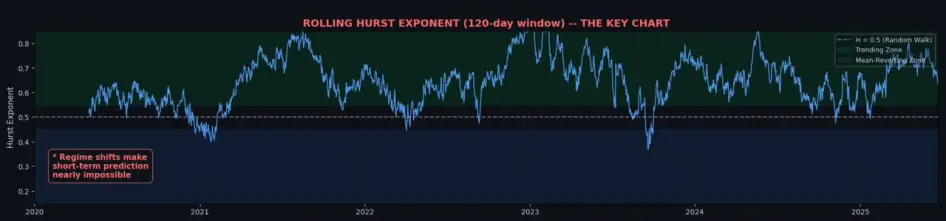
Someone ran the calculations for Bitcoin using a 120-day rolling window.
The result: H fluctuated roughly from 0.36 to 0.91.
This means the market constantly changes its regime:
— trending
— flat / ranging
— nearly random
And this is where the trap for traders begins.
They tested a strategy over a period of more than 2000 days:
— momentum: 52–55% hit rate
— mean reversion: 45–48%
— random strategy: ~50%
The short conclusion:
there is almost no sustainable short-term edge.
Regimes change faster than most people can adapt.
A big mistake is trying to extract stability from a market that is inherently unstable.
Now — the key twist.
If you look not through a microscope, but through a telescope, the picture changes dramatically.
Over ~17 years, Bitcoin demonstrates a very strong power-law structure.
In-sample R² ≈ 0.96 — this isn't about guessing days or weeks,
it's about the existence of a rigid long-term framework.
The full sample gives a Hurst exponent of approximately 0.57–0.61.
This means: over long horizons, persistence dominates.
If we break it down by time scale (approximately):
— < 3 months: noise and regime changes
— 3–12 months: mixed, path-dependent dynamics
— 12–18+ months: the trend begins to emerge
— 3+ years: maximum structural predictability
And here is the main paradox.
The very same mathematics that makes short-term Bitcoin trading a living hell,
simultaneously supports the strategy of long-term holding.
Bitcoin doesn't promise you easy money here and now.
It rewards those who understand the timescale on which it "operates."






