
Currently, there are approximately 2,368 cryptocurrencies. And each year there are a small number of new coins introduced. Of these projects it is interesting to ask how many cryptocurrencies have failed?
It is easy to see the successes in cryptocurrencies as the top coins are ranked and receive most of the media and social media coverage. But what about the projects that are failures? How can we measure what is a crypto failure?
Measuring Cryptocurrency Failure by Lack of Metric Data
One way to define failure is to determine which cryptocurrencies are no longer tradable. CoinMarketCap metric data tracks projects and shows there are 360 “essentially dead” projects with no metric data. While lack of metric data may indicate a very new project in most instances it indicates projects that have failed. Rarely do projects on the no metrics list reactivate. The failure rate is 360 “dead” projects with no metric data out of 2,368 total cryptocurrencies listed and tracked on CoinMarketCap. It means that 15.2 % of all cryptocurrency projects fail. The real number of dead projects is likely higher as this does not include those shut down by the SEC (eg. Titanium Blockchain), those that do not meet soft and hard cap amounts and fail to launch due to lack of expected funds, those that voluntarily shut down, and those that fail to get listed on any exchanges.
Measuring Cryptocurrency Failure by Low Market Capitalization Values
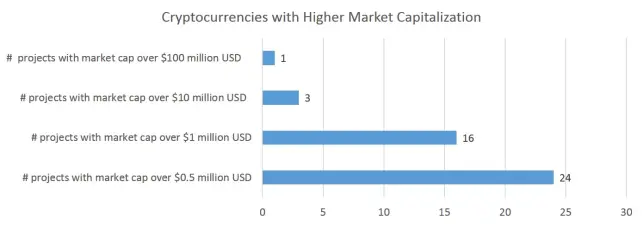
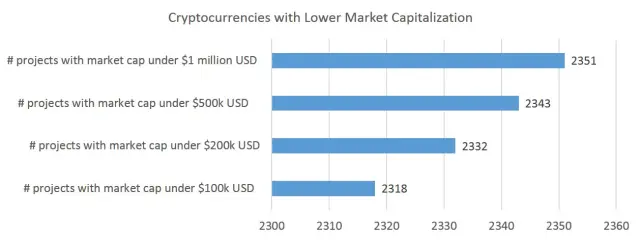
Another way to measure failure is to impose a monetary cut off on market capitalization. Projects that issue million or billions of coins and have market capitalizations under a million dollars. Projects with under a million dollars in market capital hold ranks at or below position 871 on CoinMarketCap. Projects with under a million dollars may reflect projects that are weak and slowly burning whatever available cash reserves they have remaining. Using a million dollar market capitalization as a cut-off value for weak projects shows that 1,497 cryptocurrencies out of 2,368 total cryptocurrencies reside under this value. It means that 63.2% of all cryptocurrencies projects have market capitalizations under a million dollars and comparatively may not have much activity, development or funds left for ongoing project development.
Measuring Cryptocurrency Failure by Low Trading Volume
The viability of a cryptocurrency can be measured by its liquidity and trading volumes. Failed projects have low 24-hour trading volumes. Applying a 24-hour trading volume cut off of $10,000 or more shows there are just 105 out of 2368 projects (4.4% of all projects) with adequate daily trading volume. It means 95.6% of all cryptocurrencies do not have robust day to day trading volumes.
Why Cryptocurrency Projects Fail
Cryptocurrencies can fail for any number of reasons:
- projects that have lost key members of their development team
- projects have stopped development
- projects that have failed to follow their white paper, road map, they are unable to meet milestones, and fail to implement key developments
- loss of confidence by investors in the project, CEO, team
- negative publicity about a project
- projects that have spent all of their start-up initial coin offering (ICO) capital
- projects that fail to generate a strong community of user or lose a significant number of users
- projects that have weak use cases
- projects that bring no innovation or are tokenizing existing products using cryptocurrency but have no underlying need using the blockchain
Conclusion
Looking at various metrics shows that depending on what is considered a “failure” that:
- 15.2% of all cryptocurrencies can be considered failures having no trackable metric data
- 63.2% of all cryptocurrencies projects have market capitalizations under a million dollars
- 95.6% of all cryptocurrencies do not have robust day to day trading volumes over $10,000 USD.
Combining equal weighting of the "metrics of failure" shows that more than half of the cryptocurrencies (58%) can be considered failures. Those value investors picking projects ranked lower on CoinMarketCap likely run the risk of buying in to a future failed coin. Investing within the top 20 coins that may yield lower multiples during the next bull run is good advice. Lower ranked projects with cheaper coins may realize higher multiples if they survive, however it is more likely that they could fail before the next bull run arrives.






