
Calculating the value of a share is very complicated for professional investors and almost impossible for the rest of investors.
To take a starting point we can use Graham's formula (Benjamin Graham). Better known for being the author of the book "father of value investing." With this formula we can calculate the value of the share approximately.
The investment style known as "value investing" consists of investing in currencies that present long-term growth expectations. This style is widely used by major investors such as Warren Buffett.
One of its best-known tools is the **Graham formula**, which is a simple way to know if a share is expensive or cheap, and if it is worth investing in. Let's see what it is about.
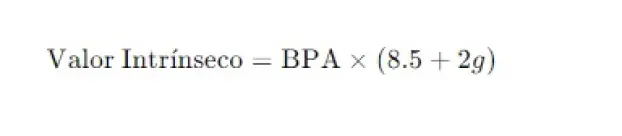
- BPA: These are the earnings per share. Basically, how much the company earns for each share in a year.
- 8.5: It is the base value that Graham assigned to a company without growth, as a minimum standard.
- g: It is the estimated growth rate for the company during the next 7 to 10 years.
Let's do an example to see how to use the function.
If a company let's call it "house" has an BPA of 5 and an expected annual growth of 4%
Intrinsic value = 5 × (8.5 + 2 × 4)
We perform the operations in parentheses 8.5 + (2 × 4) = 8.5 + 8 = 16.5
Intrinsic value = 5 × 16.5 = 82.5
It gives us a result of 82.5 so we can say that the value of that share is $82.5
If the market value of the company is less than that change we can say that it is overvalued and we should not buy it. And if the market value is higher, it indicates that it is undervalued and may be a good long-term investment.
One of the conditions that Warren Buffett uses to invest is that the market value of the stock is 30% below the number returned by the Graham function. If the value returned is $82.5, he only buys if the market value is $57.75. It should be noted that this great investor uses many other indicators.
Considerations
It should be noted that this formula gives us an approximation.
There are later versions of the formula that take inflation into account.






