
Credo provides the cables and interconnect equipment that link GPUs, NICs, and switches within data centers. While their customer base lacks diversity, they are a clear leader in the field of Active Electrical Cables (AEC).
Admittedly, this technology suffices for today’s needs, but not for the future. We are all well aware that this presents a risk; the demand for copper interconnects within servers will persist for some time—not because Credo or its competitors possess superior technology, but simply because it is more cost-effective. In the realm of artificial intelligence, speed and energy consumption have become critical, which inevitably drives the need for optical solutions. However, there is a current reality to consider: if a Co-Packaged Optics (CPO) module fails, it can damage the chip itself, and you cannot simply "unplug one cable and swap in a new one." Why does this matter? For Credo investors, there are two key points: first, short-reach AEC solutions for intra-rack connectivity offer a 20–30% cost advantage over optical alternatives; second, CPO technology has yet to fully mature. Based on my tracking of various companies, I expect to see meaningful figures by the end of 2027, with true scaling and established pricing models likely taking shape in 2028. Under normal circumstances, Credo would have been the first company to suffer during a transition to optical technology—a prospect that caused its stock to drop below $100 last year, which was when I made my initial investment. However, the management team acted swiftly by acquiring the Israel-based firm DustPhotonics; to be frank, it is not a company that truly warrants a $1.3 billion valuation.
I know some of you might argue, "Well, they didn't actually pay that price," or something similar—in which case, it might be worth your while to dig a little deeper into the analysis. If Credo reaches a level where it can truly claim a presence in the optical space, the acquisition of DustPhotonics will have cost the company exactly $1.35 billion. It’s also interesting to note that Intel was one of the early investors in DustPhotonics—I even asked myself, "You found such a great company, why didn't you buy it?" In short, thanks to DustPhotonics, Credo will be able to establish a foothold in the optical market; however, they will need to focus on marketing these solutions to their existing base of AEC (Active Electrical Cable) customers as much as possible.
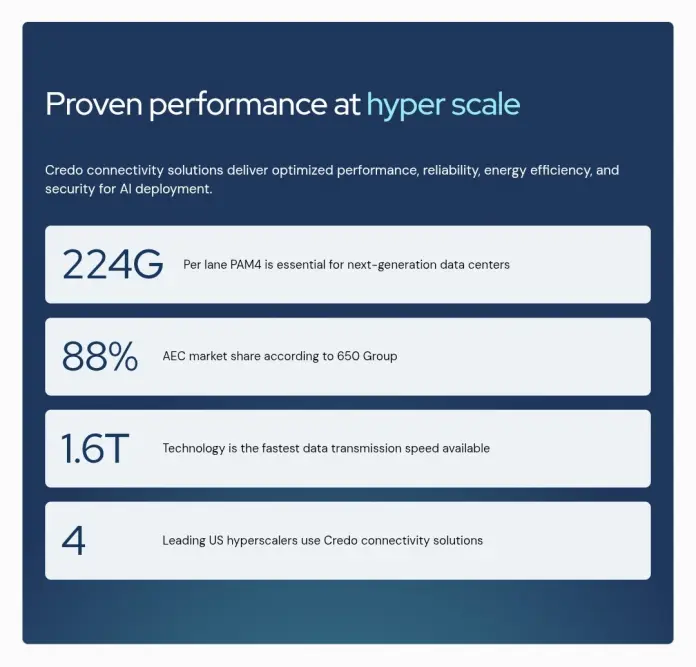
While we’re on the subject, take a look at the image you shared from Credo’s webpage. The "4 Hyperscalers" segment is certainly performing very well at the moment, but the fact that a large portion of revenue comes from these clients—which is always a risk for us—is worth noting. There’s also talk circulating about MaxLinear (MXL) and Astera Labs.
As for the MXL situation, they are actively trying to challenge Credo in this space. MaxLinear actually has its roots in optical technology, but after failing to gain traction there, they pivoted to AEC (Active Electrical Cables). Their CEO’s recent remarks are a mix of fact and exaggeration; for instance, he claims Credo holds over 95% of the market share, whereas my own assessment—and what management has stated—puts that figure closer to 85%. Furthermore, while MaxLinear’s management targets a 20–30% market share, they essentially assume that 10% of that would come directly at Credo’s expense. They’re employing a convenient strategy: "We’ll provide the chip, and you can source the cable from wherever you like." Why is this clever? Because the chip is the high-value component with healthy margins, while the cable itself offers very little margin. So, if they were to capture a 20–30% market share—which I believe would be difficult—the split between chip and cable revenue becomes critical. Why? Well, suppose the chip comes from MXL, while the cable is supplied by, say, Cisco or Amphenol; together, they could potentially offer the hyperscalers a lower price point than what Credo currently provides. Hyperscalers will undoubtedly be hesitant at first, but given the intense pressure on capital and costs, they would certainly jump at such an opportunity if it presented itself—that’s clear. Of course, the compatibility between the chip and the cable remains a crucial factor. You might be thinking that the whole story behind Credo isn't actually as good as we initially imagined—but don't worry; these are simply the real risks you need to be aware of. I could go into further detail, but for now, this should be enough to give you something to think about. It is precisely for these reasons that, while Credo looks very cheap based on its PEG ratio, it still faces selling pressure. The PEG ratio reflects future growth, and that growth currently includes the company's existing monopoly in the AEC (Active Electrical Cable) market. If a major client were to leave, that growth projection would decline, and the PEG ratio would rise accordingly.
Speaking of the PEG ratio, in terms of valuation, the P/E and PEG figures stand at 33x, 20x, and 14x for P/E, and 0.4x, 0.3x, and 0.4x for PEG. In other words, as long as the core investment thesis remains intact, the stock is cheap.
Credo is projected to grow by 205% in 2026, 87% in 2027, 55% in 2028, and 30% in 2029. As this growth unfolds, the most critical factor to monitor is whether profit margins keep pace. The good news is that margins do support this trajectory—most notably, free cash flow (FCF) is expected to expand from 33% to the 42–43% range.
On a more positive note, the latest financial report highlighted an interesting trend: the combined share of Credo’s two largest clients decreased, even as their overall spending increased. Additionally, the third-largest client’s share fell below 10%—the specific reason for this is unclear, but overall, it indicates that a broader, more diverse set of clients is contributing to the company’s financials. Over the past month, Credo has made two significant announcements: one regarding a partnership with AMD, and another concerning a strategic move in the memory sector. It is clear that the company has identified opportunities in these areas—a smart approach: enter the markets of those who are encroaching on your own. Notably, AMD clusters—such as those used by TensorWave—are utilizing Credo’s AEC (Active Electrical Cable) technology. Another key development is the 1.6T product; this is crucial, as it represents the first instance where we will see the benefits of the DustPhotonics acquisition and the potential to offset any market share lost to competing AEC solutions.
The 1.6T "ZeroFlap" is not a copper-based AEC, but rather an active optical solution. It is designed for "row-to-row" connectivity—spanning distances of up to 50 meters—while consuming only 12W of power. According to management, this solution consumes 30% less energy than comparable AEC products. It serves as an ideal offering for medium-range applications where copper AECs fall short and traditional optical solutions are too power-intensive.
Furthermore, there are the 224G-based "ZeroFlap" optical transceivers, which showcase the vertical integration between Credo and DustPhotonics. By combining a 224G DSP with silicon photonics (SiPho) technology—acquired from DustPhotonics—and the "Kfir200" PIC (Photonic Integrated Circuit), Credo is signaling that it is no longer just a DSP provider; it has expanded into photonic chips. If competitors gain ground in the AEC market—which I believe is likely—the success of these specific products will be vital for Credo’s continued prosperity. Regardless, having these offerings is far better than being solely dependent on the AEC segment.
To summarize, Credo is fundamentally undervalued, though it is worth remembering that the company maintains a monopolistic position in its niche. It currently accounts for 6% of my portfolio—which, in itself, represents a risk. Nearly 80% of my current holdings have a zero-cost basis; if we see a push toward $200 in the coming days, I plan to trim my position by 5% and simply observe from the sidelines. I’m actually quite fond of Credo—both AVGO and CRDO hold tremendous potential, provided they succeed in their respective growth narratives. However, given that CRDO has a beta of 3, it should only account for about 5% of my portfolio—relative to a 15% allocation for Broadcom. I realize my take on Credo might have come across as a bit harsh, but a friend asked me to look into it, noting that while we’re good at identifying the strengths of companies, we often struggle to spot their risks and weaknesses. That’s why I chose to approach Credo from this angle. Remember: it’s not what we know that catches us off guard—it’s what we don’t know.
Here’s a tip regarding financial statements: Bizlink manufactures Credo’s AEC (Active Electrical Cable) and Active Ethernet cables on a contract basis. By keeping an eye on Bizlink’s financial reports, you can gain some insight into Credo’s own financial standing.






