In the cryptocurrency market, “exchanges” act as the most important platform for users to trade and manage their assets, therefore, the safety, transparency, and efficiency of “exchanges” for users are significant factors.
“Decentralization” which is a guiding principle of web3 technology in its “full form” applied to DEX in the earliest days when Satoshi Nakamoto introduced Bitcoin, but the complexity of the use and operation of DEX is rather a challenge for an “average man” making Centralized Exchanges (CEX) a better alternative since it has a more simplified process letting users transfer and manage their crypto assets.
Centralized Exchanges (CEX) though harmless on the surface, come with disadvantages that negate the main tenets of Blockchain. In this article, we’ll dive into OpenEx trading protocol and all you need to know about it.
Table of content
- What is OpenEx
- Overview of the OpenEx Architecture
- Exchange Type Analysis
- Advantages of OpenEx
- Satoshi wallet: All you need to know about the app
- How to Register and Participate in OpenEx Airdrop
What is OpenEx?
OpenEx is a web3-based decentralized exchange operating on the CORE blockchain network. The protocol aims to combine the advantages of CEX and DEX to provide users with a safer, more transparent, and more efficient trading experience.
OpenEx compatibility with all smart-contract-compatible blockchain ecosystems and seamless integration into wallet application makes it well-positioned as the leading protocol for decentralized trading and assets management.
Overview of OpenEx Architecture
The below image provides a brief and “general overview” of the architecture and components of the web3-based decentralized exchange - OPenEx.
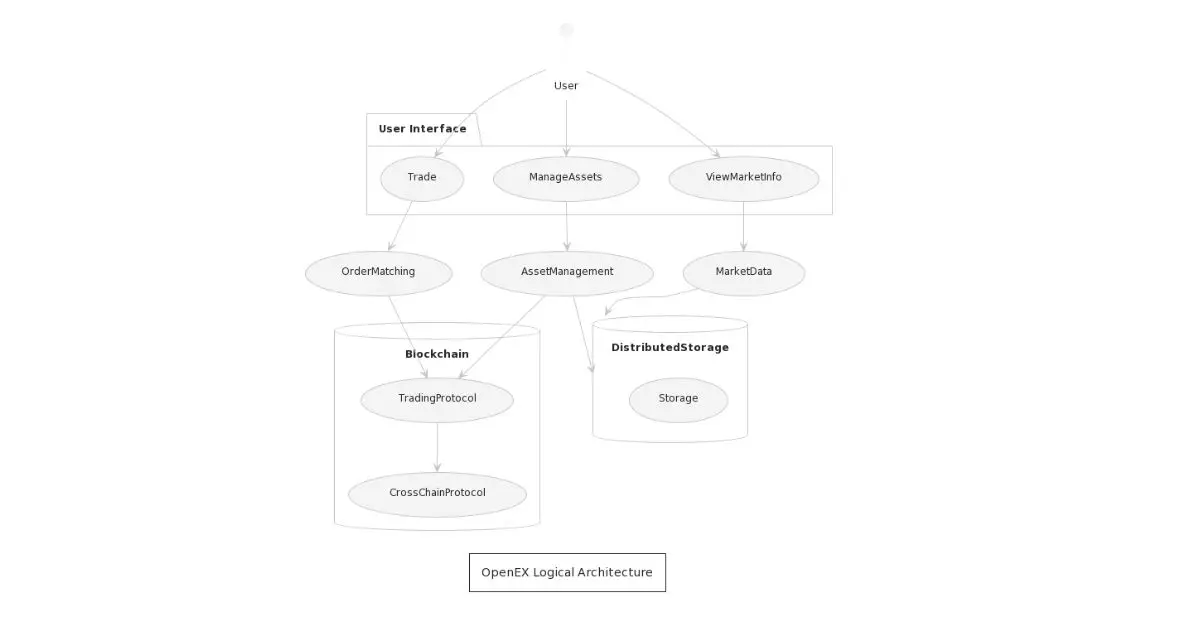
Please keep in mind that the image above is just a general overview and may not apply to every project. However, it should be similar in terms of architecture and components.
Analysing CEX and DEX
Before going into the advantages of OpenEx, it’s important that we first look at the differences between centralized exchange (CEX) and decentralized exchange (DEX) to have a better understanding. The following is a comparison of the advantages and disadvantages of these two exchange designs:
Decentralized Exchange (DEX)
Advantages of DEX:
- Privacy Protection: unlike CEX which requires users to register and prove their identity thereby taking away the anonymity of everyone registered on their platform, DEX typically does not require users to undergo KYC (Know Your Customer) when trading on DEX, protecting their privacy.
- Security: On decentralized exchanges (DEX) transactions occur on-chain, DEX does not hold users' assets, limiting the risk of “hacking attacks” on centralized exchanges.
- Transparency: All transaction records are stored on the blockchain, making them accessible on the public blockchain for anyone to view and verify them, ensuring fairness and integrity.
- Trustless: Users do not have to rely on exchanges because transactions take place directly on the blockchain without the need for any middlemen.
Disadvantages of DEX
- Speed and scalability: The speed and scalability of blockchain transactions can be relatively slow, which can impact the trading experience.
- Low liquidity: decentralized exchanges (DEX) usually have lower liquidity, which may often result in higher transaction costs.
- User experience: DEX operations may be more complicated for most users.
Centralized Exchange (CEX)
Advantages of CEX:
- Speed: As transactions are processed within the exchange instead of on the blockchain, transaction processing is somewhat faster.
- User experience: The user interface is friendly and easy to use, making it ideal for first-time users.
- High liquidity: CEXs typically have higher liquidity, which allows for quicker transactions and lower transaction fees.
Disadvantages of CEX:
- Security risks: Because user assets are stored on the exchange (central server), they are susceptible to hacking and asset loss.
- Lower transparency: The transaction data are stored in the internal database of the exchange and cannot be verified by users.
- Privacy concern: One of the biggest privacy issues is that users have to go through a KYC process, potentially exposing their personal information.
Advantages of OpenEx
Based on the above analysis, we can deduce the advantages of OpenEx - the web3-based decentralized exchange.
- Privacy protection: Users do not have to go through the KYC (Know Your Customer) process when trading.
- Security: As with DEXs, there is no requirement to store user credentials or hold custody of the user's assets, which reduces the chances of being hacked.
- Cross-chain trading: OpenEx supports cross-chain protocols, allowing for asset exchanges between different blockchains.
- Transparency: All transaction records are stored and accessible on the blockchain, ensuring fairness and integrity.
Satoshi wallet: All you need to know about the app
The Satoshi wallet app is a free airdrop platform that enables users to mine and earn free crypto airdrops. The wallet is a zero-non-custodial wallet with a simple UI and the best possible experience for users.
Credible Projects like CORE mining bounty took place on the app and made several miners millionaires. The Satoshi Wallet app has great community engagement making it the world’s “number one legit crypto airdrop platform”.
Satoshi wallet app aims to connect high-quality projects with a mass amount of users and also allows users to get top project tokens for free.
How to Register and Participate in OpenEx Airdrop
The OpenEx airdrop is currently run on the Satoshi wallet app. On the app, participants can choose whichever crypto projects they wish to participate in airdropping. Each user can choose up to eight (8) projects. The system runs each round of airdropping for an hour, participants can claim airdrop income at any time. If however, a participant does not claim tokens for 25 rounds, the airdrop will automatically stop until the tokens are claimed.
The amount of Airdrop Tokens that each participant can claim depends on individual participants' hash power and the project’s total hash power.
Below are the income calculations for each project:
Tokens per round per project = participant’s hash power / project’s total hash x project’s token amount per round
Participant’s hash power = Participant personal hash power + battle team hash power + project hash power (obtained by completing project tasks)
Project total hash power = sum of project participant’s hash power
Project airdrop token amount per round = project airdrop token amount / airdrop rounds.
How To Register On Satoshi app and start mining $OEX
- Click on the link below to download the app on Google Play/Apple store
https://www.btcs.fan/invite/2p1lh
- Register and log into the app to perform face verification
- Click on “Project” at the bottom side of the app
- Select OpenEx tap “Participate”
- Go back and Click “Airdrop” as shown at the bottom and await the next mining round, you can claim OpenEx token per hour






