
In the last month, we have seen how the Ethereum price increased from $595 to $1100. This increment is really good for ETH holders but it comes at the cost of gas fees.
At the moment of writing this post, gas fees are at 95 Gwei on average which translates into $2 approximately. If someone moves 1 or more ETH from any centralized exchange to its wallet, maybe it worth the cost. But the main issue here is with the dApps and the movement of small amounts of ETH that happens inside those services, this kind of activity is what gives sense to Ethereum.
For example, in Axie Infinity, if a new player wants to start playing it needs to buy 3 creatures (0.04 ETH or $43 each), this means, the user will trigger 3 transactions minimum. If a fee of $2 is added to each transaction, then the real cost will be more and therefore the user can abort the operation.
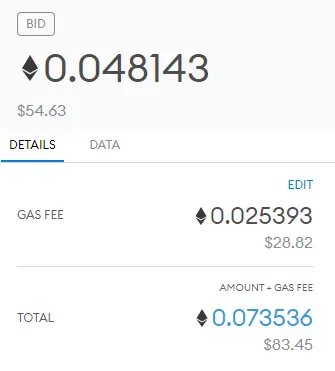
$28.82 gas fee
Now, imagine this case but for smaller value transactions like $5, $3, or $1. At this point, is sure that the user will give up because it doesn’t worth it. This is actually happening to users claiming $30 worth of rewards on some DeFi service, swapping tokens, or just buying/selling dArt for 0.005 ETH.
Competition
The main feature that Hive blockchain provides —no fees and fast transactions— makes LeoFinance or dCity exists today. Hive blog or LeoFinance model would be hard to replicate in Ethereum at the moment.
Similar to it, some dApps running on Ethereum could be thinking of moving to another blockchain with faster transactions and lower fees. One of these projects, Cardano, has announced the K Ethereum Virtual Machine (KEVM), a framework to run Ethereum smart contracts. As consequence, we could see a lot of Ethereum projects migrating to Cardano.
That was just an example, but others are trying to implement their own solutions like Axie Infinity with Ronin or MegaCryptoPolis moving to Matic Network.
Do you think this is bad or good for Ethereum?
What is your experience with gas fees lately?





