
As usual, skip to the TLDR section if you just want to learn about the tokenomics of HEC and TOR.
Intro
Hector Finance, now rebranded to Hector Network is a really interesting and fast-moving project on the Fantom chain. Initially, it started out as an Ohm Fork, but it has now become a unique entity, fuelled by a strong drive for innovation.
They have plans to expand to other chains and already feature a cross-chain DEX (decentralized exchange), in the meantime, they have built a strong community with a lot of creativity and attention to detail.
Olympus Dao and Ohm Forks
Olympus Dao is a platform on the Ethereum network featuring a decentralized reserve currency, OHM. Not designed to be a stablecoin, but a deep reserve of liquidity with its reach spread across the biggest crypto ecosystems. Users interact with it in two ways. They can stake the OHM token (and get staked OHM, sOHM) for a pro-rata share of rebases (i.e. inflation) that occur 3 times a day, usually a few hundred % APY, and governance rights. Users can also bond other tokens to receive OHM at a discount or farm LPs to provide alternative forms of liquidity for the treasury.
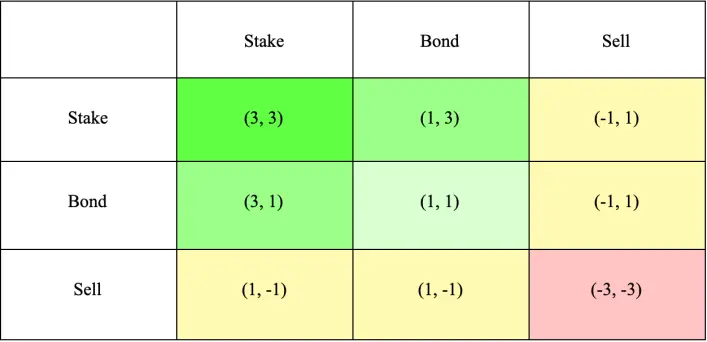
Importantly, it introduced the concept of 3, 3ing, based on a simple game theory thought experiment, which basically says that if we all stay staked or continue bonding our assets to build the treasury without selling, we will all reap the best possible rewards. While appealing to 'hodlers,' this involves a bit too much trust for most people's risk appetites. Let's not pretend this was all bad news, some people saw tremendous upside on their initial investment due to this project's rapid rise in popularity. The hilarious part is that the Prisoner's Dilemma thought experiment actually suggests the opposite, you should always rat on your accomplice to get the best outcome (-3, -3).
The defi pattern
Ultimately this project was a victim of its own success, its price and TVL charts look much like those of other defi protocols from recent times, with the hype cycle resembling a normal distribution, a shoe horse, or perhaps a cancerous node bulging out of the x-axis.
Projects (hopefully with either solid fundamentals or exciting tokenomics) draw users, the success of the initial userbase then draws hype and whales, the steadily rising slope of the systems' TVL and token price charts rapidly swell and bloat until much like a bell curve, they reach some kind of maximum. Whales decide they have had enough fun, or perhaps there is a hack, some insider shenanigans or whatever, the bubble collapses and the TVL and token price fall off a cliff (usually with an intermediary relief bounce) before returning back to their background level. Small bag holders, hodlers and those who aped in late with their life savings are left with their hands covering the gaping hole in their mouths and cold legs due to their now empty pockets.
Needless to say, this was likely not the intention of the creators, who have since stuck around and continued to slowly build and add more farming pairs to OHM as well as running the day-to-day operations of the project, slowly rebuilding its reputation.
The fork-laden aftermath
Although Olympus had solid fundamentals and now boasts an impressive treasury of over $322 million containing a basket of over 50 unique assets and a POL (protocol-owned liquidity) of over 99%, the hype train has not yet returned. Perhaps it will come in the next bull market, but perhaps it does not need this. The platform still has a solid core following, however, it is likely the sheer volume of imitators and lazy, money-grabbing replicas of this project have shied many away from its merits, while masking its original ambitions.
Hector Network, A spoon-shaped fork
According to this medium article by Hector Network, they consider themselves a spoon, not a fork. From the user end, the original project was a replica, but the underlying intentions and work ethic of Hector Dao have fashioned curved edges onto the foundations and given it depth. Now what was once a fork is now a project with unprecedented utility and an ambitious roadmap towards an even greater purpose, a spork if you will.

To paraphrase the Hector Network article, "an OHM fork is considered to be a clone on another layer-1 blockchain or on Ethereum. Spoons, however, have a different nature and intention. Most forks are contentious, while spoons are collaboration-focused. Forks are designed to suck market share and dominance from the original project, while spoons complement the technical innovation of the inspiring parent project."
Hector Dao also believe in coopetition (competition + cooperation), they want to compete with OHM as well as working on and contributing to the project that inspired them.
Finished Projects on Hector Network
In addition to the core token and OHM equivalent, HEC, Hector Dao has built the following features onto the protocol:
- The TOR stablecoin
- Hector Institute - a lending and borrowing platform
- Hector Cross-Chain DEX - Polygon, Moonriver, Ethereum, Binance, Avalanche chains
- Hector Validators - stake Fantom with the Hector Finance Validator, currently 14% APR
Tokenomics - HEC and TOR (TLDR)
If you were to take a close look at these names, you would have sworn this was their plan all along.
HEC is a deflationary rebase token (an oxymoron in the crypto world) originally this was due to occassional buybacks and burns. Staking HEC provides you 20% APY, which is paid in HEC tokens, but as an APY, you see this as an increase in your staked HEC. As ever, rebasing occurs every ~ 8 hours. Staking APY was originally over 100,000%, however, it was lowered to keep the deflationary model (HIP-011) and then again recently from 100 to 20%, due to the bearish macro outlook. When HEC is staked you receive staked sHEC, which can be wrapped to wsHEC. Wrapped tokens allow greater cross-chain and inter-protocol functionality, while allowing you to check the real value of your HEC with respect to rebasing.
As of 25th July 2022:
- Market cap - $48,204,953
- Circulating supply/Total supply - 2,401,555/2,815,039
- HEC burned - 1,092,750
Wait, burned? Yes! HEC is tied to the TOR stablecoin via a burn mechanism.
Decentralized stablecoins are collateralized by other on-chain assets. TOR is only minted when a user burns HEC. TOR can be exchanged for newly minted HEC. And vice versa.
TOR peg is maintained via:
- Smart-contract models and the HEC/stable LP, where stable = DAI, USDC, FRAX
To balance supply and demand, the HEC supply pool on Curve adds to or subtracts from TOR's supply, while users burn TOR to mint HEC and burn HEC to mint TOR, all incentivized by the protocol's mode-market module.
- Over-collateralization via the Hector Network treasury
Hector Network owns a TOR pool on the stableswap Curve.
The Curve pool acts as a 'Layer-0' for swapping TOR back and forth to maintain peg. The protocol also needs to mint/redeem from time to time with much lower frequency. Although the HEC price has some effect on the mint/redeem TOR mechanism at 'Layer-1,' the treasury can buyback and burn HEC at the protocol level in case its price decreases more than expected/desired.
Sounds like UST/LUNA? (now USTC/LUNC)
Astute reader, once again you astound me with your skills of observation. But really it's algorithmic stablecoins that have been given a bad rap, TOR is fully backed but still fully decentralized. The main common feature with LUNA/UST is the mint and burn relationship, but there are several mechanisms in place to safeguard the ecosystem and prevent a dramatic reenactment of the infamous death spiral.
- TOR minting is limited
Unlike LUNA/UST, TOR is not minted every time someone wants to own it. Minting is only possible above a certain threshold value in the Curve pool, currently 50%. This is to prevent over-minting due to either a rapid sell-off or a sudden attack. TOR can also be purchased from the Fantom Curve pool, of all the Tor pools this holds the most liquidity, thus providing the lowest price impact.
Less unnecessary minting means TORs circulating supply will only be inflated when it needs to, i.e. when market demand is significantly greater. This helps to balance the TOR liquidity with the total supply, reducing the risk of unbalancing the Curve pool.
- TOR market cap is lower
Following on from the previous point, UST suffered from rapid growth in market cap. The attackers (or maybe just a big whale) dumped a large amount of UST on the market, this drastically lowered the price of UST resulting in a cascade of liquidations on Anchor protocol. Not even a few billion in Bitcoin reserves could salvage the peg. "Deploying more capital, steady lads." Having a lower market cap means that this scale of attack will not be possible.
- Hector Dao Treasury
The treasury holds enough capital to back the entire supply of TOR, which is currently around 17 million. Again following on from the previous point, a smaller total supply is easier to fully back, no need for any algorithmic backing of parts of the supply (yet, we shall see if they follow in FRAXs fractionally algorithmic footsteps if the ecosystem grows in popularity upon cross-chain expansion).
- The Curve pool
If and when TOR becomes equal to or greater than 60% of the supply pool in the Curve LP, you will be able to redeem 1 DAI for 1 TOR, consequently, the TOR will be destroyed and the HEC will be minted or sold.
- Future protections
Finally, minting restrictions will be put in place based on slight differences between the Curve LP supply and the market cap.
If this Curve talk has been confusing, learn more about the Curve wars. If you are a defi enthusiast this is a crucial part of the ecosystem to understand. It is by no means easy to explain, if you can understand it inside and out you can consider yourself a defi pro. (Links in resources). Check defillama, have a look at where Curve sits in terms of defi TVL dominance. I may do a TLDR on it in the future, but it is by no means an easy TLDR topic.
4, 4ing - constructive ideas built on a gimmick
The original intention was to revolutionize bonding and staking. Normally, when bonds are purchased, you can claim and stake them anytime you want, after part of the bond has been vested. 4, 4 autostakes the bond before it has been claimed, and thus bonds earn interest from bonding and staking combined.
Farming pairs, wsHEC and governance
The wrapped, staked wsHEC can be used to farm elsewhere while staking, allowing you to stack yields.
Farms include:
- DAI + TOR + USDC, 11%, Curve LP - but this can be staked directly on the Hector Network webpage
- FTM + TOR, 2%, Spookyswap
- FTM + wsHEC, 28%, Spookyswap
Holders of HEC, sHEC or wsHEC can participate in governance voting.
Future projects - roadmap
Their roadmap is intimidating, the major milestones include:
- Hector Market - Atlantica - an NFT platform, intended to be cross-chain
- Hector have also developed their own NFTs (Mythos Colection), they host regular giveaways on Discord and Twitter
- Hector Library - as the name suggests, an educational space
- Hector Game - a defi game in partnership with Catheon Gaming, likely involving aforementioned NFTs
- Major football (soccer) team sponsorship - has been in the works for some time - soon to be announced
- Hector Pay - pay with defi crypto! Truly ambitious!
Other milestones include:
- Emissions plan details
- Tier-1 exchange listing
- Further partnerships
- Cross-chain expansion - starting with Binance
- Further sponsorships
Conclusions
Hector Network has drawn inspiration from the best that defi has had to offer. While other protocols and even entire networks have collapsed, Hector Dao has adapted and refined their ecosystem, continuously learning from others' mistakes, innovating off of and building beyond them.
If any of this sounds interesting to you, get involved, in whatever way it is that you participate in crypto be it trading, hodling, defi, NFTs etc. Hector Network has it all. It might be a good idea to join the discord if you don't know where to start. Once they finalize their cross-chain dreams and complete the 2022/2023 roadmap, they may finally get the attention they deserve.
Follow them on Twitter - @Hector_Network
Resources
1. Taiki Maeda Youtube - Curve Wars
2. James Bachini Youtube - Curve Wars and How I Gained Exposure
3. Pothu twitter - Curve Wars Explained
4. Ross Booth Twitter - What in the world are the Curve Wars?





