
As usual, if you just want the TLDR, please skip ahead to that section.
To proof-of-stake we go!
Under proof-of-work (PoW), consensus came from miners securing the network with their computational power, which they would throw at hash problems in their bid to mint a block of transactions - the next entry in the blockchain. More computational power equated to a greater number of guesses a machine was capable of making to find the correct answer and hence a higher chance of minting the next block and receiving the associated rewards. PoW mining creates a lot of real-world competition.
After the merge and the switch to proof-of-stake (PoS), validator nodes will stake their coins and randomly be chosen to mint blocks, staking more coins slightly increasing their chances of being chosen to add the next block. The merge has been tested on all but one of the various ETH testnets with only minor bugs being reported. The final test (Goerli testnet) should take place in August, and the Merge itself has been set for September 19th. Many refuse to hold their breath, as this landmark has been delayed a number of times over the last few years.
It costs 32 ETH to run a validator node, currently over $48,000 (as of 22nd July). Consider we are in the depths of a bear market and this discount on ETH may not be seen again. Should all go as planned.
The merge will stifle the energy-related FUD surrounding crypto - Bitcoin and Ethereum have both been reported to consume around 0.5% of global energy produced annually. As the second biggest crypto by market capitalization and the platform upon which much of crypto and defi were built and conceptualized, this transition offers Ethereum a clear opportunity to break away from Granddaddy BTC in this regard. Many anticipate an event called 'The Flippening' - where the market cap of ETH will overtake that of BTC. The Merge will likely be one of the key catalysts for this explosion in market cap.
English Mutherfudger! Do you speak it?
Vitalik Buterin identified and explained what is known as the 'Blockchain Trilemma.' Crafting an effective Blockchain requires a combination of:
- Security
- Decentralization
- Scalability
It is important to note that the merge will not fix all of these problems but it will be a push to make the following improvements:
- Sustainability
Simply because running a PoS blockchain does not require anywhere near as much computational power - PoS uses 99% less energy than PoW.
- Decentralization and security
After the Merge, there will be a minimum required number of nodes and it will be easier to run a node - you will just have to stake your ETH, instead of purchasing and maintaining a dedicated mining rig.
Even if you are a small bag holder (i.e. anyone with less than 32 ETH) - you will still be able to receive validator rewards through liquid staking protocols such as Lido and Rocket Pool. Arguably, these staking protocols could make the network more centralized, if they dedicate the staked ETH onto only a few nodes. See this Coindesk article if you are interested in the figures.
- Scalability
Sharding - this upgrade in architecture may someday enable 100k transactions per second (TPS), when it has been fully utilized.
Ethereum suffers from astronomical gas fees when the network usage is high. Unfortunately, the Merge will not solve this issue. However, layer-2 optimistic and zero knowledge rollups such as Optimism, Arbitrum and now Polygon have already created more cost-efficient ways to transact on the ETH network.
How does ETH become deflationary? (TLDR)
This is mainly related to the consequences of an Ethereum Improvement Proposal (EIP), EIP-1559 in particular, which was included in the July 2021 London Hard Fork.
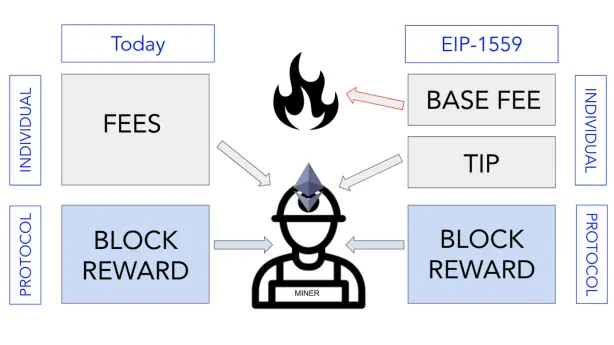
Prior to the Hard Fork, gas fees were calculated via a first-price auction, where people would bid to pay for their transactions to be processed, as expected the highest bidder would win. The proposal added a "base fee" for transactions to be included in the next block. Users or applications can now also "tip" a miner a "priority fee" for faster inclusion.
Naturally, this proposal required more air quotes than Dr. Evil. "Fire the "laser.""
To summarize:
- Before EIP-1559, gas fees were paid to miners, who also received block rewards of 2 ETH per block (plus some additional rewards).
- After EIP-1559, the protocol burns the base fee, but miners still receive the block rewards and a tip, which can be offered to the miner to incentivize preferential minting of a particular block. From the perspective of end-users, the tip is now included as part of the gas fees, see this Consensys article for more details.
This fee-burning mechanism creates a small deflationary pressure on ETH.
When the merge is finalized, rewards paid out to validators will be reduced by roughly 90%.
At this point, ETH burned > ETH issued.
It is important to note - after the London Hard Fork and EIP-1559, greater activity on the Ethereum network will result in more burning. At some points, this results in a supply squeeze.
ETH is not currently deflationary, but it has already had a few deflationary moments pre-merge. Keep in mind that ETH has been coded to have an infinite supply.
To date, just over 2.5 million ETH (< 4 billion USD) have been burnt. You can track the burn rate here and see for yourself when ETH becomes deflationary. (Go to > insights, see the burned per day graph - when the bars dip below 0 and becomes yellow = deflationary).
Miner factors?
The other factor to consider is that switching to PoS means miners no longer have to sell ETH to pay for their operations. This should significantly reduce selling pressure on ETH and make the supply burn effects of EIP-1559 all the more powerful - when network activity is aroused from its bearish slumber.
Difficulty bombastic?
Before the Merge, the so-called 'Difficulty Bomb' will be activated, making it significantly more 'difficult' and hence more energy intensive to mine ETH via PoW, once unprofitable, miners should lose their incentive to do what they do best. But this will only be triggered when the developers are certain they can go ahead with the transition to PoS. It marks a point of no return for the network.
The market will be flooded with machines of miners who have hung up their GPUs or ASICs for other ventures, for those looking to obtain one, this may be a good time to consider a purchase. The market for mining may eventually become profitable again. Maybe.
Alternately, GPU miners who choose to hold onto their rigs may look to move to different PoW networks such as FIRO, RVN, FLUX, ETC, ERGO and others. The native coins for these networks may also see some appreciation in interest and potentially in price (but there are too many variables at play to call this with certainty). See Max Maher's Youtube video in resource 4 for the full conspiracy.
Vitalik Buterin has no time for your bullshit
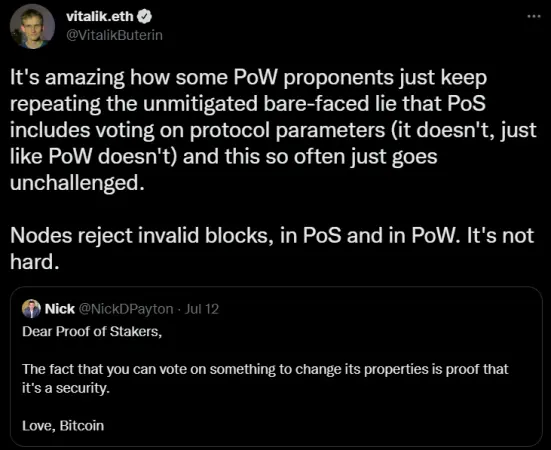
To conclude - you may ask, is PoS not prone to node corruption by a collection of wealthy conspirators? Could entities with lots of capital still not collude to stake on more than 51% of the nodes? Does PoS incorporate voting rights for validators?
Vitalik Buterin recently tweeted in response to similar FUD - which may be myths spread by Bitcoin and PoW maxis, some of that rare, endogenous FUD that comes from within the community. I'll leave you with his words.
Resources
1. Jack Niewold Twitter - ETH Merge explained
2. ETH EIP-1559 - Consensys article explanation
3. Coindesk article - Is Ethereum Staking Pool Lido's Growth an Omen of Centralization?
4. Max Maher Youtube - ETH Merge consequences for miners
5. Watch the burn website - see ETH mint and burn in real-time
6. Vitalik Buterin Twitter - PoS FUD






