
Billions of dollars are spent collectively each year by car dealerships across the United States on inventory photography. And in an increasingly digital world, car dealership general managers will likely all agree that photographs are of utmost importance and, by God, they needed those photos online yesterday!
NFTs could get these vehicle photos online and they could do it in minutes rather than the sometimes weeks it takes dealerships to get a vehicle photo-ready. That benefits the dealerships, it benefits shoppers, and, structured correctly, it benefits the vehicle photographer. Please continue reading as I call upon my five years experience as an automotive photographer to explain how.
Let’s first look at the legacy system. It’s fraught with bottlenecks that often result in weeks of delays in photography for a vehicle. Here’s the typical road to photography for a vehicle:
A dealer buys a car, they enter that vehicle into their inventory management system, they wait days or even weeks for the car to arrive via transport truck, the car is unloaded and waits in the back lot for days or even weeks inspection. And then? It may need repairs, which could mean that car sits for more days while parts are ordered. It then undergoes the needed service and is sent back to the back lot.
Now it awaits yet another bottleneck in the system: detail. It takes its place at the back of the line waiting for a simple wash, vacuum, and wipe-down of the interior. But we’re still not ready for photos. The car then needs to wait for an opening in the photographer’s schedule. It could mean it waits days for the photographer. And, as a photographer, I can tell you that photos are not always easily snapped. A car left on a lot for days can get dirty. Rain or snow could delay the photo process even longer as we wait for clear weather and possibly a spray-down of the vehicle from a power wash crew.
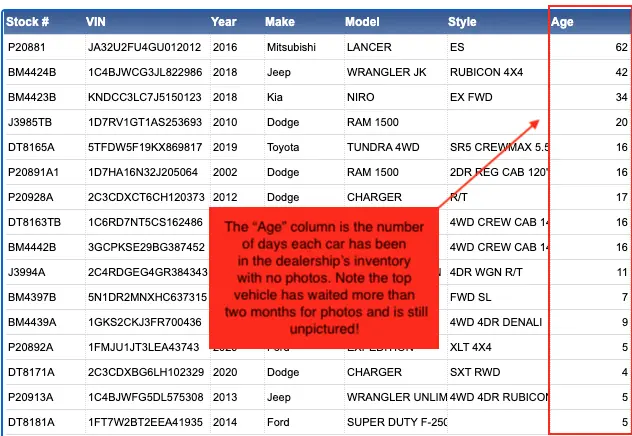
Don’t believe this process is unnecessarily long and drawn out? Look at this list of vehicle needing photography. Note the “Age” column. Those numbers are the days the vehicle has been in inventory for that dealership without photos having been taken.
But with the help of NFTs, photos of the vehicle can arrive digitally and go online before the car ever even reaches the car lot.
Most of the used cars you see on any given car dealership lot were purchased from an auction or from a rival car dealership. They may have even been transported over from that dealership’s other store a few cities over. But the photos do not accompany the car. Every time a car hits a new lot, it has to be re-photographed.
It isn’t uncommon for me to find a vehicle at one dealership that I photographed previously at a different dealership. I have to re-photograph the car when I know that it was already professionally photographed a week or so prior. It’s called a dealer trade — one dealership is looking for a specific make and model of a car for a customer and they see one across town at a rival, so they acquire it.
Why should the dealership re-pay the same - or another - professional photographer to take photos of the same car a few days or weeks apart? Nothing about the car has changed. It has only moved from one location to another.
Now, imagine there was an inventory management app that showed available photos attached to the unique VIN of a particular vehicle. It would be as simple as making the decision to purchase that NFT collection and populating the car’s webpage with photos immediately.
If it was as simple as checking a box, a dealership could make professional-quality photos available immediately upon entering the vehicle into their inventory management system. The photographer who took those photos could get a commission on the sale of the NFTs (usually 10-20%). The dealership that originally commissioned the photography of the car could sell those photos to the next dealership in the chain for a break-even price, which would mean those photos were completely free to them.
That, my friends, is how you reach maximum extracted value from photos you purchase as a car dealer. There is even a solid argument to be made for selling these NFT collections to the end-buyer for insurance purposes.

This fits the ethos of decentralization. It provides value to the creators. The dealership who is providing work gets free or near-free vehicle photography, the photographer earns a commission for their photography and gets a bonus each time the photos re-sell, and the middle management who serves only to supervise and monitor get handed their walking papers and are cut out of the process.
If you know of a project, currency, or DAO that is even tangentially related to the idea put forth above, please tell me about it. I would be interested in helping see this idea become a reality in whatever way I can. Just leave a comment.





