
The Terra (LUNA/UST) blockchain project suffered what appears to be a coordinated attack this week, causing the UST stablecoin to lose its peg to the dollar, and the LUNA token to enter into a collapsing "death spiral" over the course of a couple of days.
Similar to DAI on Ethereum, UST is an algorithmic stablecoin, meaning that it is backed by crypto assets, rather than actual dollars. On the other hand, stablecoins such as USDT and USDC are tokenized versions of dollars that are backed by traditional funds held by a centralized company.
At anytime $1 worth of LUNA can converted to 1 UST, or 1 UST can be converted $1 worth of LUNA. Market arbitragers work in the background to keep the value of UST stable at one dollar.
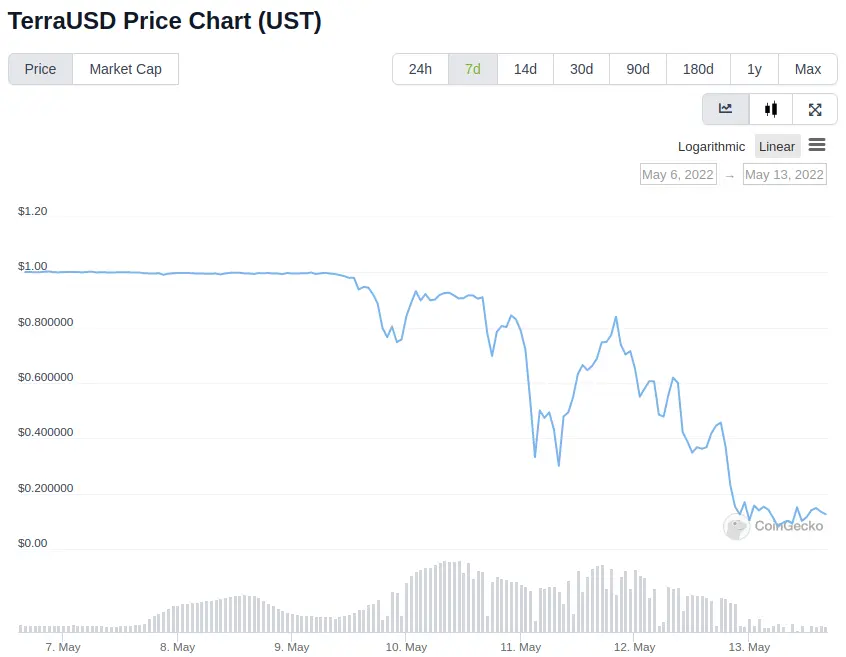
The benefit of algorithmic stablecoins is that they are transparent and censorship-resistance, but the disadvantage is that they can destabilize during volatile market activity, which was in no shortage this week. The attack started on Monday when UST's peg to the dollar started to dip, and destabilized wildly over the following days:
In a desperate attempt to re-peg UST to the dollar, billions (and then trillions) of new LUNA were minted, causing the price of the token to plummet to values far below a penny. The coin was valued at $60 on Wednesday and had fallen to less than $0.00008 by Friday.
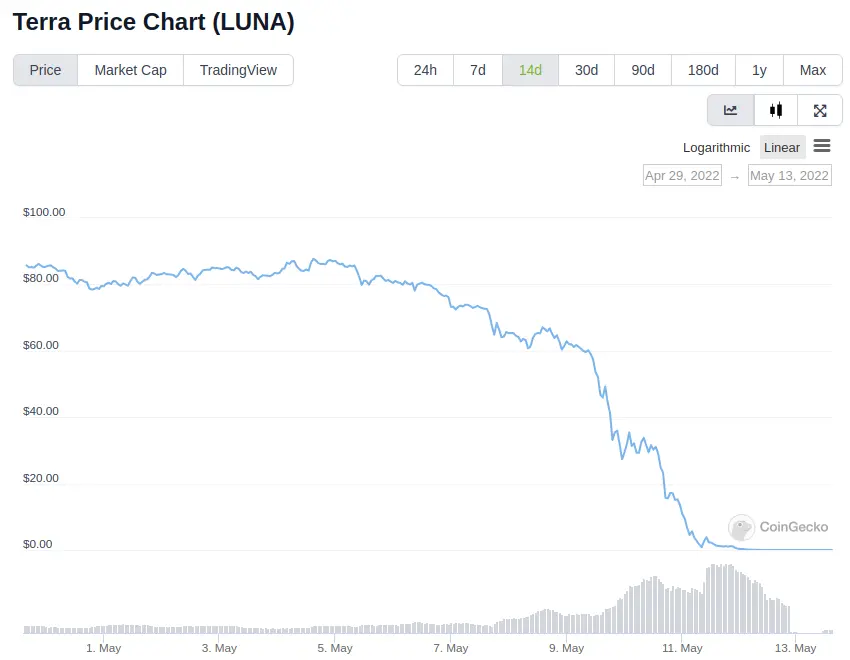
Hoping that the team would be able to find a solution to the problem, several traders got caught up "buying the dip" at $20, $1 and lower, unaware that trillions of new LUNA were being minted, resulting in the value of their newly acquired tokens to evaporate in the blink of an eye.
Terra operates differently from cryptocurrencies like Bitcoin, which are limited in supply and give HODLers the opportunity to recoup value when market fear has subsided. In this case, it was truly a matter of "catching a falling knife", as the value death spiral caused the minting of LUNA to accelerate exponentially.
Not only are the portfolios of LUNA investors down significantly, but even those of who anticipated a crypto bear market and chose to keep their wealth in the supposedly stable and secure UST, which is now only worth 10% of its original value.
Personally I have never seen a cryptocurrency fall so hard, fast, and permanently throughout my time in the space. Reading through Twitter and Reddit posts it would seem that many people are still in shock over the collapse of Terra and probably haven't yet come to terms with the gravity of their financial loss. Many claim they have lost their life savings as a result.
There is speculation afoot that this attack was committed on purpose by big financial players who borrowed large sums of UST and BTC, with the intention of dumping them on the market to put Terra into a death spiral. It could very well have be perpetrated by high level players who want to use LUNA's crash to push further regulation on stablecoins, and the cryptocurrency market in general. After all, Terra's UST would have been a major competitor to the CBDCs that central banks around the world are planning to implement.
So what can we learn from this unfortunate event? How can we protect ourselves from falling victim to such financial catastrophes in the future?
Terra was a very promising blockchain and had achieved great success in the few years it had been in operation. However, it was still in early stages of development and had not yet stood the test of time. We must be cognizant of the fact that we are investing our wealth into experimental and bug-prone projects. Keeping the majority of our wealth in a single experimental cryptocurrency is incredibly risky.
The key to avoiding this risk is to maintain a well-diversified portfolio so that no one coin makes up greater than 10% of your portfolio. Therefore if one project gets obliterated by a vulnerability, you haven't lost more than a fraction of your net worth.

There are plenty of blockchains in development with great potential such as Avalanche, Algorand, Polkadot, Cosmos, Cardano, Solana, Telos, and more. All of these chains should be part of a well-diversified portfolio. Even if one of these projects, which makes up only 10% of your portfolio, goes mainstream in a few years or decades, you should be doing quite well.
Let this be a learning lesson for all, so that future stablecoins can be engineered to withstand greater volatility and coordinated attacks. Unfortunately it looks like the UST stablecoin project has probably come to an end. However there were lots of teams working on projects within the LUNA ecosystem that may continue to survive.
Terra's founder, Do Kwon, has submitted a proposal to the Terra community that would reset the chain and redistribute the original ~1 billion supply of LUNA tokens to LUNA and UST holders before the dollar de-pegging event occurred:
https://agora.terra.money/t/terra-ecosystem-revival-plan/8701
Not everyone is in agreement with the proposal and it seems there will be much discussion before the dust settles and an action plan is put together and implemented. Given the hit to Terra's reputation from this collapse, it's doubtful that the LUNA token will recover its value any time soon.
As a disclaimer, the author did have a portion of his portfolio allocated to LUNA, Anchor, Pylon and Mirror Protocol.






