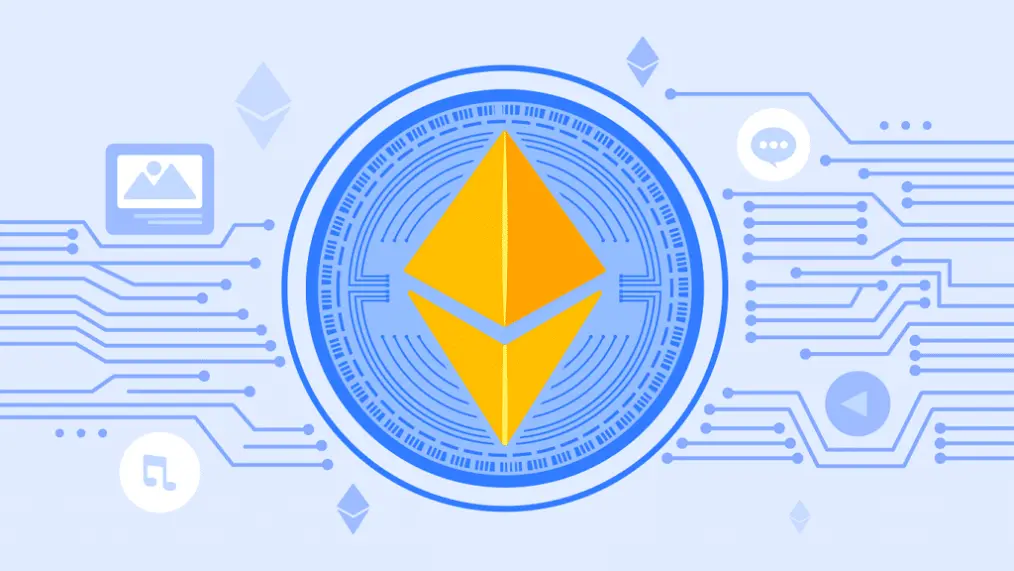
Ethereum stands as the cornerstone of Web3, commanding a $436 billion market cap and powering 60% of the 4,983 active decentralized applications (dApps) shaping the decentralized internet. Its smart contract functionality, introduced a decade ago, has fostered a vibrant ecosystem where developers build trustless systems for finance, gaming, and identity. With $1.021 billion in Q1 2025 dApp fee revenue, Ethereum outpaces competitors like Solana and BNB Chain, driven by its robust infrastructure and Layer-2 (L2) solutions. The Dencun upgrade, incorporating EIP-4844, has slashed L2 fees by over 90%, enabling 100,000 TPS and unlocking new possibilities for dApps like Uniswap and Aave. This essay explores Ethereum’s pivotal role in Web3, its scalability breakthroughs, and the challenges it faces in sustaining dominance.
Ethereum’s DeFi ecosystem, boasting $81 billion in TVL, represents 60% of the global DeFi market, dwarfing Solana and Avalanche. Uniswap, with $1 billion in daily swaps, and Aave, holding $40.3 billion in deposits, exemplify Ethereum’s financial prowess. These protocols leverage Ethereum’s secure EVM and L2 networks like Arbitrum, which recorded $73.8 million in Q1 2025 fee revenue. The integration of stablecoins like USDC supports seamless cross-border payments, as seen in Stripe’s operations across 101 countries.
Scalability Through EIP-4844 and L2 Innovation
The Dencun upgrade, activated in March 2024, introduced EIP-4844’s proto-danksharding, revolutionizing Ethereum’s scalability. By using data blobs for temporary storage, EIP-4844 reduced L2 transaction costs to $0.15 from $7.50 on the mainnet, boosting user engagement. L2 networks like Base, with $2.28 billion TVL, and zkSync, compatible with EVM via Solidity, handle 2 million daily active users. The Pectra upgrade in May 2025 doubled blob capacity and raised validator balances to 2,048 ETH, enhancing throughput. As Ethereum’s roadmap targets full danksharding by 2026, developers are leveraging tools like Alchemy, supporting 1 million smart accounts, to build scalable dApps across 200+ L2 networks, ensuring Ethereum remains Web3’s backbone.
The Vibrant dApp Ecosystem and Emerging Projects
Ethereum’s 3,000+ dApps span DeFi, NFTs, and gaming, with Web3 projects like MorphoLabs ($7 billion deposited) and Lens Protocol (2.8 million wallets) driving innovation. Uniswap V4’s hooks enable custom AMMs, reducing gas costs via flash accounting and attracting $4.96 billion in trading volume on Base. Gaming dApps like The Sandbox, with $20 billion in NFT value, benefit from L2 scalability, while social platforms like Lens empower creators with $50 million in payouts. To support this diverse ecosystem, Ethereum’s infrastructure includes:
- Developer Tools: Alchemy and Thirdweb streamline dApp creation.
- Interoperability: Chainlink’s CCIP facilitates $25 billion in cross-chain transfers.
- Smart Accounts: EIP-7702 enhances wallet UX for 26,000 users.
- NFT Marketplaces: OpenSea and Rarible process $1.5 billion in Q1 trades.
- Governance: DAOs like Uniswap allocate $45 million to ecosystem growth.
Challenges and Competitive Pressures
Despite its dominance, Ethereum faces hurdles. High mainnet gas fees push users to L2s, though 40% of dApps remain on-chain, risking congestion. Competitors like Solana, with 65,000 TPS, and Polkadot, targeting 600,000 TPS, vie for developer attention. Regulatory pressures, including MiCA’s KYC mandates and U.S. tax guidelines, impose $200 million in compliance costs on platforms like Coinbase. A $223 million exploit on Sui’s Cetus underscores security risks, though Ethereum’s audited contracts and ZK-rollups mitigate vulnerabilities. Adoption barriers, such as complex wallet setups, deter 60% of potential users, necessitating UX improvements like Web3Auth’s 1 million logins.
Conclusion
Ethereum’s 60% dApp market share and $81 billion TVL solidify its role as Web3’s foundation. EIP-4844’s scalability enhancements, reducing L2 fees by 90%, empower protocols like Uniswap and Aave to process billions in transactions. With 3.2 million monthly wallets and innovations like smart accounts, Ethereum drives DeFi, gaming, and social applications. Despite challenges like gas fees, competition, and regulatory hurdles, its L2 ecosystem and developer tools ensure resilience. As Ethereum’s roadmap advances toward 100,000 TPS, it is poised to lead Web3, redefining decentralized innovation.





