
Bitcoin just tried to climb back up to $82,000, and honestly, the way it got there is worth talking about. It wasn't just people buying coins and holding them. A lot of this move came from something called leverage. That means traders were borrowing money to place bigger bets, hoping the price would keep going up.
On Binance, one of the biggest crypto exchanges out there, open interest (basically the total value of open leveraged bets) jumped almost 8% in just one day. It briefly went above $10 billion. That's a huge number for one single exchange.
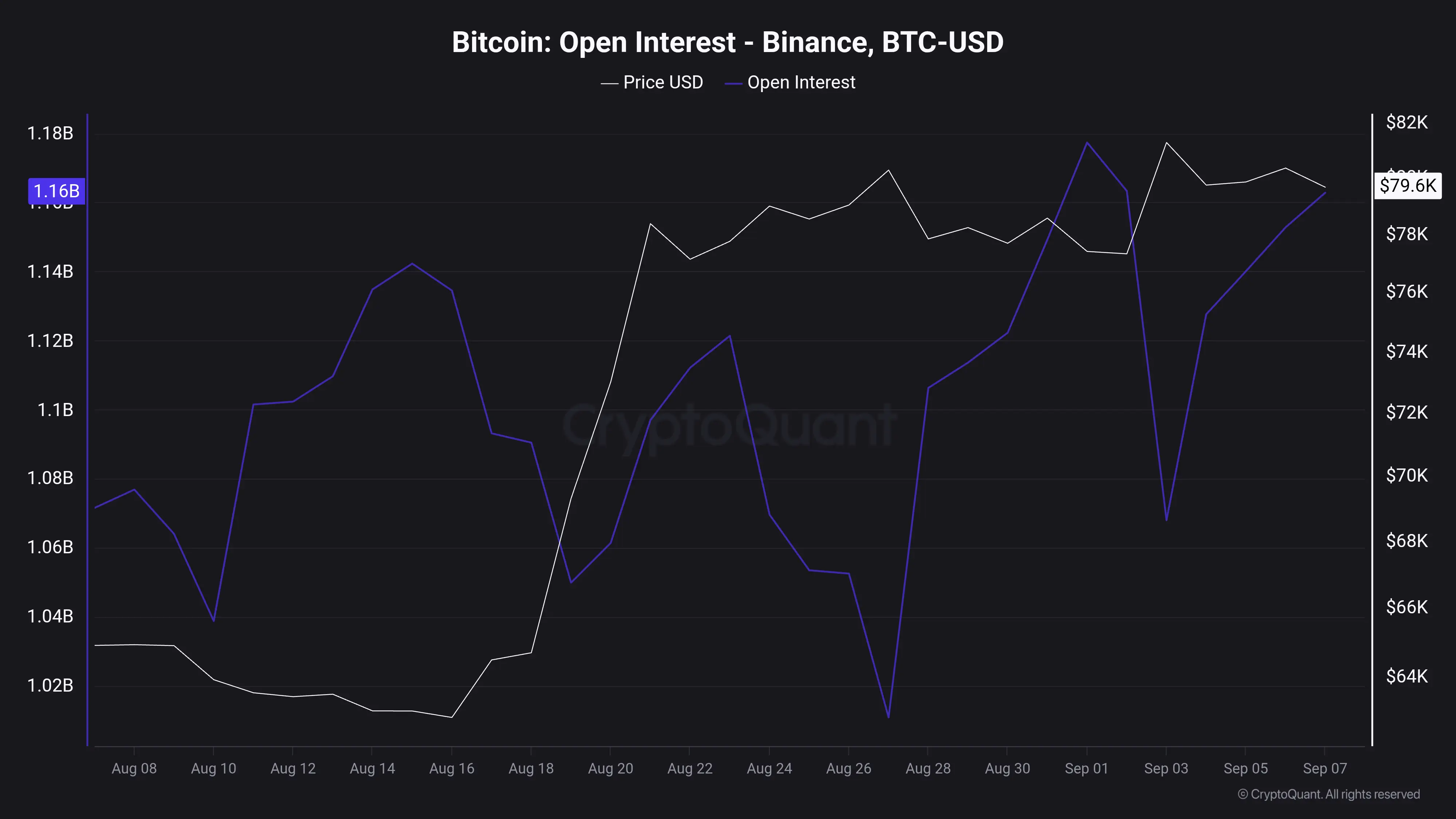
Here's the interesting part. It wasn't just that prices went up and made existing bets look bigger on paper. The amount of Bitcoin tied up in these bets, measured in actual BTC, also went up, all the way to 125,830 BTC. That tells you people were opening brand new positions, not just watching old ones grow in value.
Because so much of this leverage sits on one exchange, Binance's share of total open interest across the market climbed to 37.1%. When that much betting activity is concentrated in one place, price swings can happen faster and harder. If a bunch of these leveraged trades get force-closed at once (called liquidations), it can send the price sharply in one direction very quickly.
And that's kind of what happened next. Bitcoin dropped back under $80,000, and at the same time, Binance's open interest cooled down to $9.67 billion. So some of that extra leverage got shaken out already.
That's not necessarily a bad thing. Less leverage sitting in the market can actually make things healthier going forward, since there's less risk of a big liquidation chain reaction. But leverage alone can't carry a price rally forever. For Bitcoin to keep climbing in a more stable way, you'd want to see real spot buying too, meaning people actually buying and holding Bitcoin outright, not just placing leveraged bets on it.
Miners Aren't in a Rush to Sell
Away from the leverage story, there's another piece of good news for Bitcoin right now: miners don't seem to be dumping their coins.
There's a metric called the Miners' Position Index, or MPI, that tracks whether miners are sending large amounts of Bitcoin to exchanges (which usually means they're planning to sell). Right now, that number sits at around -0.036, which is basically neutral. For comparison, when miners are aggressively selling, this number can spike up to around 2.0.
There actually was a small spike in August, when the MPI briefly touched 2.8 before quickly dropping back down. That spike didn't turn into anything sustained. Since then, miners have mostly just been sitting still, not aggressively selling and not aggressively holding back either.
This matters because miner selling is one of the natural sources of new supply hitting the market. If miners stay calm and don't flood exchanges with coins, that removes one source of downward pressure on the price. But if that MPI number climbs back above 2.0 again, it could be a signal that fresh supply is about to hit the market, and that could slow down any recovery.
Bitcoin Is Starting to Act More Like Gold
Here's something that's been building quietly in the background. Bitcoin's price correlation with gold, meaning how closely the two move together, has climbed toward +0.50 over a 90-day window. That's more than double where it was at the start of 2026, and it's getting close to the highest level it's touched since 2020.
At the same time, Bitcoin's correlation with the Nasdaq (a stock index full of tech companies) has dropped to around +0.30. That means Bitcoin is starting to move a bit less like a tech stock and a bit more like a traditional safe-haven asset, similar to gold.
See X post Bitcoin-Gold Correlation
This shift seems to be connected to bigger worries out there, like concerns about the U.S. Treasury buying back long-dated bonds, which has stirred up talk about liquidity and currency debasement. Basically, when people get nervous about the value of regular money, some of them turn to assets like gold, and now it seems like more of them are also turning to Bitcoin for the same reason.
But just like the leverage story, correlation numbers alone don't prove a lasting trend. If this "Bitcoin as digital gold" idea is going to stick, it'll need real support from spot demand too, not just from statistics moving on a chart.
Putting It All Together
Right now, Bitcoin is going through a bit of a stress test. The leverage that pushed it up to $82,000 has already cooled off some, and miners aren't adding extra selling pressure into the mix. On top of that, Bitcoin is starting to behave more like a hedge against economic uncertainty, similar to gold.
None of these signals guarantee anything on their own. But together, they paint a picture of a market that's trying to find its footing in a healthier way, one where the next move up (if it comes) is hopefully built on steadier ground instead of just borrowed money.
Disclaimer: Above content is meant to be informational in nature and should not be interpreted as investment advice. Trading, buying or selling cryptocurrencies should be considered a high-risk investment and every reader is advised to do their own research before making any decisions.





