
Back in the 1980s when I was coming out of high school, we were all still in the interesting but insulated world where you learned a particular skill, trade or knowledge base once and then used that for the rest of your working life to sustain yourself, raise a family and pay for your retirement. The computer age hadn't yet arrived, even though by the late 1980s we were using things like DOS-based clunker PCs and Wordperfect 5.0 in every office already. The nature of the work world, much less life, was still very paper-based and slow. It also made for a lot of work zombies who lasted decades in the same position and were more than toxic to those around them.

You Can't Sit on Your Laurels, or First Degree Now
Fast-forward to today, and everything is information-based. Even your car is collecting information and then spitting it out on command to a mechanic with a computer to identify what needs to be worked on next. That fundamental shift to an information-based life also means that the skills we learned being prepared for life become obsolete much faster. In fact, there is somewhat of a relationship between Moore's Law and how much learning updating one needs to have to stay viable and relevant in the work world (putting aside other factors like generational spats and agism).
The detail on this chart might be a bit hard to make out but you get the idea; the power of tech just keeps growing exponentially every two years. And that speeds up the life cycle of tools we learn to function in the work world and stay viable with. When that life cycle is exhausted, people have to learn a new tool or become obsolete themselves too. Imagine that!
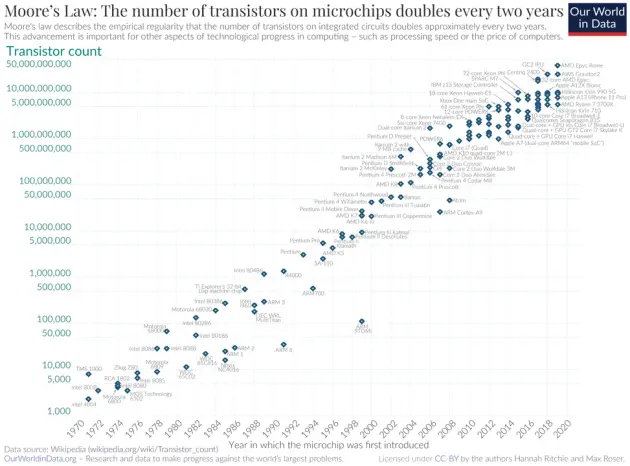
By Max Roser, Hannah Ritchie - https://ourworldindata.org/uploads/2020/11/Transistor-Count-over-time.png, CC BY 4.0, https://commons.wikimedia.org/w/index.php?curid=98219918
Fake It Til You Make It
There are, of course, plenty who will argue they don't need to learn a darn thing. They can talk the walk, and schmooze there way through challenges and requirements easily. While this is possible, and there are examples every day of someone faking it until they make it, they don't last long. That's because, at some point, skill and knowledge become paramount perform at a critical juncture. Worse, for every faker, there are 10 more people right on his or her heels waiting to jump and make a move to promote in their place. Skill, fundamentally, becomes the most consistent defense one has to retaining their value, most times.
However, there is also plenty of relevance to staying known and being connected too. As abnormal as it may seem, for example, the rush back to the office has nothing to do with productivity and everything to do with being seen and staying connected with power brokers to avoid becoming listed as "excess." This is particular important for managers who don't produce anything but supervise people.
Ignore Cultural Bias Against Learning
Ever been looked at weird? It happens all the time to career adults who commit to learning something in mid-life. Culturally, people still think all learning is supposed to be complete after your mid-20s. Yet, the reality now is, over 8.5 million people in the U.S. work world now are doing so with at least two, if not three, jobs daily. To stay viable in that kind of a market means one has to have something to offer, especially if that last skillset you were trained in was over 10 years ago. So, while the bias is still present, it's antiquated. The reality is, everybody works a full day and a lot of us are doing more at night with some kind of hustle. Given this situation, it only makes sense to find some way to leverage what is newly learned in one job for another's benefit.
So, if your company offers web design training, take it. If they offer communication building and writing improvement, take it. If they offer sales training online for those who are not in sales, take it. You may not use the training in your day job, but you can definitely use it in something else at night or on the weekends. Best of all the, it was part of your job, essentially free.
Can't Afford Training?
A common complain by many considering retraining is cost. Most immediately assume that the cost of a course, college or program is too expensive or thousands of dollars. While this is the case for a top name university, it isn't for someone willing to bootstrap and do a bit of keyboard elbow grease.
If you've been a regular reader of mine, you'll know I'm a big proponent of community college in the U.S. And now, like many countries in Europe, they are providing free education for the first two years of first-time students. Additionally, there are plenty of re-train programs providing tuition support and coverage such as HireUP and others. The trick is to actively research and ask questions everywhere there seems to be a lead for financial aid. Don't stop with the basic application form. Assistance can also come through grant programs, paid volunteer studies, day work reimbursement from your current job, government targeted programs and lot more. And you don't need to be below the poverty level to be eligible. Just simply filling out a FAFSA form at many community colleges can get you assistance from the state and school level, even if you're not eligible at the federal level.
Additionally, many online course programs like EdX and Coursera offer the option to "audit" a course instead of taking it for a certificate (the paid option). Look in the fine print for the course sign up, and click the audit choice instead. You forgo the certificate, but you get the knowledge and training for free.

Don't Turn Off Your Brain
Whether you're a homemaker running an entrepreneurial website, or a power trader connected to financial markets in a multi-screen office, the writing is on the wall - continue to keep learning new skill sets. You never know which one is going to make the difference in success as well as keeping your job for another year.






