
An X post (Twitter) has been making the round this morning, purportedly from Keonne Rodriguez in federal prison. Per the post, he's reaching out for financial help because all his options are pretty much exhausted and he needs funds to help pay his outstanding legal bills. Now, the first thing that comes to mind here, at least for me, is the thought that if you're fully incarcerated for a sentence that is pretty much life in federal prison, why would you then give a flip about paying lawyers, legal fees or any other expense? That's about the point where you pretty much tell family to sign you off, tell the lawyers to pound dirt, and get used to whatever paradigm you have to in prison to survive there for the rest of your years.
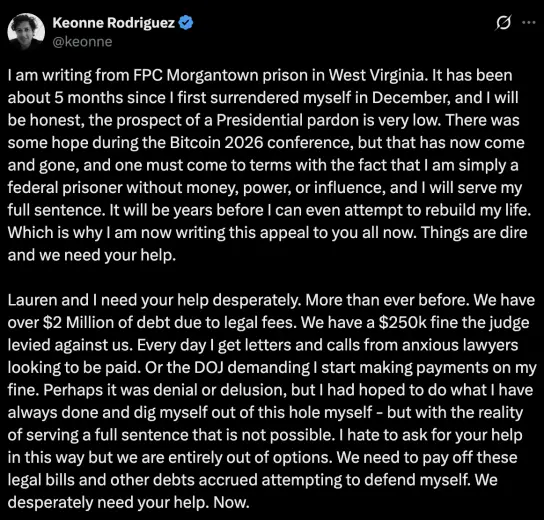
I guess there are some holdouts, and Rodriguez does mention it, to maybe get a pardon. Which of course would still need to some additional legal/lobbying help. It has happened, and many recent pardons were definitely via the help of advocates on the outside making the case for someone imprisoned. A notable, similar case was that of Ross Ulbricht, the infamous creator of the drug-trading Silk Road website. However, for the large majority of folks, hitting the end of appeals and legal challenges is pretty much it.
Why Rodriguez's case might be different and still pull out, or why lawyers and bill collectors still think they are going to get paid stomping on a turnip, probably has to do with his background. It also probably has something to do with the sentencing being pretty light, even by federal standards for such a big highlight of a case. Note, they were sentenced to five and four years only, not 25 or life.
Keonne Rodriguez, along with William Hill, were the instrumental head management of Samourai Wallet and related operations. That crypto digital tool essentially provided a set of criticals tools by which a user not only could exchange Bitcoin but could also obliterate its blockchain trail of who got what from where and where it went. In trade terms, this is referred to as a "mixing service." It's notable that neither of the two were involved in any actual traditional crime of extortion, theft, fraud or similar. Instead, they fell in the category of assisting or enhancing the ability for criminals to launder funds and effectively evade detection of financial trails through Samourai Wallet's tools.
Most of the alleged details are summarized by the U.S. Department of Justice on their website:
- Attorney for the United States, Acting Under Authority Conferred by 28 U.S.C. § 515, Nicolas Roos announced today the sentencings of KEONNE RODRIGUEZ and WILLIAM LONERGAN HILL, the co-founders of Samourai Wallet (“Samourai”), a cryptocurrency mixer that facilitated over $237 million in illegal transactions. RODRIGUEZ, the Chief Executive Officer of Samourai, and HILL, the Chief Technology Officer, participated in a conspiracy to operate a money transmitting business in which they knowingly transmitted criminal proceeds. The over $237 million dollars of criminal proceeds laundered through Samourai came from, among other things, drug trafficking, darknet marketplaces, cyber-intrusions, frauds, sanctioned jurisdictions, murder-for-hire schemes, and a child pornography website. RODRIGUEZ and HILL were respectively sentenced to five and four years in prison.
In short, the federal government dropped the hammer, specifically to make an example of the somewhat novel case that anything even remotely developed as a laundering tool for online finances would be subject to the same criminal prosecution treatment.
Samourai Wallet itself became a disruptor because the wallet combined with privacy-enhancing tools ran counter to the increasingly aggressive stance of the federal government towards hidden financial activity via blockchain. This is not a new trend; Europe has been well ahead of the curve demanding all crypto wallets have KYC and disclosure as well as shutting down private exchanges or anonymous crypto trading. Beginning with the Biden administration, the U.S. federal government ramped up regulatory control via the SEC, and the Department of Justice began rolling out high-profile case of crypto projects being prosecuted for fraud. The Samourai Wallet case, however, was a bit novel in the aspect of the creators being prosecuted for making code and software available that users then used for crime. The question hinged on two points: 1) can code be inherently illegal to publish, and 2) are code creators responsible for what third parties do with the code made public via a tool?
Prior to Samourai a couple of big cases laid down parameters of how far one could go with code. Bernstein v. United States (1999) clarified that simply sharing source code was protected by the 1st Amendment and not restrictable per se on its own being shared. Then, in 2001, Universal City Studios v. Corley constrained code intended to do something wrong, at least on the civil side (that case dealt with jail-breaking code intended when used to circumvent product protections). That case became the catalyst for allowing regulation of code per se. It also didn't help that Samourai management made plenty of public statements marketing their tools with the seemingly clear intention of avoid identity and financial detection using their tools. It was seen as something similar to someone offering getaway professional driving services for anyone who want to rob a bank.
From a legal perspective on the free speech power of code, Samourai became a distraction. Instead of having to take on the direct issue of free speech, the Department of Justice could easily focus their prosecution on the behavior of the company directors "knowingly" assisting money laundering interests. That in turn made the case an easy win in criminal court. Few juries have sympathy for ultra rich crypto bosses thumbing their nose so blatantly at financial laws.

Of course, winning the case has the added effect of putting coders on notice. Now, the DOJ has precedence on winning a criminal case arguing the use of coding tools for ill intent, versus just the issue of releasing the code itself to the public. That slippery slope then erodes 1st Amendment arguments because it shifts the focus onto the developer's intent, which is a squishy gray thing that people can easily compromise themselves on via past statements, bragging, posting and generally sealing the case before it was ever started. A similar case with Tornado Cash deviates significantly because that case focuses on the availability of the development in general, not the developer's intent and practice after release of the code. It would be much broader and be a complete reversal of free speech protections in Bernstein v. United States.
Interestingly, Samourai Wallet itself and related company quickly exited US product markets, but the tool is still available internationally. It's now positioning itself as a crypto news source versus a Bitcoin wallet with enhanced features.






