Before we delve into the topic, let's answer the first fundamental question:
What is Liquidity Mining?
Liquidity mining is a way to earn cryptocurrency rewards by providing liquidity to decentralized exchanges (DEXes). When you provide liquidity to a DEX, you are depositing two distinct cryptocurrencies into a pool in equal proportions. In fact most platforms ask you to choose your liquidity pair when you carry out liquidity mining. Important Note: In general, centralized exchanges (CEXs) are not known to offer liquidity mining programs. However they depend on traditional market-making strategies to avail liquidity to their users. Market makers are typically large financial institutions that provide liquidity by buying and selling assets on the exchange. They earn profits by charging a spread between the buy and sell prices of assets. To learn more, check out this eloquently written article by Gemini.
Simply said, while liquidity mining is not exclusive to DEXs, it is not commonly offered by centralized exchanges though in this article we review liquid mining by Binance.
You as a liquidity provider then gets compensated with liquidity provider (LP) tokens. Consequently, these tokens can then be staked in liquidity mining pools to earn cryptocurrency rewards. The amount of rewards you earn depends on the amount of LP tokens you have staked and the total liquidity in the pool.
The decision, you make should only be taken after you weigh the following benefits versus risks and in addition only invest money that you can afford to lose applying advice from a certified Financial Adviser.
Benefits vs Risks of Liquidity Mining:
These are some of the benefits of liquidity mining:
- As mentioned above, you can earn cryptocurrency rewards in exchange for providing liquidity to DEXes (and some CEXes)
- You will support the growth of the DEX ecosystem
- You can earn passive income on your crypto assets
- It's relatively easy to do depending on platform interface
On the flip side be aware of the following risks of liquidity mining:
- Impermanent loss: Meaning you risk losing money if the prices of the cryptocurrencies in a liquidity pool change significantly.
- Smart contract risk: You can of lose money due to a bug or exploit in the smart contract that governs the liquidity pool.
- Counterparty risk: You can lose money if the exchange that you are providing liquidity to goes bankrupt.
Overall, liquidity mining is a relatively new and risky activity, but it has the potential to be very rewarding. It is important to do your own research and understand the risks involved before you start liquidity mining.
Comparison of Liquidity Mining Versus Yield Farming Vs Staking:
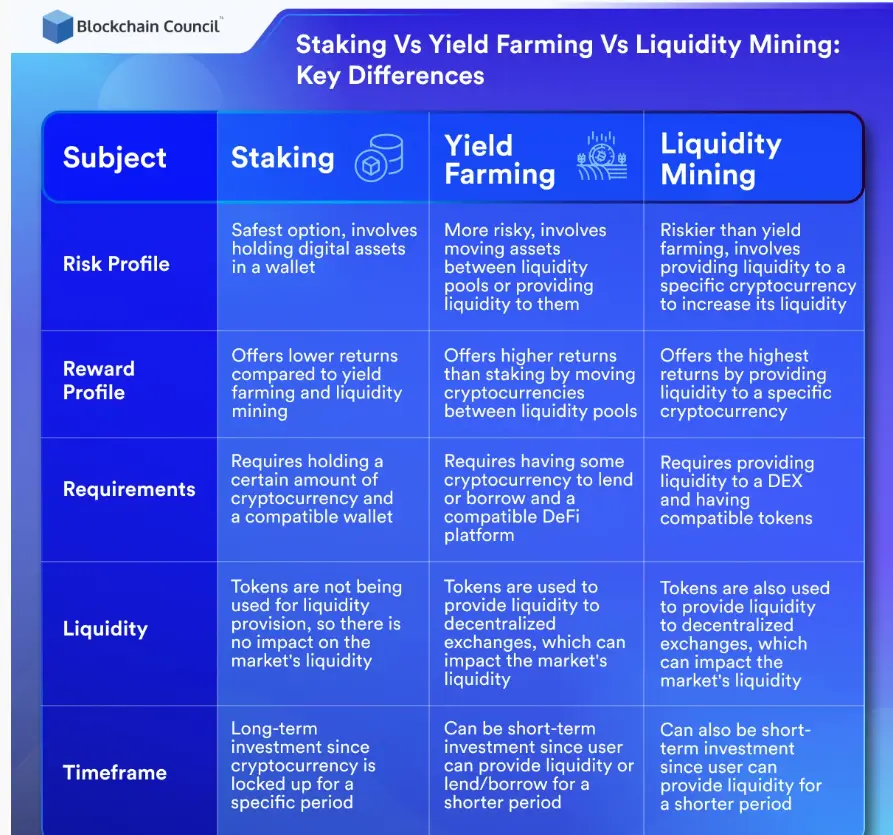
Image source:blockchain-council.org
Now that we have explored the potential risks and rewards, let's review platforms where you can provide liquidity:
1. CAKE DeFi
CAKE DeFi is my personal favorite. It is a decentralized exchange (DEX) and focuses on providing high-yield staking and liquidity mining opportunities for DFI and other cryptocurrencies. It is known for its strong community and focus on innovation.
Pros:
- High-yield staking and liquidity mining opportunities
- Strong community and focus on innovation
- Secure platform with a good track record
Cons:
- Can be complex for beginners
- Limited number of supported cryptocurrencies
For context, CAKE DeFi supports liquidity mining for the following cryptocurrency pairs:
- BTC/DFI
- ETH/DFI
- LTC/DFI
- USDT/DFI
- USDC/DFI
- DOGE/DFI
- DOT/DFI
- SOL/DFI
- MATIC/DFI
- AVAX/DFI
- DFX/DFI
- DUSD/DFI
2. Binance

Binance is the largest cryptocurrency exchange in the world by trading volume, published here by CoinMarketCap. It offers a wide range of services, including cryptocurrency trading, lending, derivatives, savings, and launchpad. The liquidity mining program Binance operates is called Binance Liquid Swap. Here are some pros and cons of liquidity mining by Binance:
Pros:
- High APY: Binance Liquid Swap offers high annual percentage yields (APYs) on staked assets ranging from 10% to 100% depending on the asset and duration of staking.
- Low fees: Binance Liquid Swap charges fees as low as 0.06% up to 0.1% per transaction.
- Zero gas or admin fees for swapping assets .
- Ease of use: Binance Liquid Swap is easy to use and can be accessed directly from the Binance exchange platform.
- Good security record
Cons:
- Centralized exchange, which makes it more vulnerable to hacks and other security breaches
3. Bybit
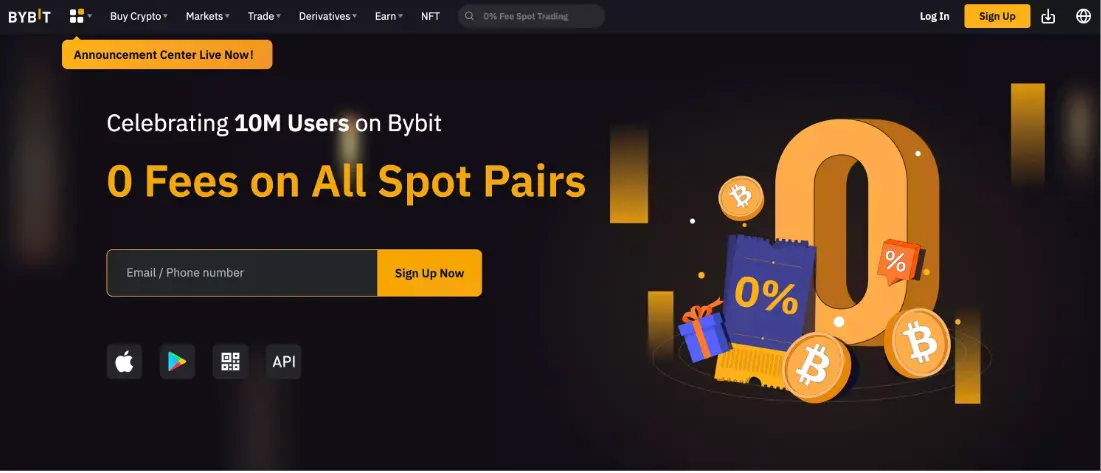
Bybit is a centralized exchange (CEX) that has been in business since 2018 and that offers a wide range of services, including cryptocurrency trading, lending, derivatives, and savings. It is known for its low fees, fast deposit and withdrawal times, and a user-friendly interface.
Pros:
- Opportunity to earn up to 100% APY
- Wide range of services
- Low fees and fast deposit and withdrawal times
- User-friendly interface
Cons:
- Centralized exchange, which makes it more vulnerable to hacks and other security breaches
- Limited number of liquidity mining pools
4. PancakeSwap

PancakeSwap went live in September 2020 as a fork of SushiSwap, another decentralized exchange (DEX) on the Ethereum blockchain. PancakeSwap was one of the first DEXes to launch on the Binance Smart Chain (BSC), which offered lower fees and faster transaction times than Ethereum.
Pros:
-
Pros:
- Earn a share in the fees
- Receive Liquidity Provider NFT tokens for adding your token to a Liquidity Pool
- Earn CAKE on CAKE Farms
Cons:
- Impermanent loss as explained above
- High slippage and the potential market manipulation
5. Uniswap

Uniswap is a decentralized exchange (DEX) that allows users to trade cryptocurrencies directly with each other without the need for a third party. It is known for its high liquidity and low fees.
Pros:
- High liquidity and low fees and
- No registration required
- Decentralized exchange,therefore less vulnerable to hacks & other security breaches
Cons:
- Can be too complicated for newbies
- Limited number of supported cryptocurrencies
Conclusion:
You have a variety of crypto platforms to choose from if liquidity mining interests you. When selecting a platform, it is critical to consider your risk tolerance, investment goals, and the specific features that are important to you. Some platforms offer higher yields, while others offer more features or a wider range of supported cryptocurrencies.
Happy Liquid Mining with all caution and restraint necessary!🎊
Check out my most popular article of October 2023 exploring why Forbes named Kucoin one of the Best Cryto Exchanges in 2023 here
....................................................................................................................................................................
TO SUPPORT MY WRITING:
- Buy Me Coffee
- Use Referral CODE: ztrg7mb4dy to Complete Missions Crypto.com
- Earn Bitcoin by Collecting Daily Faucets at Cointiply
- Join Binance: Get Crypto from their Learn to Earn Program