Polygon (MATIC) and Avalanche (AVAX) are both excellent choices for building decentralized applications (DApps). They both offer high scalability, low transaction fees, and a thriving community of developers. However, there are some key differences between the two platforms that may make one a better choice for your specific project.
Polygon (MATIC) is a Layer-2 scaling solution for the Ethereum blockchain. This means that it is built on top of Ethereum and uses sidechains to offload transactions from the main Ethereum network. This can significantly reduce transaction fees and improve network congestion. Polygon is also very fast, with a throughput of up to 65,000 transactions per second.
Avalanche (AVAX) is a Layer-1 blockchain that can be used to build a wide variety of applications, including DApps. It is known for its high scalability, with a throughput of up to 4,500 transactions per second. Avalanche is also very secure, using a unique consensus mechanism called Avalanche Consensus.
Polygon (MATIC) Origins and Founders:
Polygon (MATIC) was originally known as Matic Network, and it was founded in 2017 by Jaynti Kanani, Sandeep Nailwal, and Anurag Arjun. The project was initially developed to address the scalability issues of the Ethereum blockchain. Kanani is a computer scientist who previously worked in the telecommunications industry. Nailwal is a software engineer who has worked on a variety of projects, including the Ethereum Name Service (ENS). Arjun is a software engineer who has also worked on a number of blockchain projects.
Avalanche (AVAX) Origins and Founders:
Avalanche (AVAX) was founded in 2018 by Emin Gün Sirer, Kevin Sekniqi, and Joe Lubin. The project was originally called Ava Labs, and it was the first project to implement the Avalanche Consensus protocol, which is a unique and innovative consensus mechanism that allows for high scalability and security. Gün Sirer is a computer scientist who is best known for his work on the Chord Distributed Hash Table (DHT) protocol. Sekniqi is a software engineer who has worked on a variety of projects, including the Ethereum Virtual Machine (EVM) and the Hyperledger Fabric blockchain platform. Lubin is a co-founder of Ethereum and ConsenSys.
Summary of Polygon (MATIC) vs Avalanche (AVAX)
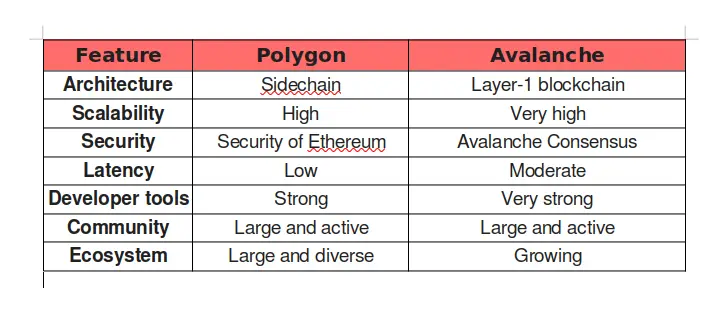
Examples of Polygon (MATIC) DApps:
- Decentralized exchanges (DEXs): QuickSwap, Curve Finance, SushiSwap
- NFT marketplaces: OpenSea, NFTX, Aavegotchi
- Gaming DApps: Axie Infinity, Illuvium, Decentraland
- Lending and borrowing protocols: Aave, Compound, Maker
- Prediction markets: Polymarket, Augur, Gnosis
- Infrastructure DApps: Chainlink, The Graph, DIA Data Intelligence
Examples of Avalanche (AVAX) DApps:
- Decentralized exchanges (DEXs): Pangolin, TraderJoe, SushiSwap
- NFT marketplaces: NFTX, Avalanche Auction House, Curate
- Gaming DApps: Battle Arena Crypto, Crabada, Swimmer
- Lending and borrowing protocols: Benqi, Aave, Yield Yak
- Prediction markets: Polymarket, Uniswap, Gnosis
- Infrastructure DApps: Chainlink, The Graph, DIA Data Intelligence
In addition to decentralized exchanges DEXs and Peer-to-peer (P2P) marketplaces, there are many cryptocurrency exchanges that allow you to buy both MATIC and AVAX, such as Coinbase, Binance and Kraken. These exchanges typically offer a variety of payment methods, including credit cards, debit cards, and bank transfers.
Which of the 2 projects appeal to you the most and why?
**************************************************************
TO SUPPORT MY WRITING:
- Earn daily Bitcoin with Surveys and games Cointiply
- Join Binance: Start blogging and monetizing content.
- Buy Me Coffee
- Use Referral CODE: ztrg7mb4dy to Complete Missions Crypto.com