
Blockchains can be used for many purposes including smart contracts deployment.
A smart contract is a computer protocol intended to digitally facilitate, verify, or enforce the negotiation or performance of a contract. Smart contracts allow the performance of credible transactions without third parties. These transactions are trackable and irreversible. Smart contracts were first proposed by Nick Szobo in 1994.
Every smart contract is identified by a unique address. It’s a long string of alphanumeric characters that is used to identify and interact with the smart contract on the blockchain. Example of smart contract address: 0x95aD61b0a150d79219dCF64E1E6Cc01f0B64C4cE.
Explore a Smart Contract on the Blockchain
A blockchain Explorer is a web application that allows users to view all transactions that have taken place on a blockchain. It is a search engine that allows users to explore and search the contents of individual blocks, view transaction histories, and check the balance of any given address.
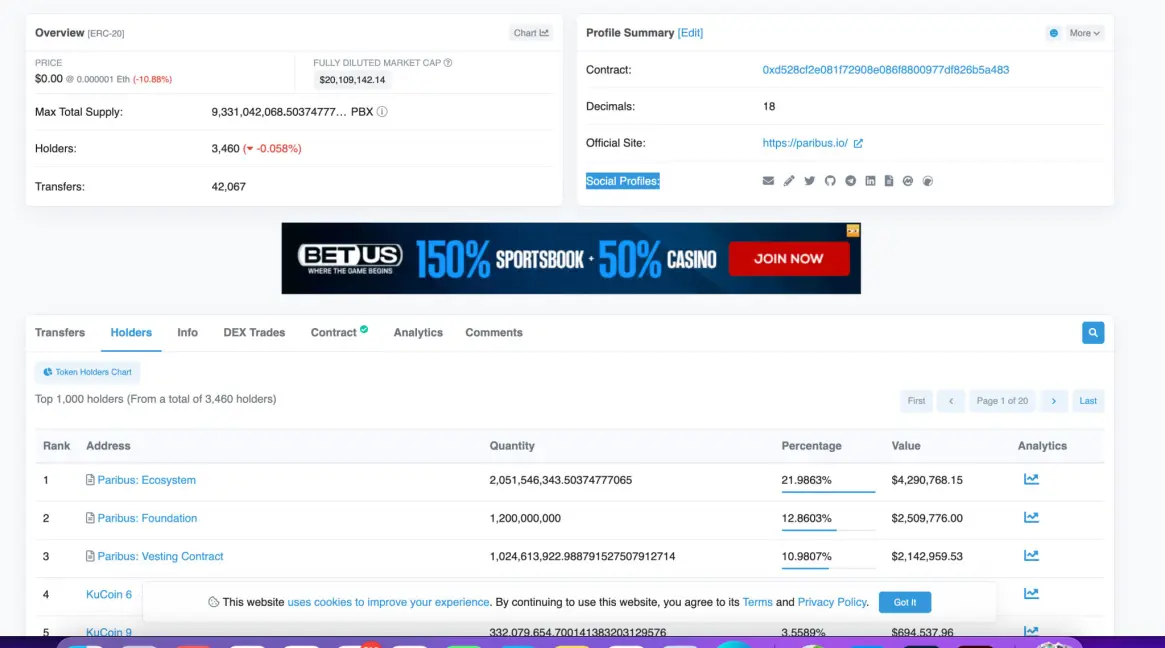
To search for any smart contract information, just enter its contract address in the search field and press enter. A new page will load giving you information about the contract. No matter the blockchain you are exploring, the information below can be found for any smart contract:
Max Total Supply: This is the maximum supply of minted tokens from the smart contract. This supply can change over time.
Holders: This is the total of individual wallets that hold the tokens from the smart contract. This is important information as you can see whether the token supply is fairly distributed among all holders. Please note, that the wallet addresses with a document icon are smart contracts themselves. These wallets can represent Decentralized Applications (dApp) like Uniswap, PancakeSwap, or Tokens lockers.
Transfers: The total transfer on the blockchain since the smart contract was deployed. The more this number is high, the more active the contract is.
Contract: This is the token contract address. (identifier)
Official Site: The link to the website of the project behind the token and smart contract.
Social Profiles: Links to social media profiles of the project.
Please see the image below for a visual example of Etherscan, which is the explorer on the Ethereum blockchain.
What Makes Smart Contracts So Important?
To answer this question, we need to observe how our world is governed by trust. Someone has to be trusted in many human core activities like banks, education, transportation, and more.
This trust is usually handled by a third party and, for the most part, administrated by other humans. And because humans cannot always be trusted, issues may always arise sometimes. For example, a bank can deny you access to your money for any reason. You wouldn't trust that bank anymore. Would you?
This is where smart contracts come to solve this trust issue. When executing a smart contract, it automatically validates once each party's conditions are met.
A smart contract won't prevent you from withdrawing your money for example, as long as you do have the amount requested and you can afford the gas fee to run it.
Many of our existing businesses can be run by smart contracts and improve all party's relationships. Below are some examples:
- Supply Chain Management: Smart contracts can be used to track the movement of goods, ensuring that payment is only released once the goods have been received and verified.
- Decentralized Finance (DeFi): Smart contracts are used to create decentralized exchanges, stablecoins, and lending platforms, enabling users to take control of their financial assets without the need for intermediaries.
- Real Estate: Smart contracts can be used to manage property transactions, from listing to sale and beyond, reducing the need for intermediaries and ensuring a more secure and efficient process.
- Healthcare: Smart contracts can be used to securely store and manage patient health records, enabling healthcare providers to easily access a patient’s medical history.
- Government: Smart contracts can be used to create transparent and secure voting systems, reducing the potential for fraud and improving the accuracy of election results.
- Gaming: Smart contracts can be used to develop decentralized gaming platforms, enabling players to own and trade in-game items and assets, and ensuring a fair gaming experience.
- Copyright and Royalties: Smart contracts can be used to automate the payment of royalties to content creators, ensuring that they receive the correct amount of compensation for their work.
Despite all these benefits that smart contracts can bring us, they should be used with caution because they are still new and present some problems that need to be addressed.
Some of these issues are immutability, so hard to update; they can be exploited by hackers; or they can be deployed by bad actors in order to steal user funds.






