
The crypto market is going through a deep downturn. Many traders are sliding into despair, especially long-term holders and investors. However, clarity is needed. These phases exist, are part of the cycle, and are nothing new. The choice that makes the difference during downturns.
The crypto world is volatile, and one must face it without monolithic approaches. In this phase, some suffer more, while others continue to build over time. The difference often stems from a decision made long before with a precise plan: lump-sum investment (PIC) or dollar-cost averaging (PAC). These are two opposing philosophies, and the numbers show how heavily this decision weighs.
The worst-case scenario: entering at the all-time high.
Let’s take Ethereum (ETH) starting in November 2021, when the price was trading at its previous all-time high around 4,800 USDT. Anyone who had invested all their capital in a single shot would currently record a PnL of -63.89%.
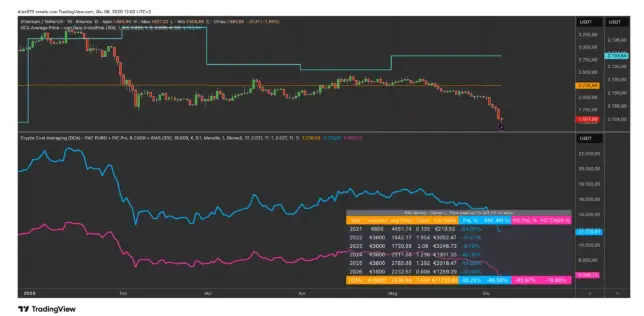
On the other hand, those who had set up a monthly accumulation plan (PAC), with the same amount distributed over time, would stand at -29.47%. Over thirty-four percentage points of damage avoided, simply by diluting entries over time.
The mechanics are simple, but it is always worth remembering. The first installments made at the peak weigh little, because they are diluted by subsequent purchases at lower prices. In a lump-sum investment (PIC), however, those high prices represented the entire capital. Ironically, we can say that it is almost better to start a PAC at a peak.
The complete picture on Ethereum
Expanding the analysis to six different entry points, the result almost always depends on where you were in the market cycle.
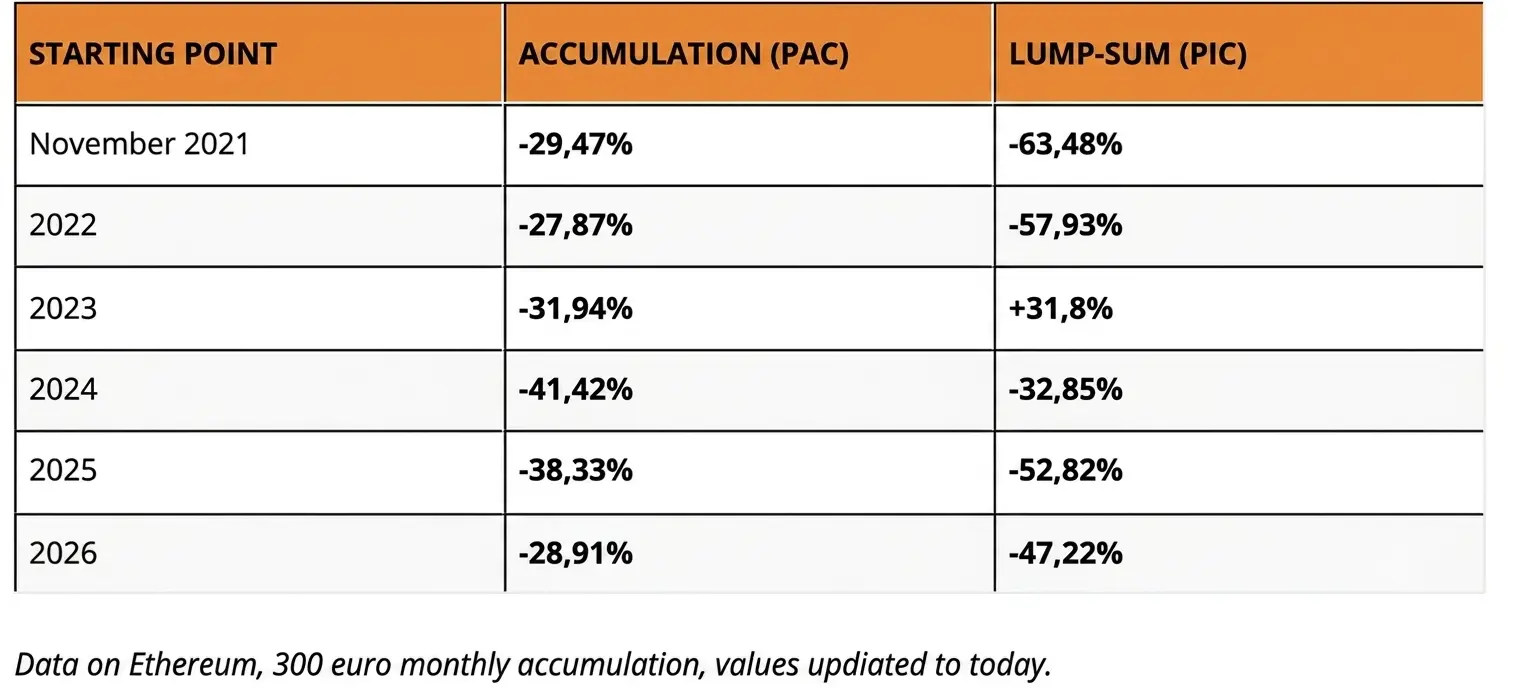
When the lump-sum investment (PIC) wins, it must be said honestly, is not always the superior choice. Those who entered in a single block during 2023, near the lows of that period, rode the subsequent recovery in its entirety. In that case, the lump-sum investment even marks a +31.8%, while the accumulation plan (PAC) remains stuck at -31.94%.
The same logic applies to 2024: those who were lucky enough to enter at the cycle low were rewarded. The accumulation plan, in this scenario, continues instead to buy at increasingly higher prices.
In 2026, the accumulation plan is cushioning the crash.
The same protective effect also emerges in 2026, both on Bitcoin and Ethereum. On Bitcoin, the accumulation marks -17.45% against the much heavier -31.1% of the lump-sum investment made at the beginning of the year. On Ethereum, the gap is even wider: -28.91% versus -47.22%.
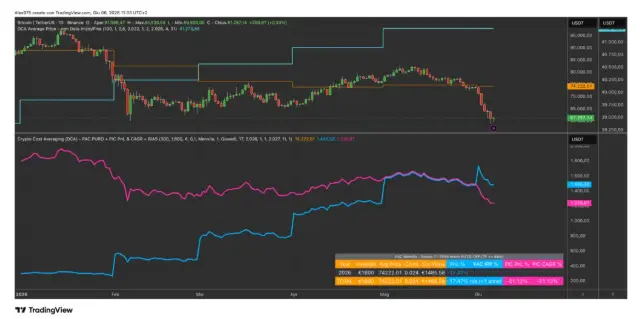
In a context of strong volatility like the current one, spreading out entries over time significantly cushions the blow. It does not eliminate the loss, as is evident from the figures, but it concretely reduces its magnitude.
What truly matters
In conclusion, the accumulation plan (PAC) should not be understood as a guaranteed profit machine. It is rather an insurance against timing errors, the most expensive kind, which no investor truly knows in advance. The advantage compared to a lump-sum investment (PIC) is greater when entering near a market peak, while it decreases when entering near a low.
In every scenario, discipline, a long-term horizon, and attention to costs remain central. Moving from a retail application at 2% to a professional exchange at 0.1% automatically grants percentage points of return every year.





