
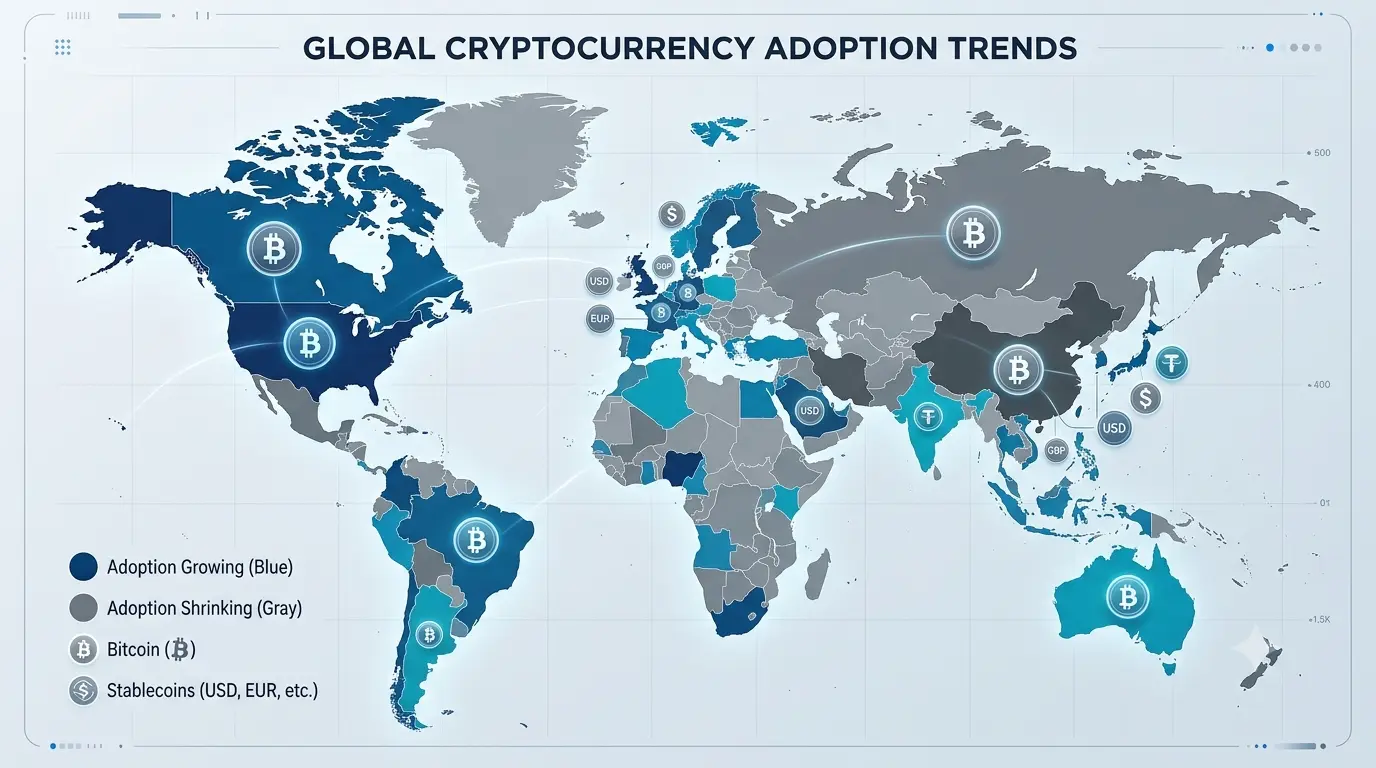
Let’s start with the facts:
Q1 2026: retail crypto activity was 11% down at $979 billion globally. That’s the second consecutive quarter of decline.
But look beyond the headlines…
Why this decline? While not what the articles say, crypto is breaking across global monetary fault lines. Some countries are exiting, others are embracing crypto for entirely different reasons than before, and their motivations are more telling about crypto's future than any price chart.
The Divergence: Speculation vs. Necessity
For developed nations, we’re seeing a retraction in retail activity: South Korea (-31%), Germany (-25%), the UK (-13%), the U.S. (-11%). The higher interest rates and strong dollar made speculative bets on crypto more expensive, and we saw an outflow to traditional finance instruments.
The developing world, though?
That’s a completely different picture. Turkey has added 7% this year to $40B, one of only two major countries with an increase. India (only -6% this year). Venezuela has climbed from 22nd to 17th.
Why?
It’s not speculation. It’s necessity. Venezuela: More about Survival than Trading Venezuela was #17 in global retail volume with $17.9B. What stands out is that stablecoins are used 90% of the time for transactions on Binance in Venezuela. People aren’t seeking 100x coins here. They’re looking to keep themselves alive amidst crippling inflation, sanctions, and limited access to traditional banks. The stablecoin is simply becoming the shadow dollar.
The Regulatory Turning Point of 2026
2026 is looking like a massive year of transformation in digital assets.
Why?
Regulatory certainty is arriving! The EU's MiCA regulatory framework is in effect. The U.S. Legislative bills such as the GENIUS Act and CLARITY Act are gaining traction, and regulators in places like the UAE and Singapore have made significant progress in creating enabling environments for crypto business to thrive.
PwC's Six Top Regulatory Trends for 2026:
* Stablecoin Enforcement: Stablecoin issuers are finally going to have a clear set of regulations around reserves, redemption rights and governance. * Tokenized Money: Bank deposits, CBDCs, and other digital tokens will transition from a testbed phase to actual market usage. * Consumer Protection: There will be higher expectations for the responsible conduct and product design by regulated companies, as firms will now have licensing to operate. Regulatory chaos is receding. That’s music to institutional ears.
Emerging Markets Take the Lead
The majority of commentary about the crypto market largely ignores the emerging markets. This year, Pakistan’s central bank officially removed an 8-year ban on cryptocurrency. Hong Kong announced it has granted its first stablecoin licenses to local and international banks, including HSBC. Israel has approved its first regulated pegged stablecoin on the Solana blockchain, known as BILS. Turkey jumped to #5 in global adoption rankings. Why does this matter? For a start, Pakistan, prior to the lifting of its ban, ranked #3 in the world for global cryptocurrency adoption. With clear regulations in place, this will likely lead to further expansion. In almost all these cases, stablecoins serve as the predominant method for transferring funds.
So What Now?
If you’re involved in crypto, you cannot afford to simply watch what’s happening in the United States. The real shift isn’t occurring in speculative trading accounts in developed nations; it’s happening where traditional banking has failed people, such as in Argentina, Turkey and Venezuela. They’re buying crypto not for the next big payday but for financial security. That’s a more profound catalyst for adoption. Final thought: 2026 just feels… different. The bubble popped. The bears hibernated. Now, we’re looking at real use cases and real regulatory certainty. The shift is from pure speculation to building infrastructure for a new financial world. The opportunities for those who see it are immense.






