The power of yesterday evening's speech, which presumably has already been experienced by everyone, contained no comment on September beyond stating that the Fed is persistently raising rates and has no intention of moving to lower inflation below 2%, or even to bring the cycle to the end of 2023. While the Fed says it has given up forward guidance, the threat is significant, warning markets not to speculate. After all, the Fed's interest-rate hike will have to go hand in hand with the monthly data. This speech sent shockwaves through the economic establishment, which ultimately interprets the peaking of inflation as the Fed's turn, and the September game as the beginning of the turn. But Powell's strong stance has distracted risk markets from their hype. He will have to shift his focus from previous time cycles to the inflation data cycle. However, in this speech, apart from the 4% federal funds rate, there is one topic that has not been mentioned at all. That is what the Fed's target for 2022 is. I believe that this is the focus of Powell's speech this time. First, Powell did not directly mention how much the federal funds rate should be maintained in 2022. Previously, he was very clear that 3.4% is reasonable. This time, there is no obvious statement that 3.4% is not necessarily maintained. But it also gives a rate of 4% at the end of 2023, rather than in 2023, which implies that if the federal funds rate has already been raised to 4% at the end of 2022, it will remain at that rate (depending on inflation) through 2023. While this would be the biggest blow to the market, it would not be easy to put up more money. Even if interest rates do not change after the hikes are halted, it means the worst is over. The bottom of the market will form in the process of raising interest rates, and when the increase is over, because there is no sustained squeeze, the risk markets will not recover quickly, but they will move from a downward range to a full horizontal range. That is, all the policy headwinds will be coming down, and the market will adjust the rest. US stocks, on the other hand, report quarterly earnings, which will be good or bad for the index. As long as the technology stocks are doing well, the overall trend of the BTC and the ETH will not be too bad. The high probability is that the price will keep rising and falling in 2023. If inflation can be lowered to the level that the Fed can consider, the turn will be on. The second issue that Powell did not address is how much the Fed wants inflation to be contained in 2022. Headline inflation of 2% is a long-term goal that includes 2023, but 2022 inflation, which the Fed had previously said was necessary to keep at 4%, is not being mentioned this time as implying that 4% inflation, at the current rate increase, may not be achievable in 2022. If this is true, looking back at the 4% federal funds rate and yesterday's PCE numbers, it suggests that if inflation really is the beginning of a gradual slowdown, it is not a bad thing to pick on short-term stuttering inflation when you are ready for "family pain". So a rate hike of 75 or more in September is the best option, while August's inflation figures are less important. But Powell has made it clear that the September rate hike will definitely be conducted in conjunction with corresponding macro data. Without giving the federal funds rate at the end of 2022 and the inflation range to be controlled, there is plenty of room for maneuver. Powell and Fed officials, in particular, have repeatedly said that the July inflation figure was good, and that the July real CPI was down 0.6% from June, which means that the Fed is satisfied with the level.
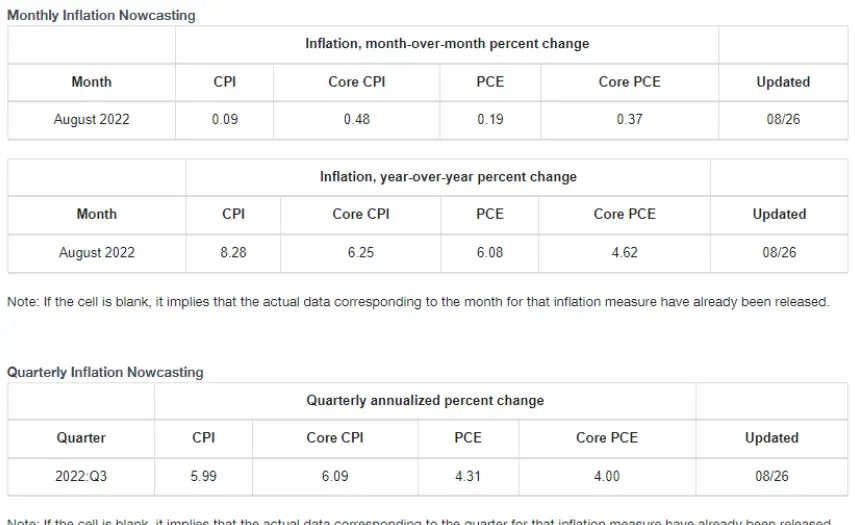
So, if the August CPI number falls below 8% (down 0.5%), then it would be a more satisfactory fall, and so the data are not entirely out of the question, and Powell has not been a hawk all the way, praising the July inflation number and saying that "to some extent, as policy positions tighten further, it will be appropriate to slow down the pace of rate increases."This dovish talk. So, in conjunction with the November US mid-term elections, my own view is that, while Powell showed commitment to fight inflation this time around, as well as discouraging risk markets from reacting to the Fed, the hawks were not sufficiently thorough, intentionally or inadvertently avoiding 2022. It is hard to argue that this was not from the mid-term elections or the Democratic Party, especially as Biden's approval ratings have soared since he signed the latest "Take Wealth to Help Poverty" legislation. You can see the Democratic Party's softly-softly approach to lower-middle-class Americans (especially the middle class), so the pressure from the Federal Reserve has to deal with the direction of U.S. stocks, which are the middle class. If risk markets had followed the path before, the US stock market's rise would have continued to increase with the 50 basis points interest rate hike in September. September may well be the peak of the increase, and in October when there is no interest rate hike, there may well be a drop, like in August. So it's hard to say whether US stocks can be a good indicator of the Democratic Party's performance when the mid-term elections are held in November. So it's very hard to say whether US stocks will be able to withstand the Democratic Party's performance. Thus, starting to crack down on US stocks now, until the actual rate hike figures are available at the end of September, the unceasing release of data is in line with the common will of the Federal Reserve and the Democratic Party. If inflation is good, even a 50-basis-point increase in interest rates can control market sentiment through November expectations. And if inflation does not look good, raising interest rates by 75 basis points, placing a heavier burden on US stocks, and then easing the pace of rate hikes in November before the mid-term election could also boost the economic camp's re-emergence. So it is now the Fed's and the White House's priority, given that risk markets are abandoning the illusion of strength and entering limited panic in the short run, that the Fed does not need to focus too much on the September rate hike, but rather needs to create market conditions. The policy direction that all of this inferences leads to is likely to be a period of weakness in risk markets before the August rate increase data is released, and even a reduction in the game of raising interest rates in September. Even if the August CPI data are fairly positive, the Fed can take steps to cool the market, such as intensifying and intensifying the tightening of the balance sheet, which the Fed has not been seriously pursuing.
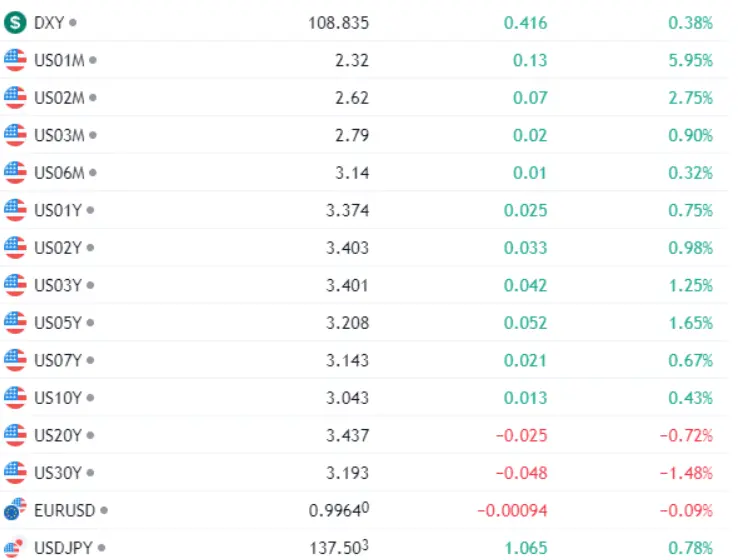
The market reaction can be very violent. After Powell spoke, the U.S. bond market did not buy. Instead, it was accelerating the release of funds. Even the previously active short-term U.S. bonds are showing signs of significant capital flight. Thus, investors' expectations of the U.S. economy are already very poor. Only 20- and 30-year U.S. bonds have bought. The ten-year and two-year U.S. debt gap is widening again.
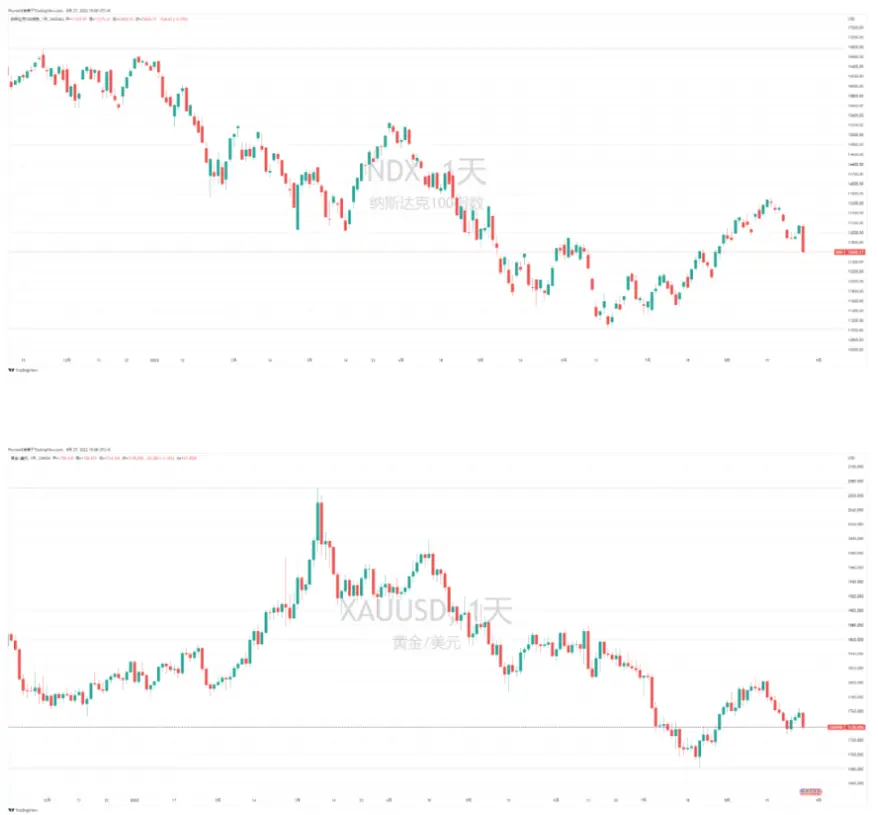
In particular, the Nasdaq 100 index had its biggest one-day drop since June 13 after Powell's speech, which also gave the market two days of breathing room over the weekend. Even Monday's move was likely to continue a downward trend that has not yet, as things stand, unleashed any interpretation of market forces. Even gold erased the gains from previous days.
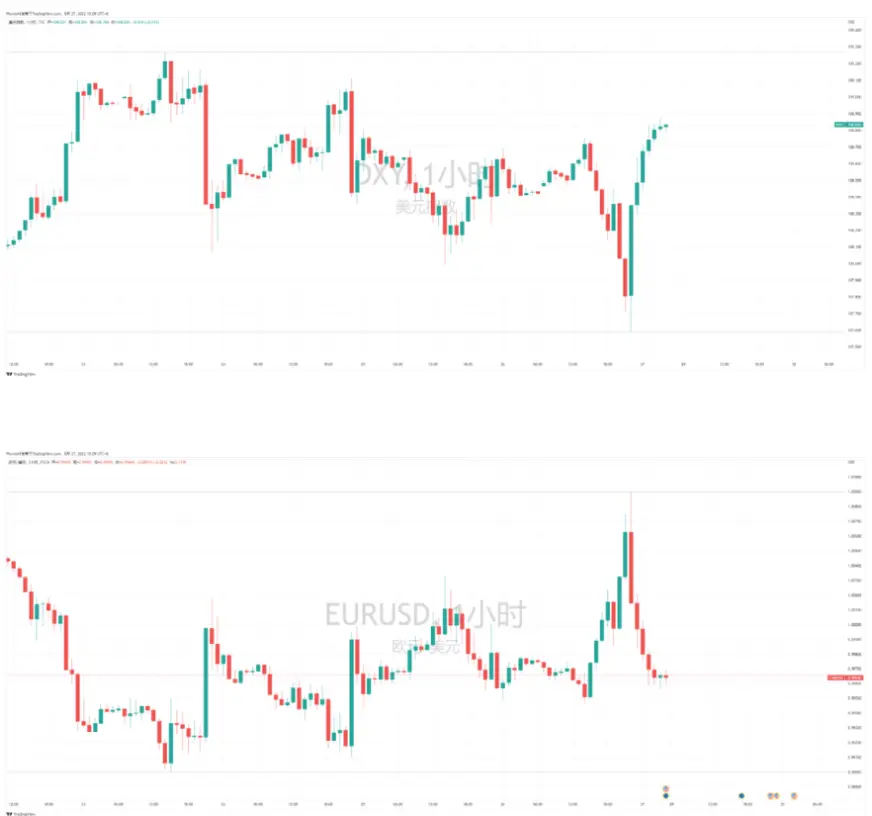
In particular, the trend of the dollar index showed a downward trend before Powell's speech, due to favorable PCE data, but after Powell's speech, a sustained decline in the euro exchange rate, due to expectations of continued high interest rates, caused the dollar index to rebound sharply, though it has not yet broken through 109, but it is not far behind. The continued rise in DXY has also limited the amount of money that can be put into risky markets. The stock market is still doing that, and the currency market is not going to be very good.
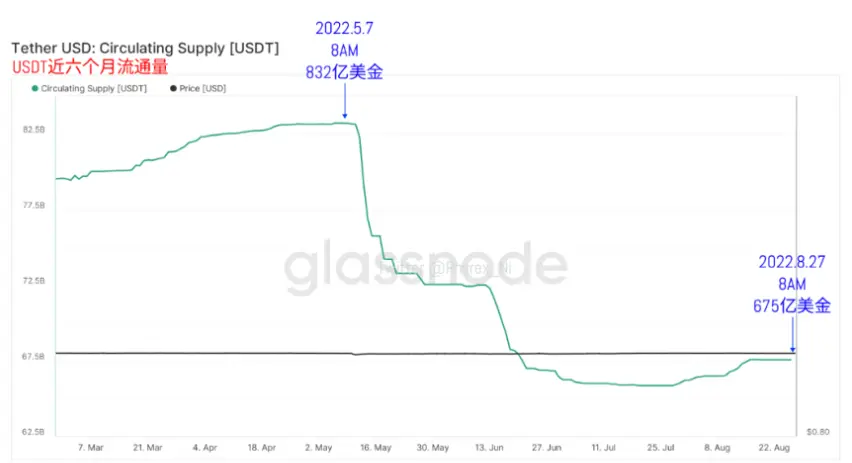
USDT's market capitalization has remained flat in terms of stablecoin funding, and as things stand, no worse news is good news. In particular, USDT remains the dominant force in currency trading, while USDT is held by more European and Asian investors. While this does not mean that more investors are on the sidelines, it does not mean that the current deterioration in macro sentiment has not yet affected these investors.
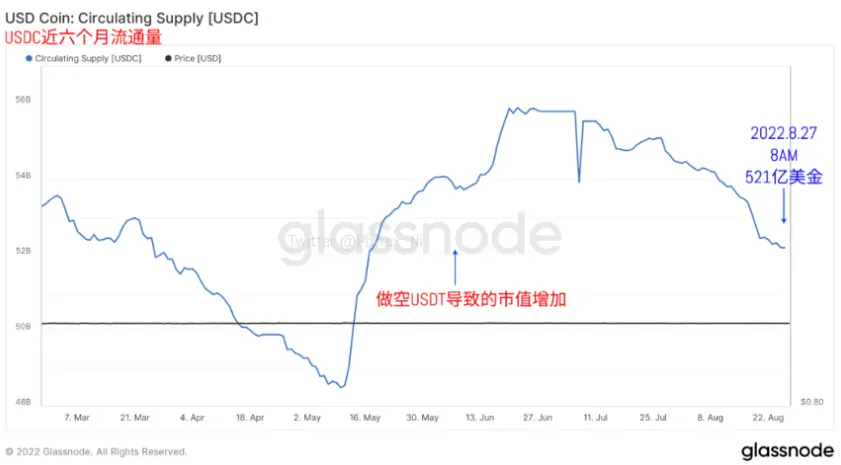
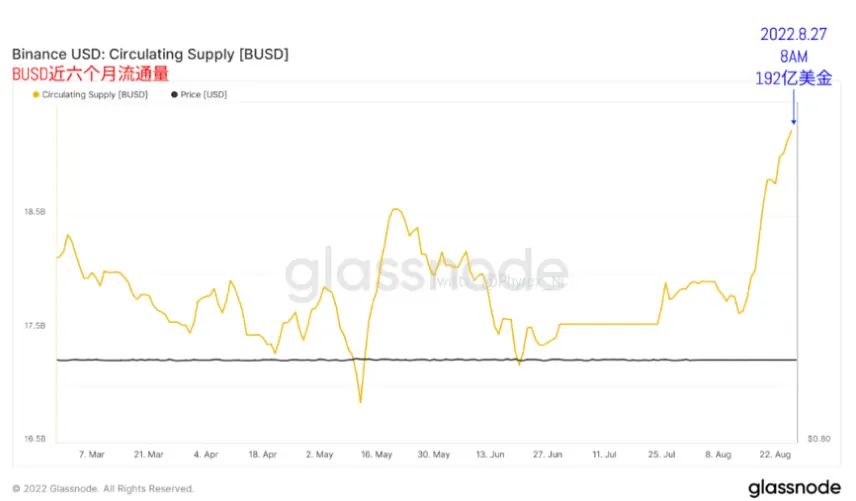
And USDC has continued the downward trend, although from the data up to 8:00 a.m. this morning, the downward trend is only about 7 million US dollars, not very high, but the corresponding increase in the market value of BUSD is more than 80 million US dollars, so the market value of the main stable currency not only did not fall, but also showed an upward trend, especially the recent increases are concentrated in BUSD.
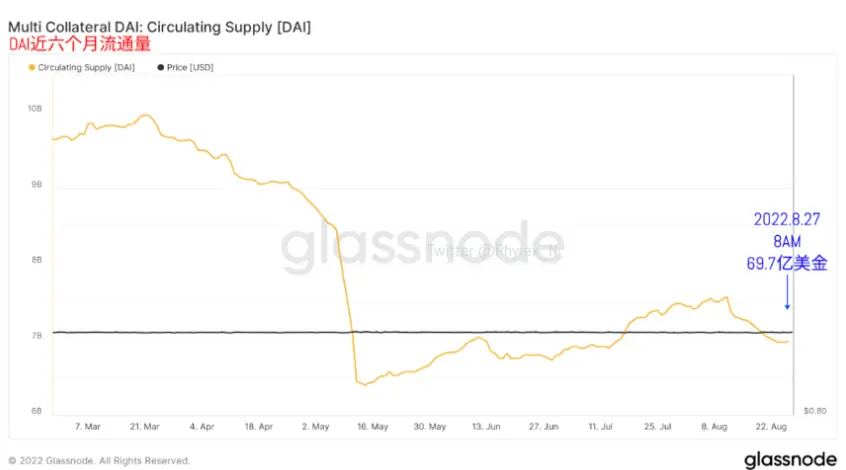
The increase of DAI market value shows that more ETH has started the pattern of spot leverage (circular arbitrage), and more holders think that the current price is already a relative low point, so they use low-risk spot leverage to increase the yield of the currency standard. As of 12:40 p.m. today, the Bitcoin position price distribution, from 23:00 p.m. yesterday after Powell spoke to the present data, shows that the BTC chain address change has had a big fluctuation. From the more detailed data, it can be seen that there is no excessive reaction in the extreme prices on both sides, although relative to the high hedge chips that continue to fluctuate at a low level, the position of the profit chips that have been holding positions for more than half a year has decreased somewhat. But over the course of more than 13 and a half hours, that's less than 1,100 units, or about 81 units per hour, which is nothing compared to yesterday's price moves. And for the earlier overall loss chips above $25,000, the total reduction was less than 6,900 BTCs, including about $29,000 for more than 4,100 BTCs at one time. The cross-comparison of the detail data revealed that the volatility was not a dumping of exchange data, nor a withdrawal of exchange data, but rather a cross-movement between exchanges. What is certain, then, is that not only did long-held chips not participate in the selling pressure; even the BTC, which has a position of more than a month, did not participate too much in the panicked selling. And even the ETH data are worth considering. Despite the sharp drop in prices, more selling pressure occurred during the main trading hours in the United States, and when time shifted to the Asian time zone, a drop in the selling pressure was clearly felt, while purchasing power continued to increase. Thus, the positive effects of ETH mergers are the main reason for maintaining purchasing sentiment, and there is no price collapse even when macro sentiment is negative. But, generally speaking, weekend price trends still can't be used as a yardstick for afternoon market prices without major capital and major selling pressure. The attitudes of Europe and the United States will still need to be considered on Monday afternoon and evening. However, judging from the current situation, weekend relative prices have stabilized and sentiment has improved somewhat





