
The new Bitcoin mining map continues to be led by the United States, Russia, and China, revealing the South American country's unstoppable rise.
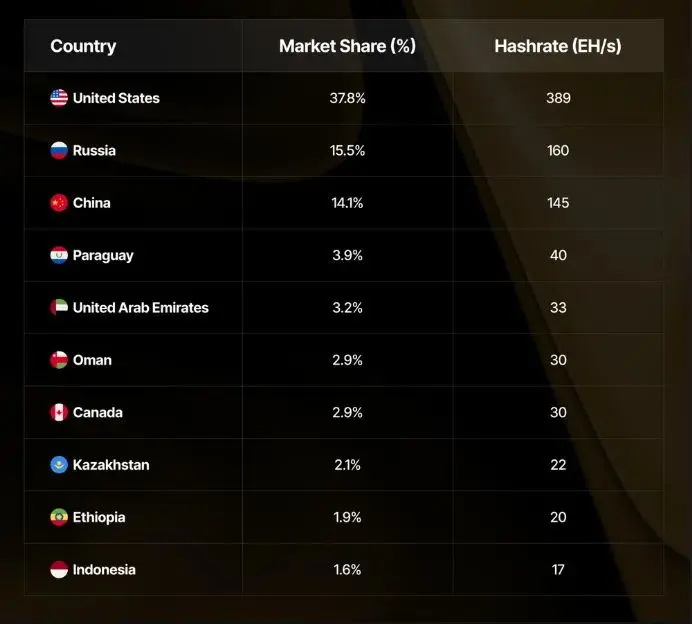
Paraguay is rapidly growing and has already joined the global Bitcoin mining elite, ranking in the top four worldwide. This rise, revealed by the latest global hashrate heat map compiled by Hashrate Index for the fourth quarter of 2025, places the South American country as a key player, handling nearly 3.9% of the global hashrate.
The new Bitcoin mining map shows a dynamic redistribution of power. Traditionally dominated by a few giants, the global scene has been witnessing significant changes in recent quarters.
Hashrate Index data monitors market share and hashrate in exahashes per second (EH/s) by country on a quarterly basis, providing a clear view of leading regions and those emerging as strong competitors.
This year's Q4 report highlights persistent geographic concentration, with just a handful of nations monopolizing the majority of global hashrate.
The United States remains in the lead with a crushing 37.8% (389 EH/s), followed by Russia with 15.5% (160 EH/s), and China, catching up, with 14.1% (145 EH/s). Together, these three titans account for approximately 67.5% of global hashrate.
However, the subsequent emergence of Paraguay with a robust 3.9% (40 EH/s) disrupts this panorama, relegating powers such as the United Arab Emirates (3.2%), Oman (2.9%) and Canada (2.9%) to lower positions.
Bitcoin mining gains momentum in Latin America
Comparing mining activity during the fourth and third quarters of 2025, it is observed that the United States boosted its share with an increase of 1.95 percentage points, solidifying its dominance.
In contrast, Russia experienced the steepest decline, losing 1.09 percentage points of its global market share. This persistent decline, while maintaining its second position in the global ranking, indicates that it is unable to match the pace of expansion of its main competitors.
Meanwhile, countries such as Laos (+0.22 pp), Bolivia (+0.21 pp), and Georgia (+0.17 pp) exhibited notable growth, albeit in smaller volumes.
As in early 2025, the United States continues to consolidate its position as the world leader in Bitcoin mining. Meanwhile, nations such as Paraguay, Oman, and Ethiopia have strongly entered the top 10, demonstrating a diversification in the distribution of mining power.
Latin America, led by Paraguay, is now positioning itself as a region of rapid growth in Bitcoin mining, challenging the established hegemony. As CriptoNoticias reported, the arrival of international companies highlights the attractiveness of the Paraguayan mining environment.
Recently, KULR Technology Group, a leading player in the aerospace energy industry, announced the deployment of 3,570 ASIC mining machines at its facilities in Asunción.
This operation increases its operating capacity to 750 petahash per second (PH/s) in Bitcoin mining, with an ambitious projection of reaching 1.25 exahash per second (EH/s).






