
An entire ecosystem is being built on top of Ampleforth behind the curtains. Those who don't have time to pay close attention to the roadmap, playbook, and semi-announcements will surely find the upcoming developments beyond exciting.
The idea of this is to enable Amplefore to be used as a core DeFi asset and enhance the industry on blockchains other than Ethereum.
Let's explore what's on Ampleforth's Roadmap in detail.
1. Liquidity - ✅
2020 was a year in which Ampleforth's Team focused on boosting its liquidity across the markets. Having a great depth of liquidity is extremely important as it allows traders to get in and out of AMPL easily. Without the liquidity, nobody would be able to make any reasonably sized trades with $AMPL.
Although still, it is far from liquidity depths, the $AMPL upward trend of liquidity deposits continues.
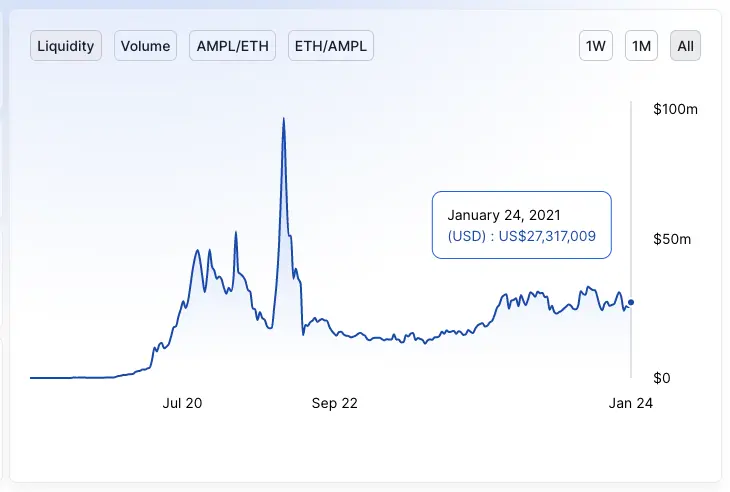
Through a series of liquidity mining incentives, the Ampleforth team have managed to achieve a liquidity level of around $27.3 million on the AMPL-ETH Uniswap pool;
The liquidity mining incentive programs, called Geysers, are designed to provide liquidity providers with AMPL rewards for depositing their assets in different pools.
It all started with the first Geyser, named Beehive 1.0, on June 23rd;
At that time, the liquidity in the Uniswap pool was underneath $500K. From there, it started to rise to break the $ 10 M liquidity level by July 12th quickly.
A couple of months later, the team announced that they had introduced nine new Geysers to boost liquidity on the Mooniswap AMM;
This Geyser was dubbed ‘Enceladus,’ and it was designed to help boost liquidity through pairs such as Chainlink, Maker, and Compound Finance.
The AMPL-ETH Mooniswap pool’s liquidity quickly started to rise to reach as high as $1.2M by the start of September.
Beehive 2.0 would come to life in September 2020, bringing the second wave of liquidity mining incentives for Uniswap liquidity providers.
In November 2020, the Ampleforth team announced the addition of three more Geysers.
One of the three new Geyser’s announced was the third round of Beehive 3.0, to continue to boost AMPL-ETH liquidity on Uniswap.
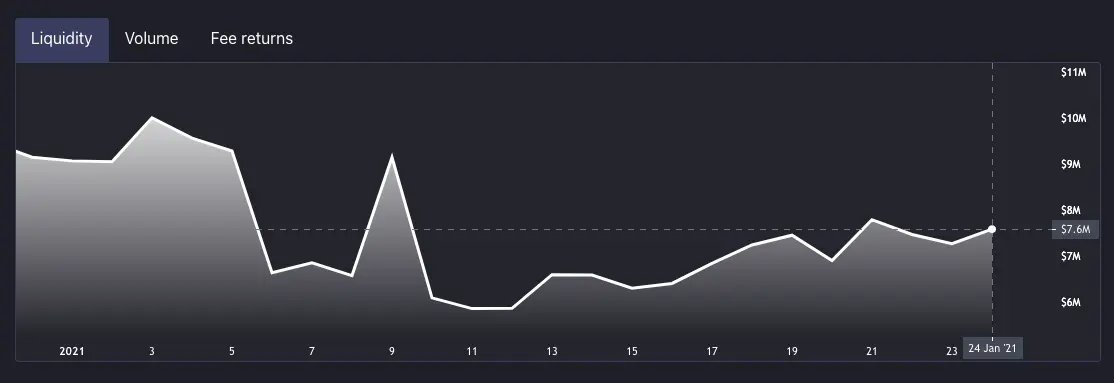
The second Geyser to be announced was dubbed Old Faithful V1, which was designed to bolster liquidity on the Balancer liquidity pool for AMPL/USDC;
The liquidity incentive worked, and there is still a total of $7.6M inside the AMPL-USDC liquidity pool on Balancer;
The final Geyser announced in November was called Pescadero V1, designed to bring liquidity to the AMPL-ETH pool on Uniswap;
The team is aggressively incentivizing liquidity for a specific purpose. They have an upcoming “special purpose AMM” on their roadmap, and I expect this to be a decentralized exchange that supports all kinds of elastic assets.

This would significantly help elastic tokens as it seems to be quite difficult for multi-variable assets (MVAs) to get listed on high profile exchanges as it requires a lot of customization relative to regular ERC-20 assets.
2. Lending ➡️
Lending is one of the core pillars of finance whether it's centralized or decentralized. With lending platforms such as Compound Finance and Aave both crossing a market cap of $1 billion, there is no doubt that this is where a large proportion of the DeFi money is heading to.
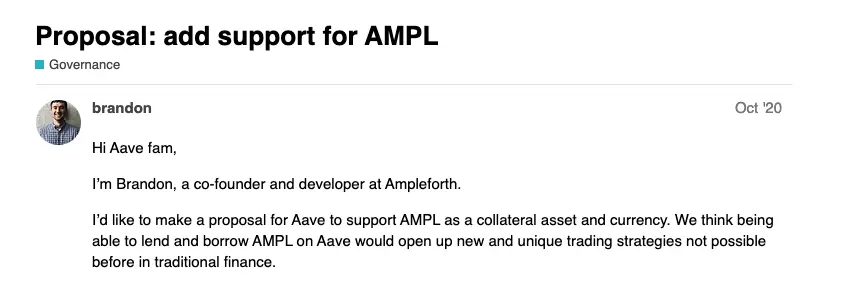
In October 2020, Brandon Illes, co-founder & developer of Ampleforth, proposed to add AMPL as asset collateral on Aave.
He proposed adding AMPL to the platform would open up new unique trading strategies that aren’t possible in traditional finance, or hell, I'd even say in DeFi even at the moment.
It seems that the proposal gathered a lot of traction, and it is a question of when, not if, it will be added to Aave. The team has already started working on the required aToken implementation and is conducting final testing on this.
Emilio Frangella, an Aave developer, also noted that AMPL is quite close to being listed on Aave;
In addition to this, there is already a Chainlink price feed in place for AMPL, so most of the moving pieces are in place for AMPL to be listed on Aave pretty soon.
Lending seems to be going further than just an implementation on Aave. For example, new lending platforms are building on top of the Ampleforth technology itself, such as the bubbling Yield Credit project.
Yield Credit offers individualized loans and borrowers are incentivized to repay their loan in time in order to earn YLD. One of their initial collateral options will be $AMPL.
3. Multichain ➡️
Another focus in the Ampleforth roadmap is to turn it into a multichain asset. In early December 2020, Ampleforth announced that it has plans to run $AMPL on top of three other blockchains: Tron, Polkato, and Near Protocol;
AMPL would still exist on the Ethereum blockchain, but the integration into these new blockchains would turn Ampleforth into a multichain asset, enabling an algorithmic stablecoin to be interoperable amongst a range of different blockchains.
It seems that other blockchains are excited to have AMPL on board with Justin Sun, CEO of Tron, saying the following about the integration;
“We expect deep liquidity pools to form early on in order to support widespread use for trading and collateral as soon as possible.”
It is expected that these integrations will occur slowly over the next few months.
4. Derivatives ➡️
The last focus on the Ampleforth roadmap is to do with being listed on different derivative exchanges.
For now, there only seems to be FTX (that is centralized) that supports perps on AMPL;
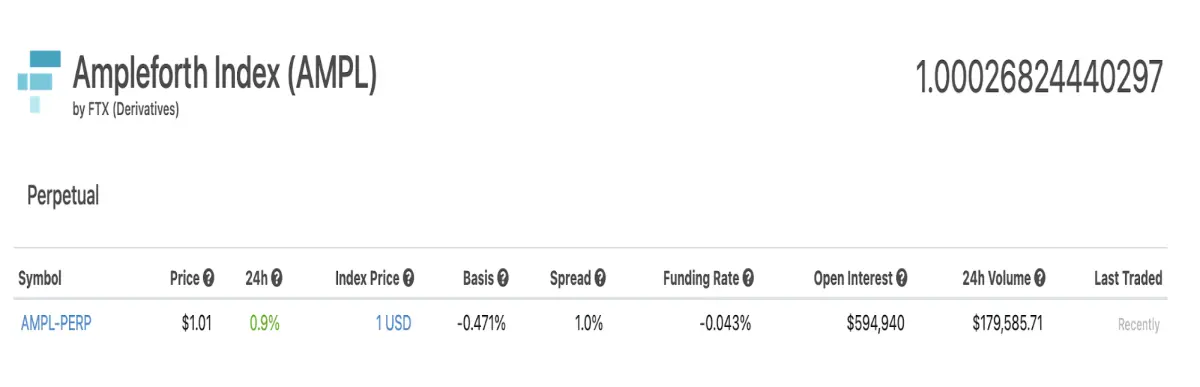
Source: CoinGecko
As mentioned, adding AMPL to exchanges has proven to be quite difficult due to the heavy customization it requires. This is because AMPL is a multi-variable asset that undergoes a rebase event every 24 hours.
It seems that exchanges had struggled to add Ampleforth, and FTX also had a little hiccup when they added it to their own exchange. It was listed on July 23rd, and a few users reported that the price of AMPL shot up to $13,000 - by accident. There was an error in the spot AMPL books, which translated over to the futures market, making many people think they were very rich overnight. However, any issue created was resolved very quickly.
The exchanges that have already managed to add Ampleforth through a very tricky method, which involves pausing withdrawals and trading around the rebasing period to conduct a daily manual rebalancing of everybody’s wallet holdings.
It would be exciting to see more exchanges thinking up new ways to add these elastic supply tokens on their exchanges in the future.






