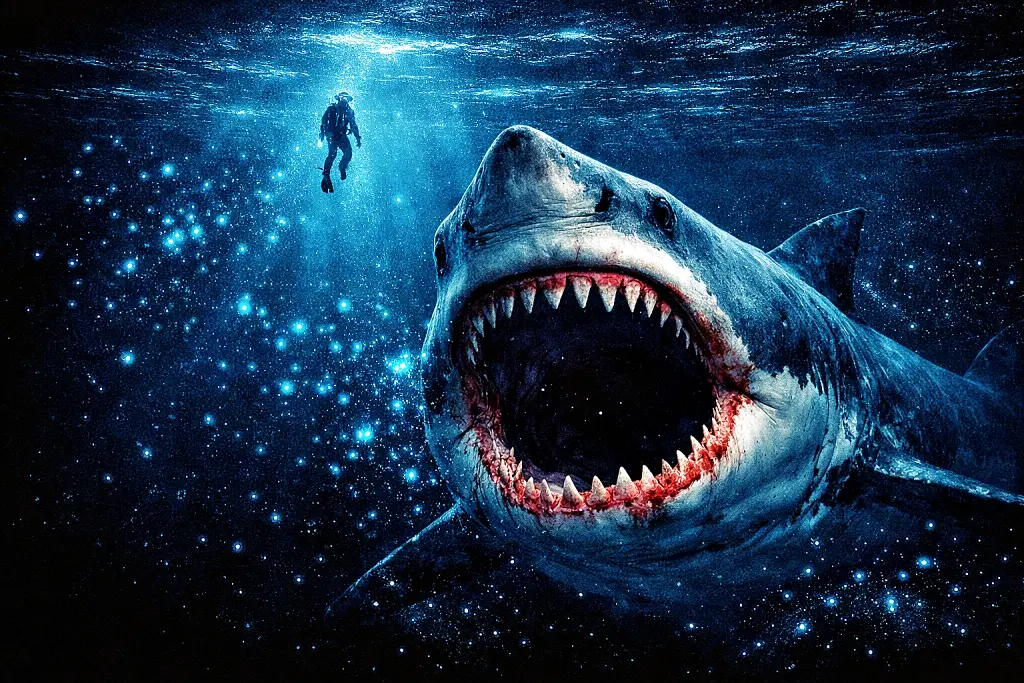
You’re in the ocean.
Not too far from shore.
Everything feels normal at first.
Then, for no clear reason, you get that weird feeling.
Like you’re not alone.
It’s probably nothing.
That’s what you tell yourself.
But your brain still goes there.
What if something is down there?
Something big. Something old.
Something like the Megalodon!
We’re told it’s extinct.
Gone millions of years ago. End of story.
Still… when you actually look at what this thing was, it’s hard not to pause for a second.
We’re talking about a predator with a bite force estimated around 18 tons.
Its teeth could grow bigger than a human hand.
Not just sharp but thick, built to handle bone.
This wasn’t just a large shark.
It was designed to take down whales.
And it didn’t always go straight for the kill.
Some researchers think it targeted fins first, basically trapping its prey before finishing the job.
That’s not just power. That’s strategy.
Now compare that to something like the Great White Shark.
Fast, efficient, already scary enough.
But next to Megalodon, it feels… smaller than you’d expect.
So how does something like that just disappear?
We call it extinction but a lot of the time that just means we stopped finding clear evidence.
It doesn’t mean we’ve checked every corner and confirmed it’s gone.
And honestly, we haven’t.
Most of the ocean is still unexplored.
Not “we haven’t looked closely” unexplored.
Actually unexplored.
There are depths we can’t reach properly, places where pressure alone would crush almost anything we send down.
If something wanted to stay hidden that’s exactly where it would be.
There have been odd things over the years.
Whale carcasses with bite marks that don’t quite match known predators.
Sonar readings picking up unusually large moving shapes.
People who spend their lives at sea saying they’ve seen something that doesn’t fit anything we’ve officially documented.
Is any of that solid proof? No.
But it’s also not something you can just completely ignore.
Some scientists even think predators like Megalodon may have pushed whales to evolve the way they did.
Bigger bodies, different behaviors, migration patterns.
Almost like an arms race we only see one side of now.
And that’s the strange part.
We’ve mapped parts of Mars better than our own oceans.
We can see galaxies millions of light years away.
But down here, on this planet, there are still places we barely understand.
So yeah, maybe the Megalodon is gone.
But if something like it wasn’t…
Would we really be the first to know?