Most days, technology feels invisible.
You wake up, check your phone, scroll a bit, maybe send a few messages.
Everything works so smoothly that you don’t think about what’s happening behind the scenes.
Internet, satellites, power grids, it all runs quietly in the background.
But recent reports are pointing to a risk that’s easy to ignore and hard to deal with.
A strong solar storm!
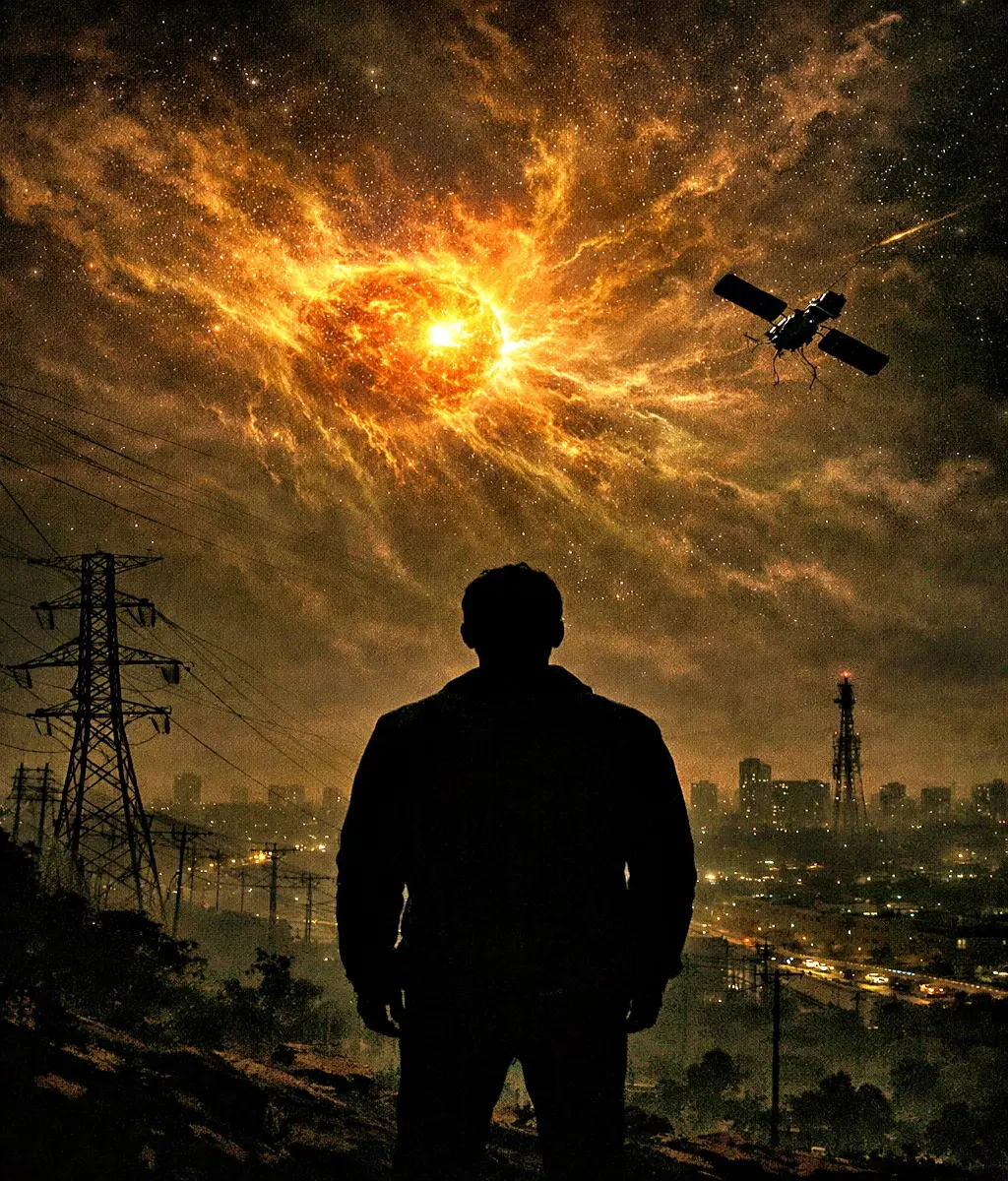
According to scientists and recent space weather reports, a worst-case solar storm could disrupt satellites, GPS systems and even large parts of the global power grid.
This isn’t a distant theory.
It’s a known risk that becomes more relevant as our dependence on technology grows.
Naturally, the first question is simple.
When could this actually happen?
No one knows.
Solar activity follows an 11-year cycle and we are currently in a more active phase.
That increases the chances of stronger solar events but it doesn’t make them predictable.
A major storm could happen this year or years from now.
What scientists agree on is not the timing but the certainty.
At some point, it will happen again.
We’ve already seen it once.
In 1859, the Carrington Event hit Earth with unexpected intensity.
Telegraph systems failed, equipment sparked and operators reported behavior they couldn’t explain at the time.
That was in a much simpler world.
Today, the situation is very different.
Modern infrastructure depends on a constant flow of electricity and data.
Satellites manage communication and navigation.
GPS systems support transportation, logistics and everyday smartphone use.
Power grids keep entire cities functioning.
So what would a similar event look like now?
A powerful solar storm wouldn’t need to destroy anything to cause serious disruption.
Interference alone could be enough.
Satellites could be affected.
Navigation systems could lose accuracy.
Power grids could experience outages in certain regions.
And while the storm itself might only last hours or a few days, the effects could last much longer.
Power systems don’t always come back instantly.
Satellite issues can take time to resolve.
Recovery depends on how widespread the impact is.
That’s what makes this different.
The event is short.
The consequences are not.
Unlike cyberattacks or technical failures, this is not something that can be stopped once it begins.
At best, systems can be prepared and damage can be reduced.
But the event itself cannot be avoided.
That’s why this topic is getting renewed attention.
As global systems become more connected and more dependent on real-time data, the potential impact of a large-scale disruption increases.
What once affected a single technology like the telegraph could now affect multiple layers of modern life at the same time.
The internet, navigation, communication, even parts of the power infrastructure.
Not everywhere and not permanently.
But enough to make the dependency visible.
We tend to think of modern technology as stable and reliable but in reality,
it relies on multiple systems working together without interruption.
A solar storm is one of the few natural events that can test all of them at once!