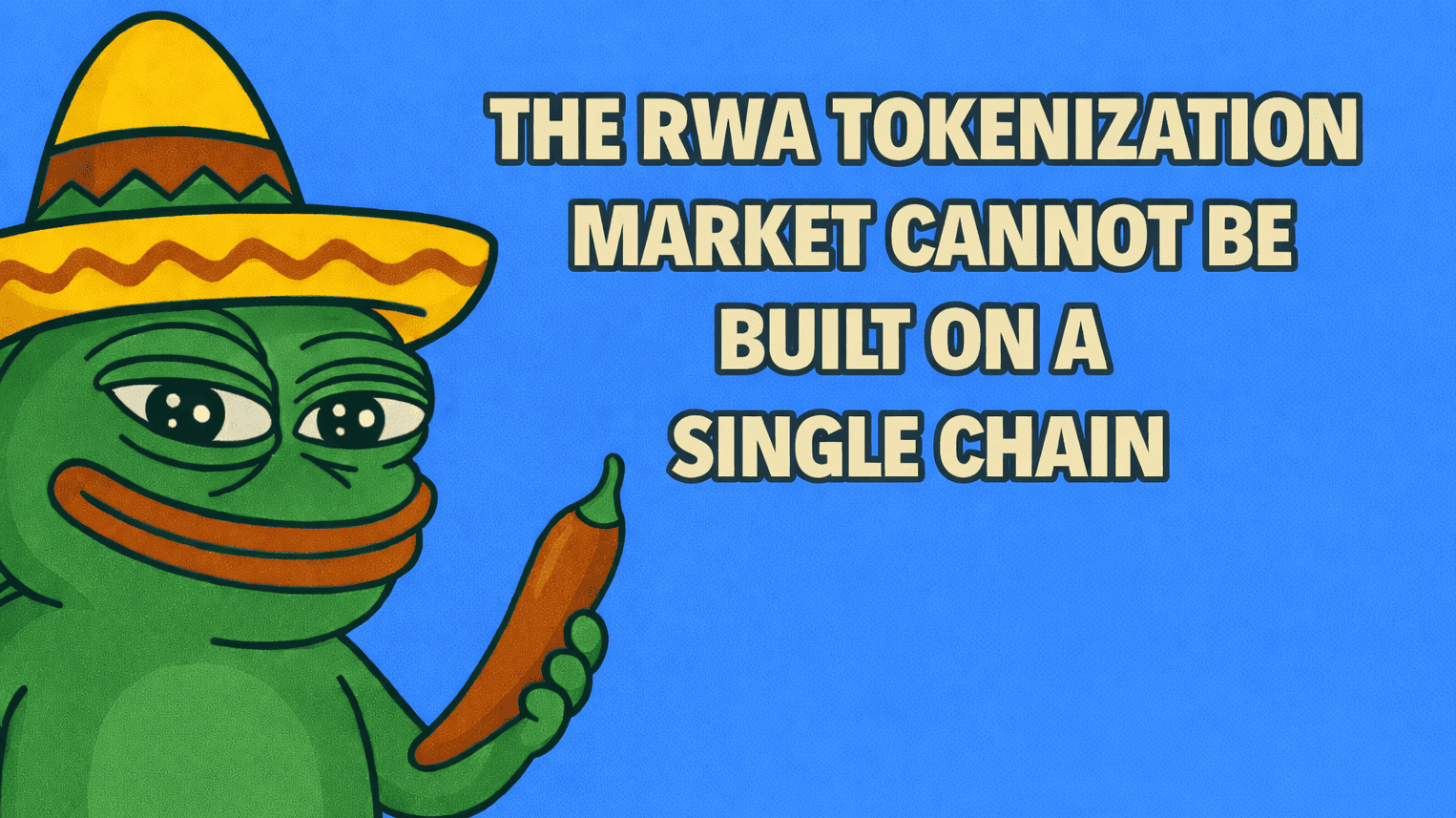
Recently, Rob Hadick, a partner at the venture capital firm Dragonfly, shared an insightful perspective on the future direction of the asset tokenization market. His core argument is simple. Real world asset (RWA) tokenization will not evolve into a structure dominated by a single blockchain. Instead, it will inevitably grow into an ecosystem where multiple blockchains share roles based on their respective strengths.
This view becomes intuitive once the nature of the RWA market is properly understood. Asset tokenization refers to the process of bringing real world assets such as bonds, equities, and real estate onto the blockchain in a tradable form. Unlike DeFi or NFTs, which largely operate within a relatively closed crypto native environment, RWA directly interfaces with the traditional financial system. As a result, the requirements placed on the infrastructure are far more complex.
The sheer scale of the RWA market makes it unrealistic for a single blockchain to handle on its own. The global bond market alone far exceeds the total market capitalization of the entire crypto market today. To move assets of this magnitude on chain, fast transaction processing is not enough. The system must simultaneously support high performance throughput, low fees and deep liquidity, long term asset security, and most importantly a structure capable of accommodating regulatory and legal requirements.
The problem is that it is extremely difficult for one blockchain to satisfy all of these conditions at once. Prioritizing security and decentralization inevitably introduces constraints on speed and cost, while maximizing performance and user experience often requires trade offs in security architecture or consensus stability. Given these unavoidable technical trade offs, role specialization is not a choice but a structural necessity.
This is where the positions of Ethereum and Solana naturally diverge. Ethereum functions as something close to the final ledger in the asset tokenization environment. This is not because it is the fastest chain, but because of its long established security, credibility, and institution friendly ecosystem. The fact that most major stablecoins are either issued on Ethereum or maintain their deepest liquidity there is highly symbolic. Stablecoins are the core settlement asset for tokenized asset trading, and Ethereum serves as the base layer where those settlements ultimately finalize.
Ethereum has deliberately chosen stability over speed. For institutions handling hundreds of millions or even billions of dollars in financial assets, this trade off is critical. Assets that demand absolute trust such as government or corporate bonds, high value financial products intended for long term custody, and record systems that require globally recognized security standards align precisely with Ethereum’s strengths.
Solana, by contrast, is a chain focused on how assets are actually traded. If Ethereum is the vault that preserves asset authenticity and trust, Solana is closer to the exchange and execution layer where those assets actively circulate in the market. For the RWA market to function in practice, secondary markets after issuance are essential. Solana is optimized for this role through fast confirmation times, low fees, and an architecture that remains stable even under heavy concurrent user activity.
Because of these characteristics, Solana is well suited for products targeting retail investors, services with high transaction frequency, and financial applications where user experience is critical. This is not a question of superiority over Ethereum, but rather one of serving different functional layers within the same system.
Ultimately, the RWA market is evolving toward division of labor rather than direct competition. Ethereum provides the foundational financial infrastructure that proves and securely preserves asset value, while Solana offers the execution environment that enables those assets to be actively traded and utilized in real markets. One operates as a layer of trust, and the other as a layer of liquidity.
This is precisely why Rob Hadick’s analysis is compelling. Asset tokenization is not a market that will be decided by raw performance competition among chains. It is far more likely to grow through a structure in which each blockchain maximizes its strengths while complementing the weaknesses of others.
Ethereum and Solana are not positioned to replace one another. Instead, they are increasingly likely to coexist as complementary pillars supporting an ever more complex on chain financial system. This shift signals that the blockchain industry is moving beyond experimental technology and maturing into a specialized and functional extension of the real financial system.