
Something big just happened in US crypto regulation, and most traders are underreacting. The Office of the Comptroller of the Currency just moved crypto one step closer to the core of the US financial system, with conditional approvals that look a lot like the first wave of crypto “banks.”
This matters now because stablecoins are becoming payment rails, not just trading tools. And when regulators bless infrastructure, capital tends to follow. Quietly at first, then all at once.
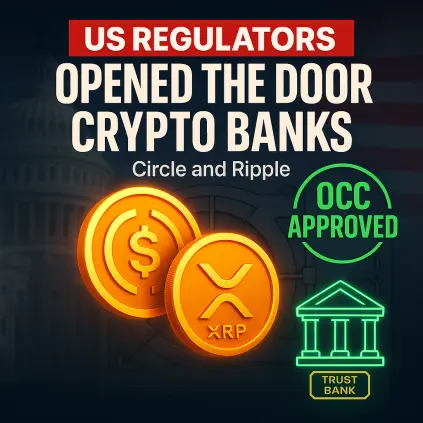
On December 12, 2025, the OCC granted conditional approvals tied to national trust bank charters for five major digital asset firms. The names are the headline: Circle, Ripple, BitGo, Fidelity Digital Assets, and Paxos.
Two key details most people miss:
• These are trust banks, not full service banks.
They generally cannot take deposits or make traditional loans.
• But they can do the money plumbing work.
Custody, settlement services, stablecoin related fiduciary activity, and institutional grade rails are the real prize.
Anchorage Digital has been the exception in prior years. Now the exception is becoming a category.
Why Regulators Picked the Trust Bank Route
This is the compromise path.
Regulators want stablecoins and crypto custody inside a supervised perimeter, but they do not want to hand out full banking privileges like deposit taking. Trust charters create a lane where crypto firms can be examined, capitalized, and governed like financial institutions without turning them into universal banks. Bank Policy Institute
It also fits the post GENIUS Act world, where stablecoin issuers are being pushed toward clearer compliance standards, including Bank Secrecy Act obligations and tighter reserve expectations. The White House
What This Signals to the Market
Markets do not just price news. They price second order effects.
Here is what this move is really signaling:
• Stablecoins are being treated like strategic infrastructure
Not a side quest for crypto traders, but a financial primitive.
• The US is choosing integration over exclusion
Not by letting everything fly, but by building a regulated box and inviting big players into it. Reuters
• Competition is about to get real
The OCC itself framed the approvals as pro competition. Meanwhile banking lobby groups are already pushing back, which tells you incumbents feel threatened. Axios+1
Who Benefits and Who Gets Squeezed
This is where it gets tradable.
Potential winners:
• Regulated stablecoin issuers
A charter can make counterparties more comfortable holding and integrating your stablecoin. Axios
• Institutional custody and settlement providers
Fidelity Digital Assets and BitGo getting closer to national status matters for mandates that require regulated custody. OCC.gov
• Payment networks built around stablecoins
When stablecoins move from exchanges into payroll, remittances, and merchant settlement, the total addressable market expands.
Potential losers:
• Unregulated yield games and offshore gray zones
Capital prefers compliant rails when the rules are clear.
• Banks that relied on slow rails as a moat
Faster settlement and programmable money compress fees over time.
Picture the market mood for the last two years.
Every rally ran into the same wall: “Sure, but regulators will crush it.” That fear created a very specific psychology: traders chased pumps, but long term capital stayed cautious.
Now flip the script.
A trust bank charter is not a meme. It is a permission slip that changes boardroom conversations. The real narrative shift is this: crypto firms are no longer asking to be left alone. They are asking to be supervised, so they can scale.
And supervision is exactly what institutions need to go from “small allocation” to “core infrastructure.”
A few numbers frame why this is happening now:
• Stablecoins hit roughly $300 billion in 2025
That is big enough to matter to policymakers and payment incumbents. Morgan Stanley
• USDC sits around the high $70 billions in market cap recently
Meaning it is not just a product, it is a system. metamask.io
• Tether USDT supply is about $185 billion
The stablecoin race is already at nation scale, and regulators know it. Financial Times
• Bitcoin is trading around $90,395 and Ethereum around $3,122 today
This backdrop matters because regulatory clarity tends to have the most impact when the market is already liquid and attention is high.
A realistic scenario investors should consider:
If regulated trust banks become the default stablecoin issuers and custodians for US institutions, then stablecoin velocity rises. More stablecoins moving through compliant rails means more onchain settlement demand, more exchange liquidity, and tighter integration with traditional finance workflows.
That is not a straight line to higher prices tomorrow. But it is a straight line to a larger crypto economy over the next cycle.
• It de risks part of crypto’s core business model
Custody and payments are foundational. If those become regulated and normalized, the ceiling rises. OCC.gov
• It changes the exit plan for institutions
Many funds want exposure but need compliant counterparties to sleep at night.
• It reframes the stablecoin narrative
From “exchange chips” to “digital dollars with regulatory wrappers.” Latham & Watkins
What Comes Next
The approvals are conditional, which means the real work starts now.
Watch for:
• Final OCC sign offs after capital, governance, and risk controls are proven Axios+1
• More applications from payments firms and crypto native infrastructure players
• Public fights with banking lobby groups escalating as the category grows ABA Banking Journal
Key Levels to Watch
Even though this is regulatory news, price still decides sentiment.
Bitcoin levels to watch near current price:
• $92,500 as the near term reclaim zone
• $89,500 as the line that separates dip buyers from panic sellers
• $88,000 as the deeper support area if risk off accelerates
Ethereum levels to watch:
• $3,250 as the bounce confirmation area
• $3,050 as the support that cannot break if ETH wants momentum back
Risk Factors
Do not ignore these:
• Conditional approval is not final approval
Firms must meet conditions and the timeline can stretch. Reuters
• Regulatory backlash is real
Banking groups are already arguing that trust charters create uneven standards. ABA Banking Journal
• Market risk still dominates in the short run
Even the best regulatory news gets sold off during macro stress or leverage flushes.
This is not just a headline about Circle or Ripple. It is the US quietly building a regulated crypto banking lane where custody and stablecoin infrastructure can scale nationally without pretending to be traditional deposit banks. If you have been waiting for a moment where regulation stops being pure downside risk and starts becoming an adoption catalyst, this is one of the clearest signals yet. OCC.gov
Not financial advice. Just the map.
Do you think trust bank charters will make stablecoins explode into mainstream payments, or will banking lobby pressure slow this down before it really takes off?






