Updated: 3 November 2026. Model names change fast, so check the date before you rely on any name below.
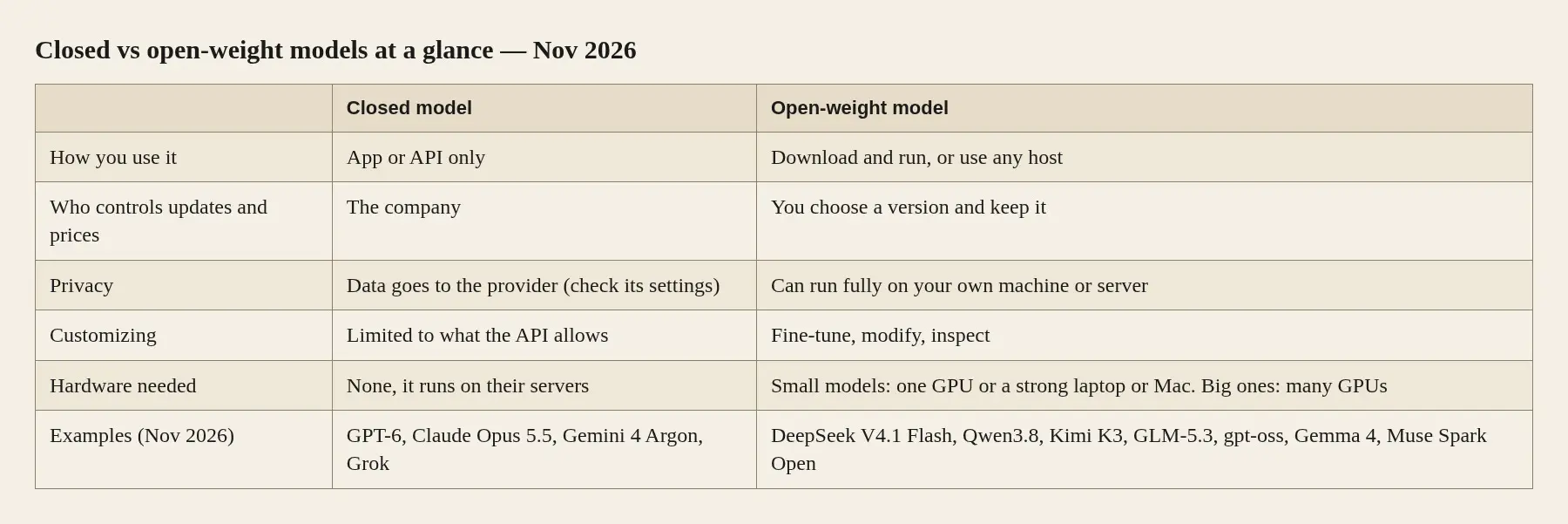
A closed AI model is one you rent. You use it through an app or an API, and the company keeps the weights. An open-weight model is one you can download and run yourself, under a license.
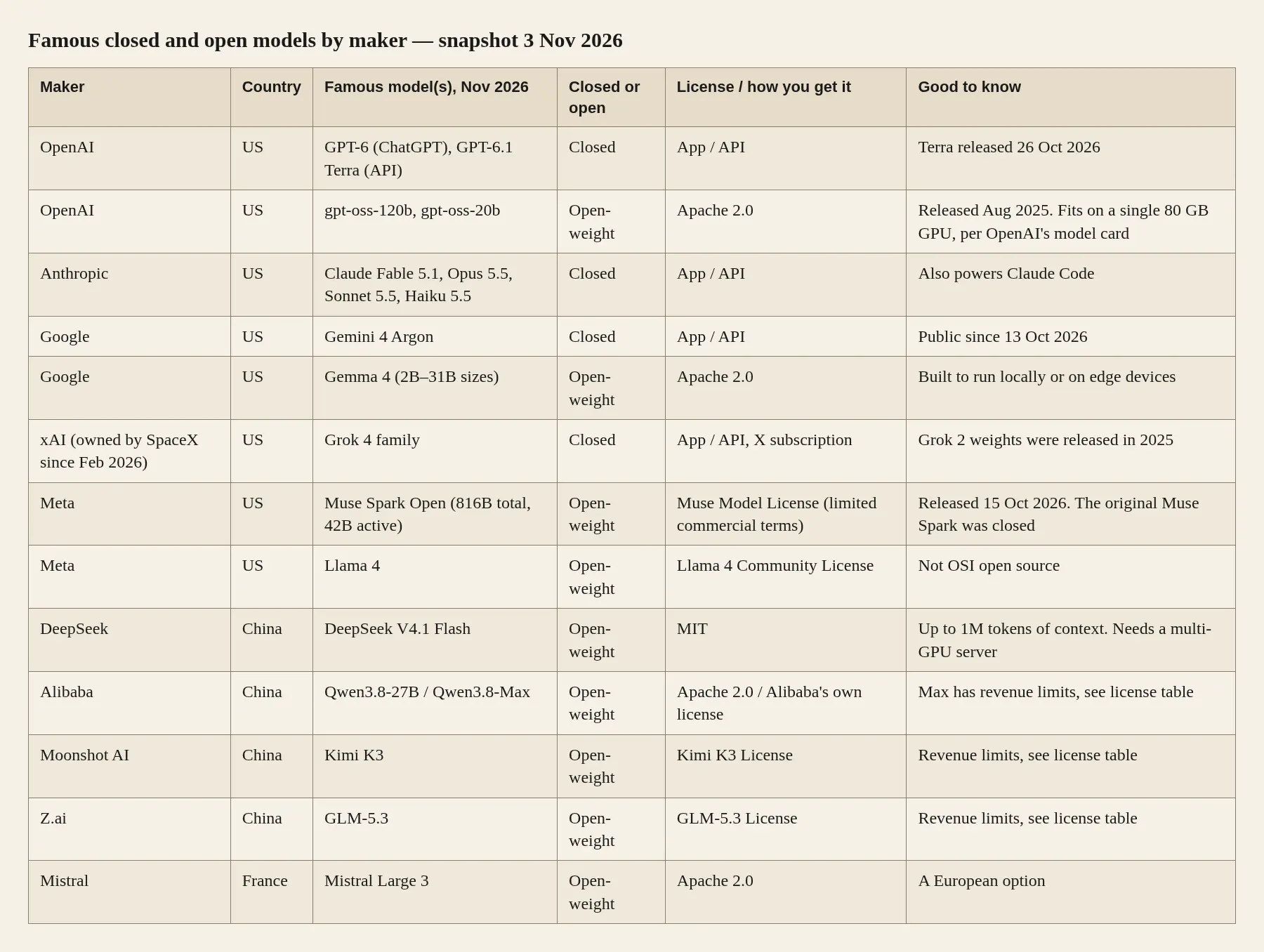
Here is the short version for November 2026. The famous American models most people use every day (GPT, Claude, Gemini, Grok) are closed. The strongest open-weight models mostly come from Chinese labs (DeepSeek, Qwen, Kimi, GLM). America has open models too: OpenAI’s gpt-oss, Google’s Gemma 4, Meta’s Muse Spark Open and Llama 4. Below is the whole picture in one place.
What is the difference between a closed and an open AI model?
The difference is who holds the model’s “brain file”. An AI model’s knowledge lives in its weights: billions of numbers it learned during training.
With a closed model, the weights stay with the company. You get access through its app or API, on its terms and at its prices.
With an open-weight model, the weights are published. Anyone with enough hardware can download the model, run it privately, change it, or host it for others, within the rules of its license.
An analogy, and only an analogy: closed is like streaming a movie. Open-weight is like owning the file. But owning the file does not mean you get the script and the raw footage. That deeper level is what “open source” means, and we will get to it next.
Is “open-weight” the same as “open source”?
No. Most “open” models are open-weight. True open-source AI also shares the training code and enough information about the training data to rebuild the model.
The Open Source Initiative (OSI) set the bar in its Open Source AI Definition 1.0. It asks for four freedoms: to use, study, modify and share the model, for any purpose. It also asks for information about the data, the complete code for training and running, and the parameters (the weights).
Very few models meet that bar. Nathan Lambert at Interconnects names Ai2’s Olmo, Marin and EleutherAI’s Pythia as fully open examples. He also points out that openness is a spectrum. Nvidia’s Nemotron, for example, shares a lot of its training data, but not all of it.
Licenses matter here too. Meta’s Llama 4 weights are downloadable, but its community license is not recognized by OSI as open source. It has a threshold of 700 million monthly active users, and its multimodal models exclude users based in the EU (as reported by the Kasimir blog).
Which famous AI models are closed and which are open?
At the top, US models are mostly closed, with a growing shelf of open ones. Chinese labs lead in open weights. This table is a snapshot as of 3 November 2026.
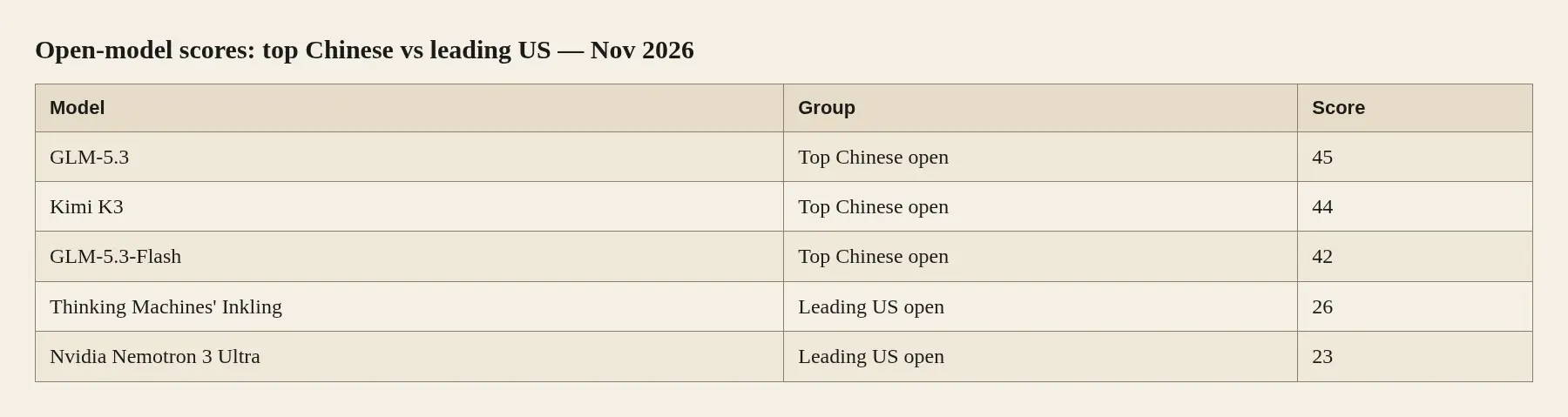
A note on rankings. On the Artificial Analysis index, Interconnects reported GLM-5.3 (score 45), Kimi K3 (44) and GLM-5.3-Flash (42) as the top Chinese open models, and Thinking Machines’ Inkling (26) and Nvidia Nemotron 3 Ultra (23) among the leading US open models. That snapshot is from 14 September 2026, before Muse Spark Open launched. Treat it as one author’s dated picture, not a fixed ranking.
Why are China’s best-known models open while America’s are mostly closed?
This part is analysis, not settled fact. The big US labs make money by renting their best models through apps and APIs, so they keep those weights closed. Chinese labs have used open weights to win adoption around the world.
Lambert at Interconnects says Chinese companies have been the clear leaders in open-weight models since about April 2025. His figures, from September 2026:
China passed the US in Hugging Face downloads in July 2025, mostly thanks to Qwen.
On OpenRouter, open-model usage grew from about 1 trillion to about 80 trillion tokens per week, and Chinese models went from about 70% to over 80% of that.
US companies building on Chinese open models include Harvey, Cursor, DoorDash (Kimi), Airbnb (Qwen) and Perplexity (DeepSeek).
His estimate of the gap: Chinese open models trail the closed US frontier by about 2 to 5 months. US open models trail by about 6 to 9 months.
These are one author’s estimates, and they are worth reading as such.
The US open shelf is growing. Meta released Muse Spark Open in October 2026, Google moved Gemma 4 to Apache 2.0, and OpenAI has gpt-oss. But the top of the US market is still closed.
For users anywhere in the world, the practical point is simple: the best free-to-download models right now are mostly Chinese, and the best rented models are mostly American.
What does “open” let you do that “closed” does not?
Open lets you run the model privately, keep a fixed version, fine-tune it, and avoid per-message pricing. The trade-off: you need hardware, and you must read the license.
Privacy. The model can run where your data lives. Nothing has to leave your machine or server.
Control. No surprise retirements. For contrast, OpenAI retired GPT-5.5 from ChatGPT on 14 October 2026. With open weights, the version you downloaded stays the version you have.
Cost. You pay for your own compute or a cheap host instead of a subscription. Whether that is actually cheaper depends on how much you use it.
The license traps. “Open” does not always mean “free for any use”. Some concrete examples:
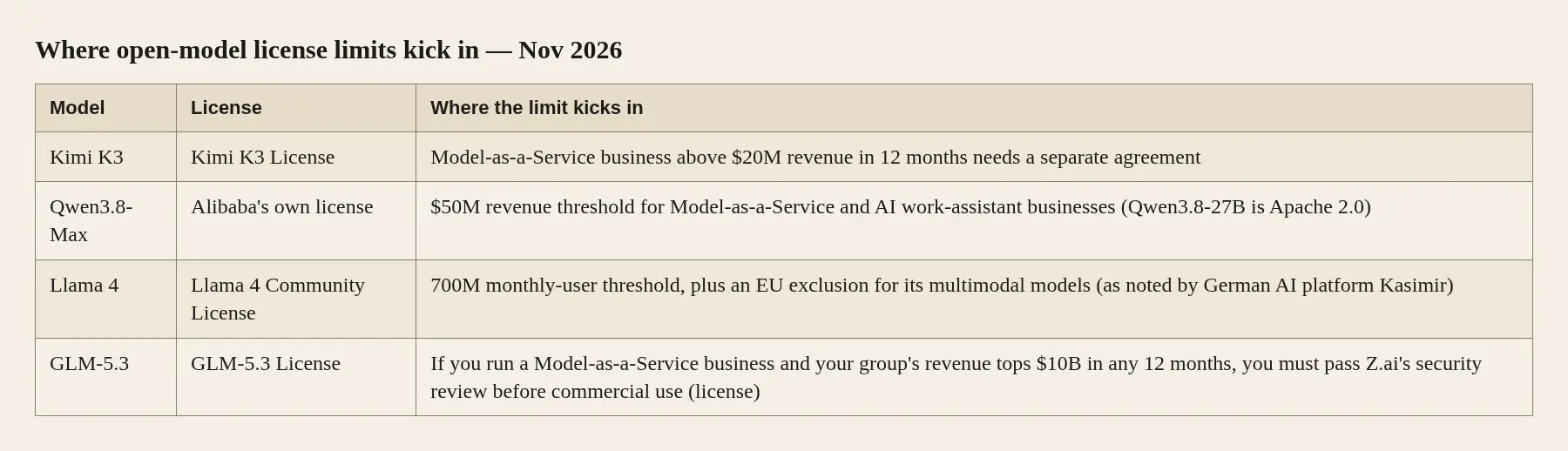
The best advice here comes from Kasimir: read the LICENSE file in the model’s repository, not the press release.
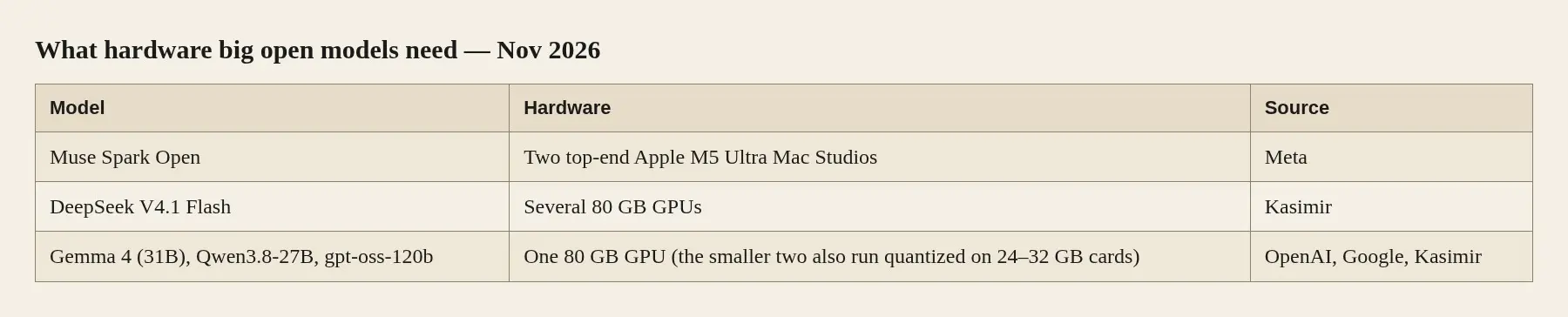
The hardware reality. The biggest open models need serious machines. Meta says Muse Spark Open runs on two top-end Apple M5 Ultra Mac Studios. DeepSeek V4.1 Flash needs about seven 80 GB GPUs, according to Kasimir. Smaller models such as Gemma 4, Qwen3.8-27B and gpt-oss-120b fit on a single card.
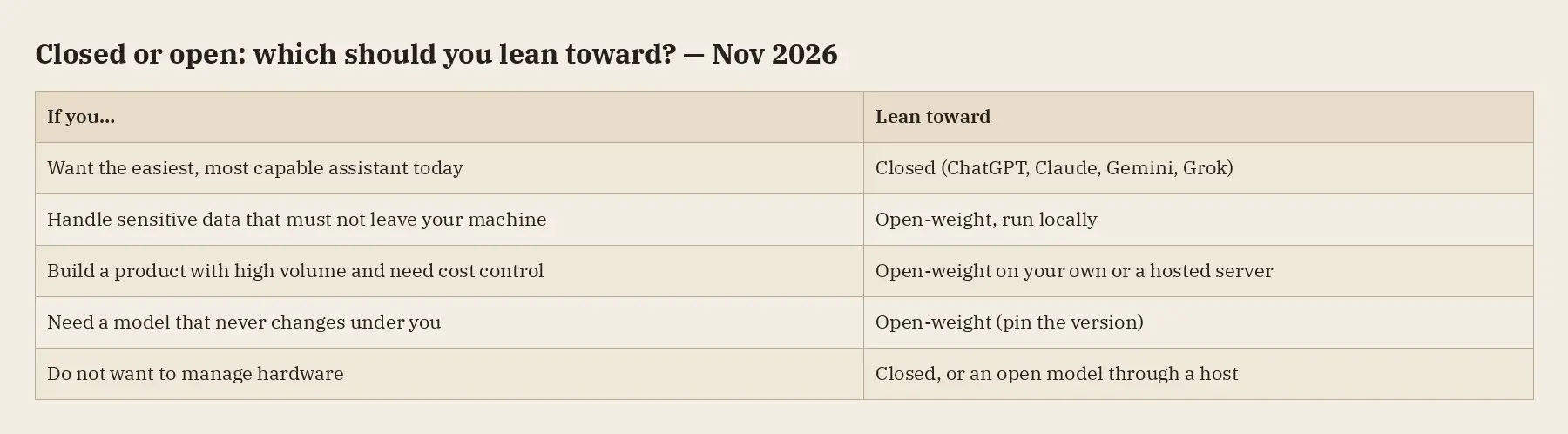
Which should you use: closed or open?
Most people should start with a closed app. It is the easiest path and the most capable today. Choose open when privacy, cost at scale, or control really matters to you.
You also do not have to pick only one. Many tools now mix both. Cursor’s model list, for example, puts Claude, GPT, Gemini and Grok next to DeepSeek, Kimi and GLM.
FAQ
Is ChatGPT open source? No. ChatGPT runs on closed models (GPT-6). OpenAI’s open-weight models are gpt-oss-120b and gpt-oss-20b, under Apache 2.0.
Is DeepSeek open source? DeepSeek V4.1 Flash is open-weight under the MIT license. Like most open-weight models, it is not the same as fully open source in the OSI sense, so check each release page for what is shared beyond the weights.
Is Llama still open? Llama 4 weights are downloadable under Meta’s community license, which OSI does not consider open source. Meta’s newer open-weight release is Muse Spark Open, from October 2026.
Can I run an open model on my laptop? Small ones, yes, such as the smaller Gemma 4 sizes. Frontier-size open models need servers or several high-end machines.
Are Chinese open models safe to use? The weights run wherever you run them. If you host them yourself, your data does not go to the maker. Check the license and your company’s policy before you use one.
Which is better, open or closed? The closed US frontier still leads. Lambert estimates the best open models trail it by roughly 2 to 5 months.
The takeaway
Closed means you rent the model. Open-weight means you can hold it. In November 2026, the famous American models are mostly closed, the strongest open models are mostly Chinese, and the US open shelf (gpt-oss, Gemma 4, Muse Spark Open) is growing. Whichever you pick, read the license.
About Me

I’m Darlin Baje, a Filipina AI engineer. I make my way around the world while I work in the middle of the AI shift: clear explanations, practical tools, and systems that help people without the hype. I use AI for everything — automations, email, shopping, cleaning, booking flights, and agents that run my life. Everything starts with a conversation — contact me. www.darlinbaje.com
Further reading