
SEO is how you get found in search results. AEO (answer engine optimization) is how you get your content used as the answer in tools like Google's AI Overviews and chatbots. GEO (generative engine optimization) is a research term for the same goal: getting cited inside answers that AI writes.
For a small business, the good news is this. Google says its AI features don't need any special tricks. The same SEO basics still apply. On top of that, write clearly and put the answer first, so an AI can quote you in one clean paragraph.
I'm Darlin Baje, an AI engineer. I write my own posts answer-first for exactly this reason, and this one follows the same format.
What do SEO, GEO, and AEO mean?
SEO (search engine optimization) is the work of helping search engines find, understand, and show your pages. AEO (answer engine optimization) is an industry term for shaping content so that AI tools and answer boxes pick it as the direct answer to a question. GEO (generative engine optimization) comes from a 2023 research paper by Aggarwal and colleagues, and it means getting content to appear and be cited in answers written by generative AI.
All three are about being found. The two newer ones care more about being quoted by an AI than being clicked in a list.
The three acronyms side by side.

The GEO paper, "GEO: Generative Engine Optimization", is by Pranjal Aggarwal, Vishvak Murahari, Tanmay Rajpurohit, Ashwin Kalyan, Karthik Narasimhan, and Ameet Deshpande. It was first posted to arXiv on 16 November 2023. Nobody has clearly established who first used "AEO", so I won't name anyone.
Are AEO and GEO different from SEO?
Mostly, no. They are a writing style and a shift in focus that sits on top of SEO. They don't replace it.
Google is direct about this for its own AI features. Its Search Central guidance says: "There are no additional requirements to appear in AI Overviews or AI Mode, nor other special optimizations necessary." It also says SEO best practices remain relevant for those features.
The difference is in the question you ask yourself:
SEO asks: "Will they click me?"
AEO and GEO ask: "Will the AI quote me?"
Either way you need pages that can be indexed, are trustworthy, and are easy to understand.
My reading is that AEO and GEO are mostly industry labels for the same thing: answer-first content that's easy to cite. For Google at least, good SEO already covers its AI features.
What does Google say about ranking in AI Overviews and AI Mode?
Make sure your pages are indexed and can show with a snippet. Follow the SEO basics. Write helpful content for people. You don't need special files or schema.
Here is what Google's guidance on AI features says, in plain terms:
Eligibility is simple. To appear as a supporting link in AI Overviews or AI Mode, a page has to be indexed and eligible to show in Google Search with a snippet. Google says there are no extra technical requirements.
No special files. You don't need new machine-readable files, "AI text files", or extra markup. There's also no special schema.org structured data to add.
Query fan-out. AI Overviews and AI Mode may run several related searches across subtopics. So a page that answers a sub-question clearly can still be linked, even if it isn't the main result.
AI Overviews don't always show. Google shows them only when it thinks they add something, and says they often don't trigger.
The fundamentals still matter. - Crawling: allow it in robots.txt and your CDN. - Internal links: use them. - Page experience: give people a good one. - Text: put important content in text. - Media: back it up with quality images and video. - Structured data: keep it matching the visible text. - Listings: keep your Merchant Center and Google Business Profile up to date.
Google's separate guidance on helpful content adds the trust layer. Its systems prioritise helpful, people-first content. E-E-A-T stands for experience, expertise, authoritativeness, and trust, and Google says trust matters most. It encourages clear bylines and author information. Google has no preferred word count.
What should a small business actually do?
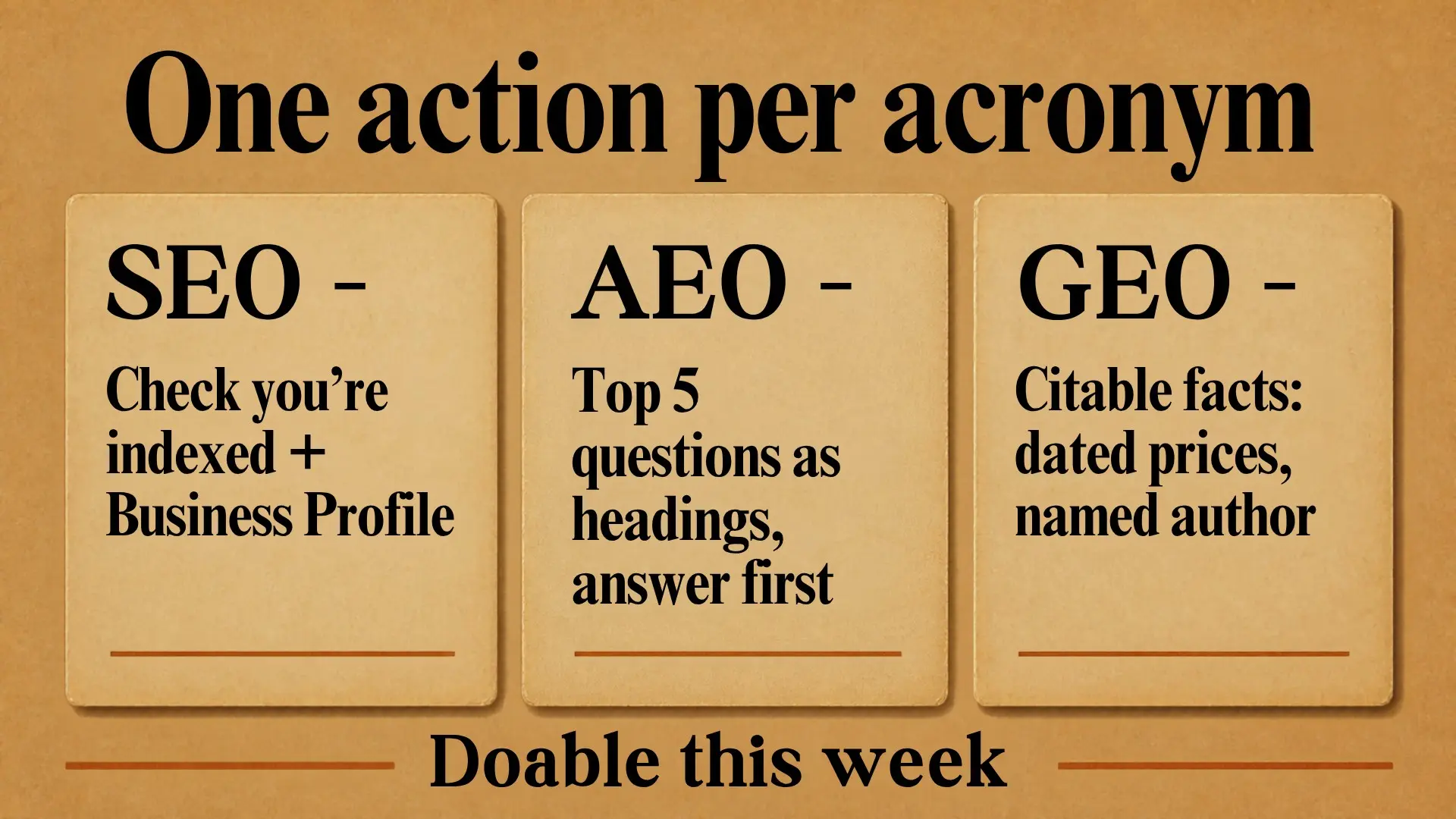
Take one action per acronym. You can do all three this week.
One action per acronym, doable this week.

Beyond that, this is the writing checklist I use. It's my own practice, not a Google rule:
Answer first. Put the answer first, then the details.
Question headings. Use headings shaped like questions.
Standalone sections. Make each section stand alone, because it might be quoted by itself.
Tables and FAQs. Add a small table or FAQ where it helps.
Real byline. Put a real byline and an About page on your site.
Dates. Date anything that changes, like prices or versions.
I write every post so its first paragraph could be read aloud by an AI as the answer. If you can do that for your five most common customer questions, you're ahead of most small websites.
What should you NOT waste money on?
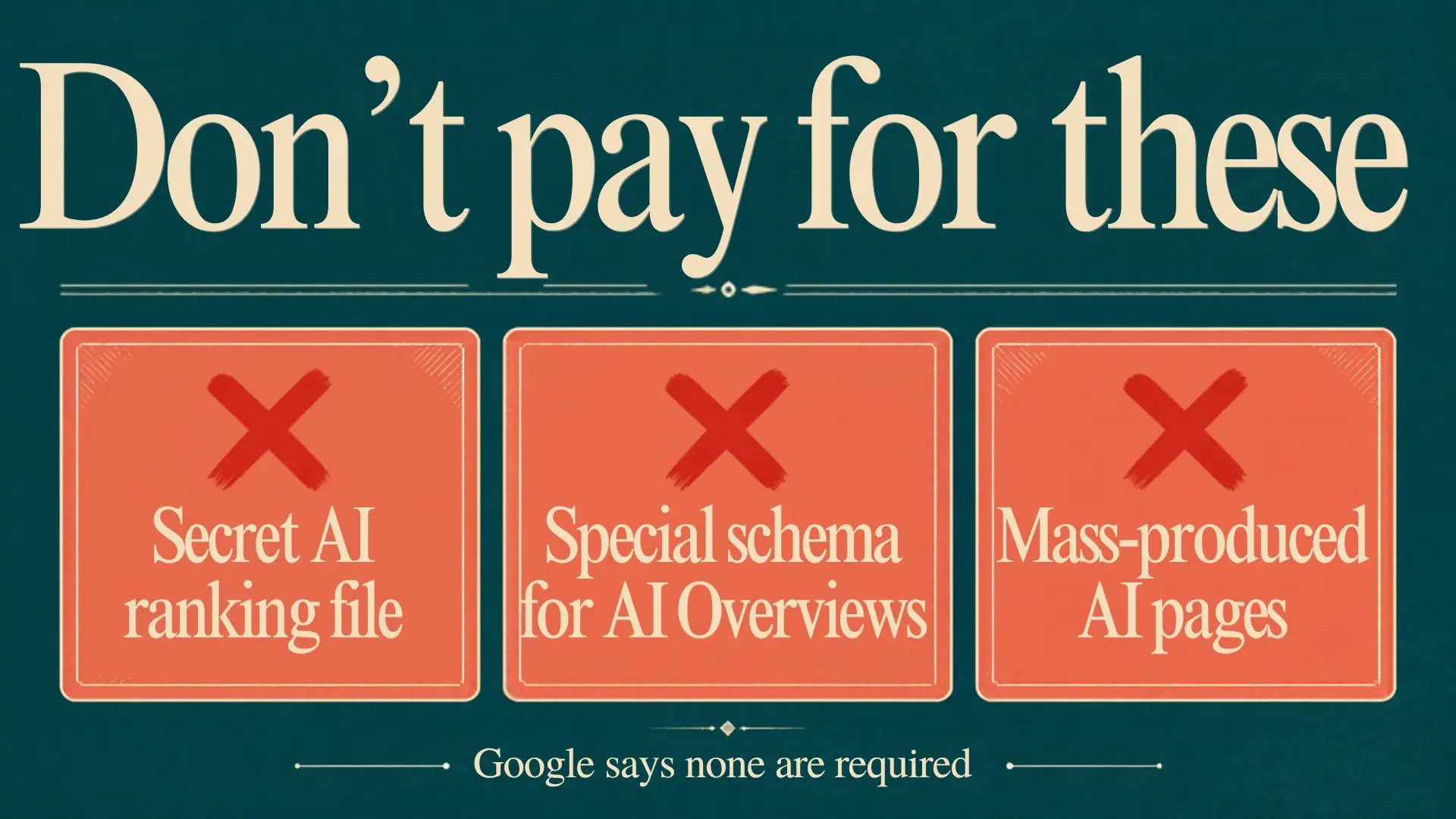
Don't pay for anything sold as a secret AI ranking file or special schema for Google's AI features.
Google says you don't need new machine-readable files, AI text files, or special schema.org markup to appear in AI Overviews or AI Mode. If someone charges you for that, they're selling something Google says isn't required.
Two more things to avoid:
Mass-produced AI pages. Google says using AI to churn out content mainly to manipulate rankings breaks its spam policies. I use AI every day, but to help people, not to flood the web.
Fake authors. Google says fabricated author profiles are deception. Use your real name and your real experience.
One caution: all of this is Google's guidance. Other AI tools, like ChatGPT, Claude, or Perplexity, may work differently. I haven't researched their rules, so I won't claim to know them.
How do you measure it?
Search Console. Google counts traffic from AI Overviews and AI Mode inside the normal Performance report in Search Console, under the "Web" search type. So keep watching the same report you already use.
Analytics. Look at what people do on your site. Google says clicks from results pages with AI Overviews are "higher quality", meaning people spend more time on the site. That's Google's claim, so check it against your own numbers.
Manual spot-check. Ask AI tools the questions your customers ask, and see who gets cited. Treat it as a spot-check that shows you where you stand, not as a metric.
FAQ
Is SEO dead because of AI?
No. Google says SEO best practices remain relevant for its AI features, including AI Overviews and AI Mode.
What is the difference between AEO and SEO?
SEO aims for rankings and clicks. AEO aims to be the direct answer an AI gives. For Google's AI features, the advice for both is the same: solid fundamentals and clear, helpful content.
What is GEO?
GEO is generative engine optimization, a term from a 2023 research paper about getting content cited in AI-generated answers.
Do I need special schema or an AI text file for AI Overviews?
No. Google says you don't need new machine-readable files, AI text files, or special schema.org structured data.
How do I know if AI Overviews send me traffic?
It's included in Search Console's Performance report, under the "Web" search type.
Can I stop Google using my content in AI features?
Yes. Google's controls:
Googlebot controls: robots.txt, plus nosnippet, data-nosnippet, max-snippet, and noindex.
Google-Extended: limits AI training and grounding in some other Google systems.
So what's the takeaway?
SEO gets you found. AEO and GEO get you quoted. For Google's AI features the recipe is the same SEO basics plus clear, answer-first, trustworthy writing. Skip anyone selling you a secret AI file.
About Me

I'm Darlin Baje, a Filipina AI engineer and entrepreneur. I make my way around the world while I work in the middle of the AI shift: clear explanations, practical tools, and systems that help people without the hype. More at darlinbaje.com. Everything starts with a conversation — contact me.
Further reading






