
Thank you for stopping by and checking out this series detailing coins and tokens with market caps below one billion dollars $US that have the potential to be a valuable part of your portfolio. We'll be examining their history, their role in the greater crypto ecosphere, and if they're poised for major growth that's worth your time and money.
This week, I'll be reviewing the coin that looks to provide a solid foundation to the decentralized financial system: Ampleforth (Amples)

Primary Info:
As of 1/10/2021, from the Ampleforth Dashboard and CoinMarketCap
Supply (Circulating/Total): ~299 Million / ~376 Million
Platform: ERC-20
Primary Exchanges: Kucoin, Uniswap
Coming onto the public stage during the middle of 2020, Ampleforth is a currency coin that aims to match the value of the US Dollar in 2019 as adjusted by the Consumer Price Index. Now, this might just sound like a stablecoin with built in inflation management, but the difference between Ampleforth and coins like Tether, USDC, and Dai is that it doesn't rely on any form of collateral to maintain it's value. Instead, Ampleforth relies on an elastic supply and market forces for price stability.
How It Works:
At the center of Ampleforth's protocol is their rebase system, which adjusts the total supply of Amples in the accounts of all holders of the coin up or down in order to match the change in demand as well as encourage movement towards the target baseline once a day. Now while waking up finding you've got more or less of a coin in your wallet than you did the previous day might sound far from stable, you need to understand that while the specific number of coins might adjust the percentage of coins in relation to the total supply you hold doesn't change during the rebase. If you held 1% of all Ampleforth coins before the rebase, you will still hold 1% of the supply after it, just the specific number of coins that represents does.

At a certain point each day (with a small amount of randomness), Ampleforth's system automatically checks the volume weighted average price of the coin through their own and Chainlink based oracles and determines whether a rebase is warranted. If the current price is within 5% of the current price target, no changes in supply will occur. If the price is above or below this range, then the protocol will act by increasing or decreasing the supply of Amples for each user. For example, if the price of 1 Ample reached 50% above the target price then the system would react by increasing the total supply by 50%, but not all at once.
In order to keep over corrections from happening the supply changes are graded linearly as if they will occur over a time period of ten days and then the system will institute the first day's supply change on that scale, which in our example above would be a 5% increase in supply. Now I highlighted the "as if" of that last line because the protocol recalculates the need and size of any supply change each day while forgetting what happened the previous day. So if on the next day the price of an Ample was at 20% above target we'd only see a 2% supply change instead of the 5% the system thought was going to happen, and if we were within 5% of the target price no change whatsoever would occur. The same goes if the price drops below the lower threshold, with supplies shrinking at a specific pace until the price recovers.
This creates an interesting pattern for Ampleforth's market cap, as it is not just reliant on the current price but is influenced by how it has performed in relation to its price target over a period of time. Let's look at an example:
For the purpose of this example let's say the current supply is 400,000,000 and the current price is at $1.03, which is also our target price for this example.
The next day, the price jumps to $1.236 (20% above target) by the time the protocol checks the oracles and, now that we're above the upper threshold, the protocol takes action and begins to increase supply. As we mentioned above, this would end up with a change of +2% to supply for the first day. This would set our supply at 408,000,000. The following day we drop back down to $1.05, well within the target range so no further supply actions are taken and we stay there for two days.
Now, lets say that instead of the value of an Ample jumping 20% it only went up 15%, but only dropped to 10% over target the second day before going to $1.05 on the third. This would give us a price of $1.1845 and a movement of +1.5% in total supply on the first day, bringing supply to 406,000,000. On the second day we've moved down to $1.133, which is still above the threshold, so we have another rebase. Now remember that the protocol forgets what it did the previous day and recalculates the supply change each cycle, so now we're looking at a change of +1% of supply for the day. This puts us at 410,060,000. On the third day we slide back into the target zone at $1.05.
At the end of three days in these two examples we're back at the same price point of $1.05, but significantly different supply totals and market caps:
Price Spike (20% one day gain): 408 Million x $1.05 = $428.4 Million market cap
Smaller Bull Run (15%-10% two day hump): 410.06 Million x $1.05 = $430.56 Million market cap
As you can see, the overall market cap of Ampleforth benefits more from steady trading with moderate periods of above target zone prices that help increase the overall supply and availability of the coin over quick spikes and drops in price. However, the potential gains of this higher periods mean that eventually profits will be taken and the price will slide back down into an equilibrium state.
Now of course you have the opposite effect when the price of an Ample goes below the bottom threshold with supply contracting. However, there is still something to be gained from this movement as it then becomes possible to purchase a greater share of the overall supply at a lower price than previously possible, which can then increase demand and push the price back into the target zone.
It is these counter-cyclical pressures that help make Ampleforth a synthetic commodity-money.
The Synthetic Commodity-Money
Much as been made lately of how Bitcoin is Gold 2.0 (and I posted as to why this isn't entirely accurate), and while it does share some of the benefits of a commodity when it comes to holding value due to it's absolute scarcity, it also cannot adapt to changing demand and therefore is still susceptible to price volatility at a scale that can make it unsuitable as a base monetary unit for a smart contract or other economic activity that relies on predictable values for currency. This is the problem Ampleforth aims to solve with their protocol.
Since the protocol is designed to expand and contract supply automatically based on specific rules and the actions of the market, it can absorb price shocks in either direction while not diluting the percentage share of tokens holders own nor falling prey to discretionary policy decisions that could lead to inflation or other undesirable actions that could hurt the value of the Ample. By designing a system that aims to maintain a specific, predictable price without relying on any type of collateral, Ampleforth has the ability to serve as a true synthetic base money that won't get caught up in the correlative moves of other cryptocurrencies like Bitcoin or Ethereum nor be tied into monetary policy decisions that affect the USD and could have consequences for stablecoins like Tether and USDC.
So if we view Ampleforth as a synthetic base money, or "cash", how would it fit in to your crypto based investment portfolio?
Cash: The Other, Other Investment Asset
While stocks and bonds are the most commonly held investment assets, cash and cash-equivalents are an important part of any portfolio as they provide the best liquidity to take advantage of opportunities as they present themselves as well as a safe harbor to store profits when volatility in the market surpasses your risk profile.
Now in the past cash could be held longer term so long as general interest rates kept up with inflation, but with the FED likely to keep interest rates low for several years to come dollars seem to be a losing investment. With Ampleforth's price target set to account for inflation in the USD, it avoids this problem which gives it an advantage over Tether and USDC for use as a cash equivalent when trading on decentralized markets over the long term. If they can begin to match the availability of liquidity mining for the token that those stablecoins enjoy as well as their volume its possible that Ampleforth's acceptance as a base currency for the cryptocurrency ecosphere might come about.
Another challenge Ampleforth faces in the near term when it comes to acting as a cash like asset is the high gas costs of the Ethereum network. While Ethereum 2.0 promises to bring these down, for the near term small denomination trades will be negatively effective which can act as a drag on Ampleforth's volume.
Risks
Like other cryptos I've talked about on this blog, the main risk when considering taking Ampleforth into your portfolio is it not achieving a critical mass of support and use. Volume has been inconsistent since it's release, and while it has picked up in recent months there has still been large price swings that the protocol has had to work hard to overcome.
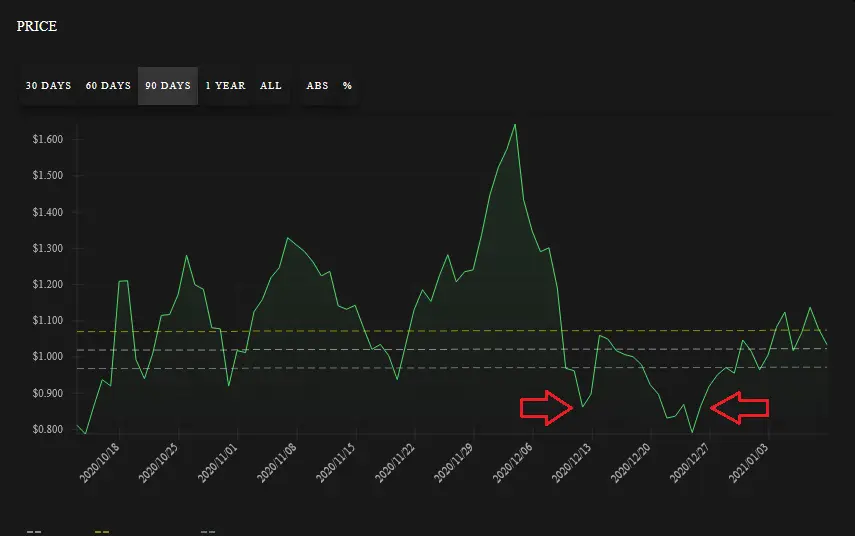
Most concerning to me are the significant dips I've highlighted on the chart above. The one bottoming out on 12/13 only lasts a couple days but represents over a 15% drop in price over the course of a day, which is far from what you would want to see from a token looking to maintain a fairly stable price. The drop at the end of the 2020 that happened soon after is even more significant, with the price of an Ample staying below the lower threshold for 10 days and a bottoming out of over a quarter from the target price.
Now, as we can see in both cases the price DID recover which shows that for now the market theory behind the protocol works. The question in my mind is what happens if we see a longer period of below-target prices? When prices are above-target the market action is pretty straight forward: Sell off the extra Ample gained from supply expansion until the price drops towards equilibrium. With below-target it's not so simple as a holder would see both the value of their coins going down as well as the amount of coins they own. While their share of the total supply isn't changing, there is the question if that fact can overcome the emotional reaction to seeing both those numbers getting smaller in their wallet.
What I really would like to see as a counter to this would be a push to have Ampleforth accepted as payment for good and services, which I believe would provide for considerable upward pressure if its price fell significantly below the target. While programming can be created to update prices of goods/services in real time, this isn't always practical and could generate volume from those taking advantage of the discount while also driving the price up.
In any event, for Ampleforth to find a sustainable equilibrium it's going to have to gain significant volume to help even out it's pricing across multiple markets.
Final Thoughts
Ampleforth's protocol presents a fresh take on providing a base currency for use in the crypto ecosphere, but for it to really achieve its goals there is will be work to do expand its breath of acceptance. I believe Ampleforth is a worth while coin to gain some exposure to (especially if you've already earned some on this website), and it's price volatility provides a number of opportunities for profit. However, I'm not ready to replace my USDC with it as my cash equivalent in this space just yet. There is great potential here, but Ampleforth may need some more time to mature before being able to become a standard use commodity money.






