
It's been about 4 months since I started writing on Publish0x with my first set of posts going over how to trade options related to BTC on the LedgerX platform and then sharing the wheel strategy I would be using to take advantage of Bitcoin's price volatility to make extra cash income off of my held coins. You can find these two articles here and here.
To be honest things didn't go along as planned soon after started, but one of the great things about the wheel strategy is that it can still turn out to be profitable even when prices move faster and farther then you were expecting as well as providing opportunities to recover any unrealized losses you might occur in your trades.
Let's take a look at my trading history on LedgerX for the past few months. Note that I'm trading in 0.01 BTC increments so while the middle column shows the price for a 1 BTC the column to its left are the actual dollar values I was working with. The final column is the $0.15 fee for opening and closing a trade that LedgerX charges, which for this kind of trading is quite reasonable.
I've broken down this list into three parts sections, representing different parts of my trading strategy over time:
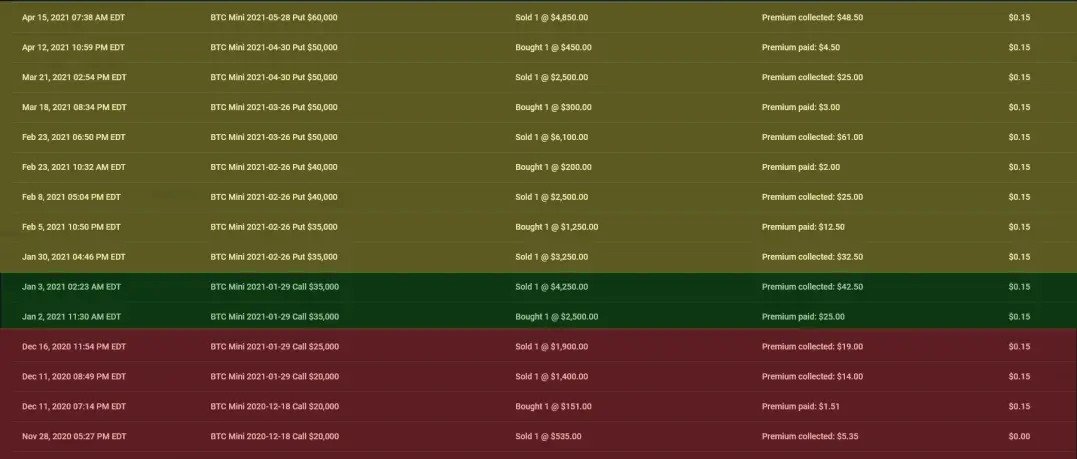
As you can see in the red section, I actually began my wheel strategy on the covered call side as I already possessed sufficient Bitcoin to meet their minimum trade values and it would be easier to transfer that then setting up a wire transfer to deposit cash into my account at LedgerX. My initial trade was very conservative, the length of time from expiration and amount of movement of Bitcoin at the time only earning me a few dollars profit but provided experience in how the platformed worked.
With this first trade under my belt I decided to commit 0.02 BTC to options trading, selling off 1 contract (0.01 BTC) on the 11th of Dec and the other on the 16th at a higher strike as the price started to rise. In the end both calls were exercised at their expiration as Bitcoin hovered around $34,300 on Jan. 29th. Now it should be noted I still made money on both these trades as my initial collateral Bitcoin had cost me less than the strike prices I had set my calls at and I still had the premium from the contracts, I had just missed out on further profit if I had just held the coins and sold at market prices that day.
The green section in the middle was an attempt to take advantage of the high volatility and rapid gains Bitcoin was making by using the premium I had collected to purchase a call (also known as going long on a call) on the theory that at the very least the expectation of a further climb by the market would continue. While there was only a few hundred dollars of movement in Bitcoins price for the 14 or so hours I owned the contract, I had nailed the timing on expectations as I was able to close out an almost 70% gain in less than a day. When they hit, long calls can be very profitable but they can also end up totally worthless in a short amount of time if the market doesn't move your way quickly enough. With Bitcoin's prices going though wild swings at this time I decided it would be a safer play to return to my wheel strategy.
With only enough funds to back one contract at a strike price that would provide any kind of useful return, I sold my first cash-secured put on Jan. 30 (the beginning of the yellow section) fairly close to the current price of BTC that day. If I was trading stocks I would have left a good deal more room between my strike and the current price, but in this situation I could see the mania starting to build and decided the premium was worth the risk. I turned out to be right as Bitcoin continued its rocket upwards. Now normally with a wheel strategy you would allow the contract sold to run to expiration to (hopefully) capture the entire premium. However, with BTC's constant move upwards it proved to be more profitable to buy back the contracts once most of the profit had been captured and sell another one either at a higher strike or further out to gain more premium. You can track how I move first up the strikes and then further up the calendar at the $50K strike, collecting nice returns all along the way until I move up to the $60K strike on the 15th of this month for a nice premium with confidence that....
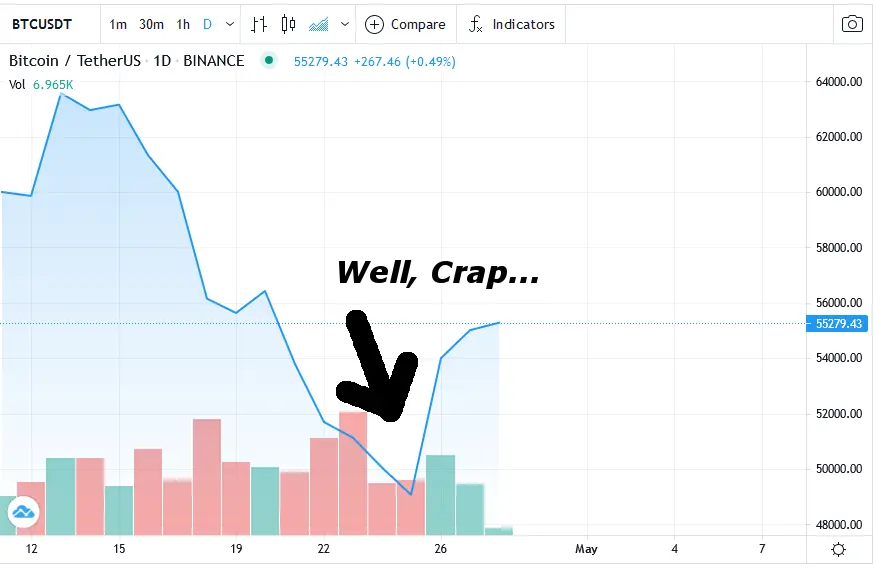
Now the flash crash we experienced a short while ago might seem to have destroyed my current contract position, but in actuality this is the kind of event a wheel strategy can help protect you against and still allow you to be profitable. Lets take a look at the numbers:
I've sold 1 contract (equal to 0.01 BTC) 5-28 Put at the $60,000 strike price. This means that when May 28th rolls around whoever purchased my contract can make me purchase 0.01 BTC from them for $600 even if its current actual price is lower. Now we have to remember I've been collecting premium on previous put contracts for the last 4 months, including this one, with a net profit of $168.65 so far. With this in mind we can calculate our cost basis.
When it comes to put contracts, cost basis will equal the amount we will have to pay if the contract is executed minus how much premium we've taken in so far. So in this situation we have:
$600 - $168.65 = $431.35 Cost Basis
This means that as long as BTC doesn't fall below $43,135 by the contract's expiration date, we will still see a profit even if BTC is below $60K and we're assigned. We will have essentially purchased 0.01 BTC for $431.35 even if it is actually going for higher on the regular markets. With this BTC we can start selling covered calls again, collecting more premium along the way and driving our cost basis down even further until we end up getting assigned on that end and switch back to selling puts again. The wheel keeps turning and we can keep profiting.
As you can see, the wheel strategy can ride out high market volatility while still providing the chance for considerable profits, the only major risk factor being Bitcoin suddenly losing all value. It's entirely possible to miss out on huge gains like I face at the beginning of this strategy, but with patience you can make up those missed gains and then some if you stick to your plan.
----------------------------------------------------------------------------------------------------------------------------------------------------------------------
Looking for good faucets to help stack satoshis? Check out Cointiply, Fire Faucet, and Pipeflare. Each have their own ways of earning bits of crypto, so there's a good chance at least one of them will fit your preferences.






