
Business Description
Robinhood is a trading up made famous by being the first platform to offer commission-free trades. They make most of their money through a Payment-for-Order-Flow model, by routing their trades through other providers and getting paid to rout their trades. The became the center of attention for mainstream media during the Gamestop short squeeze with some cautioning against the easy access to the stock and crypto markets by inexperienced investors. Others, such as Kevin O’Leary and Cathie Wood have expressed the view that Robinhood offers a great opportunity for retail investors to enter capital markets.
IPO Access
Robinhood announced its Robinhood IPO Access feature, whereby retail investors will have the option to buy certain stocks at the IPO price, before they enter exchanges. This is the first time, small investors gain early access to stocks, allowing them to realise gains much earlier. The first company offering shares through IPO access is Figs, a Scrub maker offering 1% of Class A shares to Robinhood users.
Fundamentals
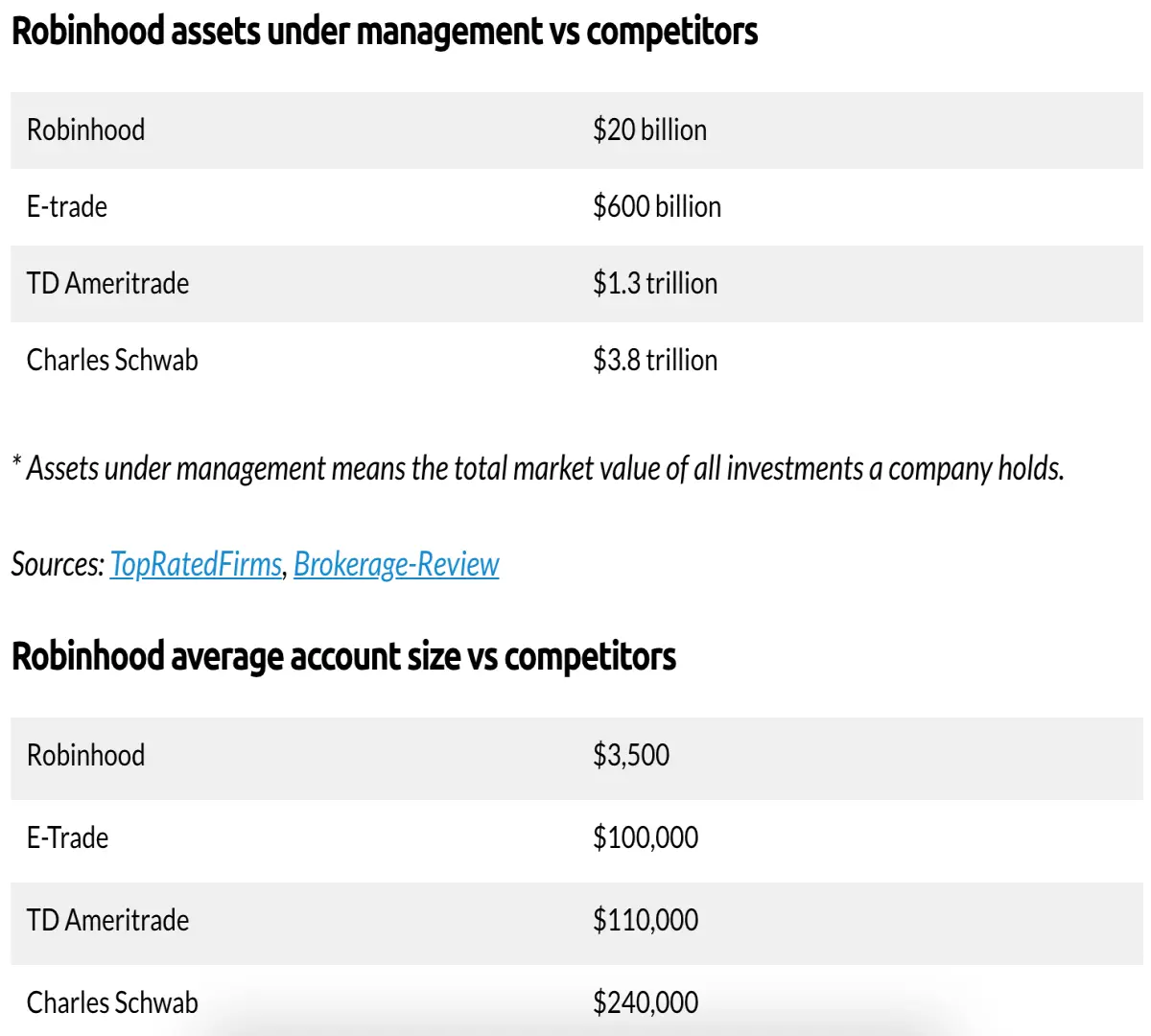
In terms of fundamentals, they are a growing company. The number of users is increasing, as well as the number of transactions. However, their Assets Under Management are much lower compared to other, established competitors.
MOAT
Robinhood’s primary competitive advantage was that it offered commission-free trades. However, since it launched, incumbent firms as well as new entrants have followed the same model, making Robinhood’s previous competitive advantage obsolete. Moreover, they only cater US clients, limiting their reach compared to other platforms, such as eToro. Their only remaining distinguishing factor is their IPO access feature. The degree to which this will secure a MOAT for Robinhood will depend on the number of new companies willing to list through them, and whether other platforms will follow the same strategy.





