
Introduction
Nuon is the first decentralized flatcoin in the world. The first question that came to my mind when I was reading its whitepaper was: what is a flatcoin? This article attempts to answer the question. We should look at the basics of what money is exactly.
Money has three main functions. It implies that anything that has the following three properties can be money:
- Medium of exchange. The first function of money is that it can be used to buy and sell goods and services. This facilitates the trade and decreases transaction costs by reducing the need for barter to nil. If you need a pair of shoes, you just go to a store and pay with your money. No need to pay with your, say, grains, if you are a farmer.
- Unit of account. Money is the commonest measure of value across the economy. What this means is that a book may cost 3 kgs of apples or an hour of cleaning work. But it’s more typical to see its value as measured in fiat money, e.g., $15.
- Store of value. Since the value of money is retained over time, it allows people to store their wealth.
The next momentous step in the history of money was crypto. The first cryptocurrency, Bitcoin, could be used as a medium of exchange (an infamous example - someone paid 10,000 BTC to buy two Papa John's pizzas in 2010). But the problem is cryptocurrencies are too volatile. You don’t want your money to be worth $50 today and then to plunge to $0.05 tomorrow.
So, the concept of stablecoin was conceived. Stablecoins are designed to keep their value against the benchmark asset, such as a commodity, fiat currency or another cryptocurrency. Most stablecoins created to this day are pegged to the US dollar which means they are designed to have a price close to $1. Though there were several epic failures in the relatively young history of stablecoins, we can posit that they are doing for what they had been developed.
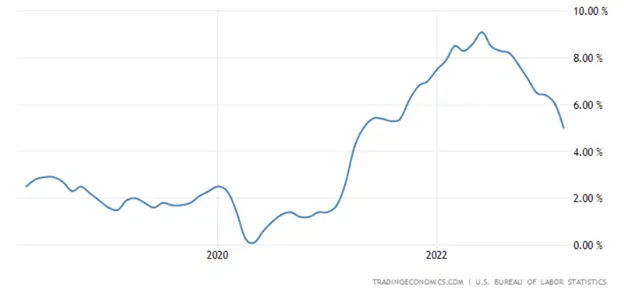
But stablecoins, too, have a flaw. If you carefully read the last function of money above, you probably noted that I stealthily ignored an important property of money. That is, money doesn’t store value well. Money loses value over time due to inflation. Since fiat currencies lose their value in the inflationary regimes, fiat-backed stablecoins should depreciate as well. Your 10,000 USDT doesn’t have the same purchasing power as it did a year ago. The Post-Covid era US inflation rate peaked (we hope it did!) in June 2022 when reached 9.1%.
Flatcoin
Enter the idea of flatcoin. A flatcoin is a decentralized stablecoin which doesn’t lose its value due to inflation. Since it is pegged to the price of a particular basket of goods and services, it provides protection against inflation. When the price of that basket rises, the price of flatcoin increases as well. The idea is that as the flatcoin’s price is correlated to inflation rate, it retains its real value over time.
Nuon
So now we know that Nuon is the world’s first decentralized flatcoin. Think of it as a digital asset providing both volatility hedge and inflation hedge. That is, it is a stablecoin changing in value in line with the inflation rate. Nuon protocol uses daily inflation level to compute the target peg of its flatcoin. You may wonder how the protocol obtains daily data if official inflation reports by governments are usually published monthly. The answer is Truflation, an independent inflation index oracle, which measures inflation levels daily and provides the calculation to Nuon protocol. But the frequency of official inflation gauges, such as CPI is not the only reason why the protocol chose to use Truflation.
To be fair to TradFi (traditional finance), shielding investors from inflation is not a DeFi-native idea; there are examples of inflation-indexed securities, the most popular of which is TIPS (Treasury Inflation-Protected Securities). Introduced in 1997, they are issued by US Treasury in 5-year, 10-year and 30-year maturities. TIPS are designed to protect portfolios from loss due to inflationary effects. The principal value of TIPS is adjusted to changes in the inflation rate, namely Consumer Price Index (CPI), the benchmark for measuring inflation. When there’s inflation, the principal rises; conversely if there’s deflation, the principal value will decrease. Though the coupon rate is fixed at time of issuance, investors will get higher payments in case of inflation because their coupon payments will be calculated based on adjusted, higher principal value.
The problem with TIPS and other inflation-indexed bonds is that they are linked to CPI. Despite being the most common measure of inflation, CPI can understate true inflation rate in the economy. Therefore, one of the important, if not the most important, things in designing a true inflation-indexed security is to find an inflation measure that reflects the price of goods and services in the economy.
Truflation
This is what the Truflation index attempts to solve: measure real and unbiased inflation rate on a daily basis. Nuon Protocol uses Truflation oracle to fetch true real inflation rate which then is employed to calculate the target peg of Nuon based in the formula below:
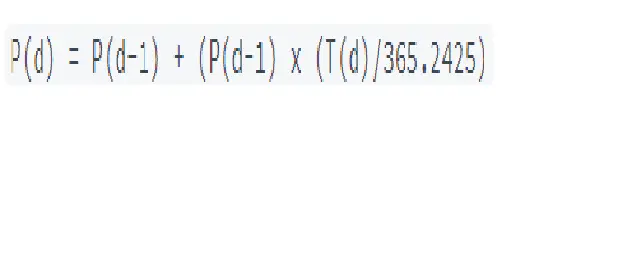
The formula for the peg takes yesterday’s peg as a basis and adds to it Truflation’s daily year-on-year inflation rate divided by the number of days in a year. So, if inflation rises, the target peg of Nuon will reflect it. And unlike official CPI numbers which is published monthly, Nuon will do it on a daily basis. Nuon price is soft pegged to inflation data which means that the target price is allowed to have some movement around it. This soft peg is necessary to adapt to an ever-changing market environment.
Collateral
To maintain the peg, the protocol uses overcollateralization. To mint NUON coin, you should provide the required collateral. Currently, the only asset that is accepted as collateral is ETH with the minimum 130% collateral ratio. It is expected that other crypto assets, such as BTC, AVAX, USDT, will be possible to provide as collateral in the future.
Liquidation Ratio (LR) is another metric to which users should pay attention. Cryptocurrencies are highly volatile; the collateral can lose some value and may not be sufficient to cover the position. Users have to ensure that Collateral Ratio is always higher than LR lest their positions be liquidated. Users will get a warning if CR is too close to LR within a predefined threshold. If CR eventually equals to or goes below LR, the collateral is liquidated 100%. To balance the peg, the protocol uses liquidated collateral to purchase NUON coin on the market which will be burnt.
LR dynamically changes based on three factors:
Liquidation Ratio = Peg Target + Volatility constant (CVB) + Peg Gap (DPR)
- Peg Target. This is the target peg that is calculated based on the Truflation oracle.
- Collateral Volatility Buffer (CVB). It is a number reflecting the historical volatility of each digital asset used as collateral. This is added to the peg target to maximize the likelihood that the protocol will be able to sell off the collateral in case of liquidations.
- Dynamic Peg Ratio. DPR indicates the difference between the market price and Nuon’s target peg. Since the peg is soft, some limited peg fluctuations are expected but there should be protection against them. Nuon trading below (over) the target peg increases (decreases) DPR. The DPR is calculated based on the following formula:
(On chain price - Target Peg) / On chain price
When Nuon price is higher than the peg, the value of your position rises which implies a lower Liquidation Ratio for all assets on the protocol. Decreasing liquidation risk incentivizes investors to mint Nuon and sell it on the market which will decrease the gap and restore the peg. Conversely, if the Nuon trades below the peg, the value of investor’s portfolio decreases which increases the Liquidation Ratio for all assets. Investors can buy more Nuon to add to their position and dodge liquidation. This buying pressure will drive the coin price and lead to repeg.
Why it may be a good idea to invest in NUON?
- First, in this inflationary regime that we are going through right now everyone wants protection from deleterious effects of inflation. Minting Nuon not only shields your assets from inflation, it also generates yield on your collateral. Meanwhile, you can also receive yield on other DeFi protocols by staking or farming your NUON tokens. So, despite its overcollateralization, we can say that Nuon is capital efficient.
- Nuon will appreciate in value if inflation rises. So, in this bear market Nuon can be one of the few digital assets that can increase in value. Also, we can expect that persistent inflation will create high demand for Nuon which will push the coin price up as well.
- Arbitrage opportunities. When there is a difference between target peg and Nuon market price, it will create an arbitrage opportunity that begs to be exploited. If the coin is trading over the peg, one can mint Nuon and sell it on the market thus pocketing the difference between them.
- If you are a true DeFi degen, you can use a riskier strategy, namely leveraged yield farming. You can choose to stake your Nuon tokens on other DeFi protocols. If the token value rises, you can mint even more Nuon and stake or farm them on other protocols amplifying your yield.
Conclusion
Inflation is persistent across the economy and doesn’t seem to decelerate as Fed would want to see. It is certainly not transitory as they claimed. To minimize its effects, you want to invest in assets performing well during inflationary periods. That’s why inflation-proof investment will be a hot topic in DeFi if inflation doesn’t decrease. Nuon, the first decentralized flatcoin, is going to be a harbinger of this theme. It allows an investor to protect her portfolio against the loss due to inflation. Not only this but you can also generate yield on your Nuon tokens and on the collateral provided to the protocol. You can think of it as a digital asset combining all three properties: generating interest, volatility hedge, and inflation hedge. It is a yield-bearing stablecoin appreciating in value in line with inflation rate.






