
The first part of the article can be found at:
Now that we understand gas fees on Ethereum, let's look at the novel solution offered by Hedgehog protocol - hedging gas fees
Hedgehog protocol
Hedgehog’s gas derivatives really seem useful and even necessary for the blockchain network. But who can benefit from it? Who are the prospective users of these contracts? At the risk of sounding rude, I have to note that an average Ethereum user — or any blockchain user for that matter — is not that sophisticated. The protocol’s writers put it quite bluntly but eloquently: “when you ask the end user to hedge their own gas fees, they will tell you to go find your mom”.
Different matter is big players who will find gas derivatives useful for their business. Potential buyers of gas hedging derivatives include but are not limited to:
- Paymasters. In the context of Ethereum, paymaster is a kind of sponsor. It is an entity (a smart contract account) covering gas fees of a transaction executed by someone else. Paymaster is one of the essential components of another Ethereum upgrade, EIP-4337, which is a standard for account abstraction for the Ethereum blockchain. This will hopefully revamp dApp usability and user experience because Paymasters will pay users’ gas fees on their behalf. Since Paymasters have to pay gas fees, sometimes even a hefty premium during network congestion, it is prudent to assume that they will be interested in Hedgehog derivatives. The idea is not dissimilar to that of in other markets. You buy gas derivatives to hedge yourself against gas price spikes.
- Layer 2 solutions. As already briefly mentioned above, these protocols allow to avoid excessive gas fees due to their technology to offload part of computation from the blockchain, thus reducing the demand for the mainnet. But they themselves incur significant operational costs due to their using a lot of gas. For example, Arbitrum, the largest Ethereum Layer 2 solution in terms of Total Value Locked at the time of writing, has spent 20,500 ETH only on base fee alone. With the current price of ETH this is almost $43 million!
Where do these expenses mostly come from? Each transaction on Layer 2 protocols incurs two types of costs: L2 or execution fee, and L1 or security fee. The former is the fee you as a user pay to execute your transaction on a Layer 2 solution. The latter is the fee to publish your transaction on L1, in this case the Ethereum mainnet. That’s why this is sometimes called “mainnet publishing fees”. The diagram below shows the amount of fees in ETH spent monthly by layer 2 protocols while publishing data to the Ethereum mainnet.
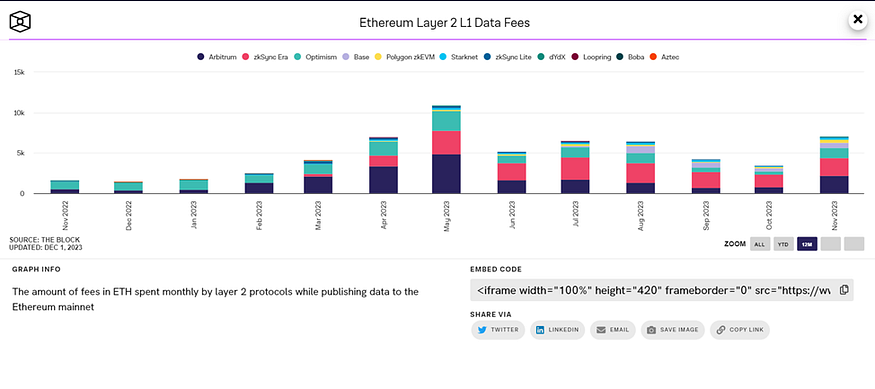
Timing of Hedgehog protocol for Layer 2 solutions is close to perfect, I think. If bull market comes, ETH price will surge raising gas fees to heights as well. Considering that more protocols and NFT projects are launched during a bull market in comparison to a bear market, the demand for the Ethereum mainnet will increase drastically which will magnify L2 operational costs. Hedgehog will allow these protocols to decrease their costs and increase profitability.
- Validators. To verify and execute transactions blockchain networks need validators who can be an individual or a group of individuals. However, verifying transactions and adding new blocks to the blockchain require resources which incur costs for validators. That’s why validators are renumerated in the form of gas fees. Though the relationship is not as unambiguous as it may seem, we can say that validators do benefit from high gas fees. They are not a curse for validators, they are a blessing. If this is so, then why would validators even think of hedging gas fees? The same reason why a Bitcoin miner chooses to hedge their position — drop in BTC price will negatively impact your profit margin. In fact, unpredictability of cash flow is one of biggest hurdles for Bitcoin mining industry to attract investors. Now change BTC and miners to ETH and validators. The problem is not high gas fees; it is exactly opposite, low gas fees. Validators need hedging to stabilize their cash flows.
- NFT Marketplaces. It is not surprising to see these players among the potential beneficiaries of gas hedging. This is because minting an NFT due to its resource-consuming nature requires a lot of gas. To improve user experience with NFTs, these marketplaces choose to go fully or partially gas-free. UCOLLEX, a platform to buy physical and digital collectibles and where you don’t need even a crypto wallet, pays gas on behalf of its users. If this trend continues, and I don’t think of any reason why it won’t, NFT marketplaces will have to hedge their gas fees.
Besides hedging, Hedgehog’s gas derivatives can be used for speculative purposes, too. As already mentioned, some events can cause gas price to surge. If there is a popular NFT mint or a chain of DeFi liquidations is expected, you can buy gas derivatives betting on an increase in gas price. In a similar manner, you short these derivatives once an anticipated event happens or doesn’t impact market as expected; this is how you, a true DeFi degen would express the trading idea that gas fees will return to their normal level. I think it won’t be an exaggeration to claim that this would create a new asset class — Ethereum gas price.
Conclusion
High gas fees, especially their surge during certain events, are a big issue for the Ethereum ecosystem. Its unpredictability and volatility do challenge Ethereum’s scalability, further adoption and growth. Being the largest blockchain network, Ethereum doesn’t stay still and constantly evolves. Innovations such as Layer 2 solutions, and Account Abstraction and the increasing popularity address the gas problem, but don’t solve the problem altogether. In fact, as we have explained, these entities themselves can suffer from the volatility of gas fees. Excessive gas fees can eat into their earnings eroding their profitability. A product allowing big players to hedge their gas fees seems almost inevitable for the further growth of Ethereum.
Enter Hedgehog protocol. Hedgehog protocol allows to hedge volatility of and speculate on gas fees on the Ethereum network. It’s a novel idea which has the potential to improve user experience of the largest blockchain network. Many participants of the Ethereum ecosystem, such as NFT marketplaces, paymasters or Layer 2 solutions would benefit from hedging their gas fees. Though V1 of the protocol is focused on Ethereum gas fees, the future plan is to generalize to other on-chain derivatives, such as Bitcoin hashrate, EigenLayer hedging, and even end-user speculation.






