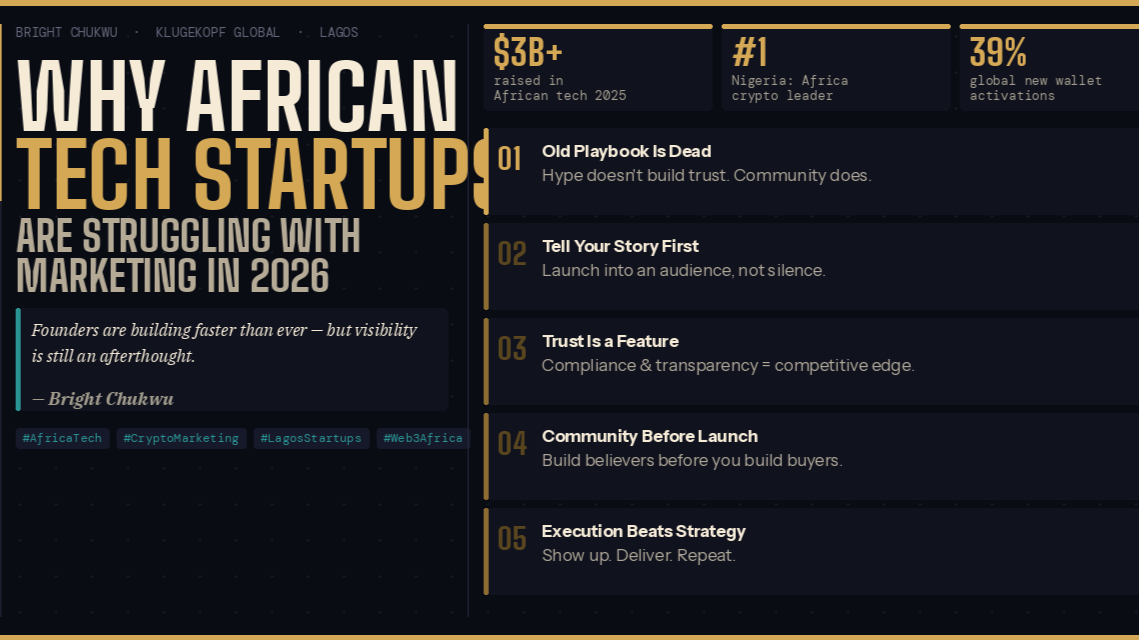
Nigeria is leading Africa in crypto adoption. Lagos keeps showing up on global startup rankings. Funding into African tech has been climbing again.
So why do so many startups still feel invisible?
I've spent the last few years working across Nigeria's tech, crypto, and AI ecosystem helping companies manage marketing, communications, and operations. One pattern keeps showing up:
"Founders are building faster than ever, but visibility is still treated like an afterthought."
The problem usually isn't the product. The problem is that nobody knows why the product matters.
The old marketing playbook stopped working
A few years ago, a flashy website, a Telegram group, and some influencer posts could get a crypto project noticed. That doesn't work the same way anymore.
People have become more skeptical. They want proof, not promises. They want to know who is behind a project, what problem it solves, and why they should trust it.
The projects that seem to be gaining real traction today aren't always the ones with the biggest budgets. They're the ones that build a community early and communicate clearly about what they're trying to achieve.
Nigeria is helping drive adoption but many startups aren't telling their story
Industry reports suggest Nigeria remains one of the world's fastest-growing markets for crypto adoption and digital finance. The demand is there. The talent is there. The ecosystem is there.
Yet I've seen founders spend months building a product and only start thinking seriously about marketing when launch day arrives. By then, they're launching into silence.
I remember speaking with a founder who had built a technically impressive product over the course of several months. The launch came and barely anyone showed up. Not because the product was bad because no audience had been built beforehand.
That conversation changed the way I think about marketing. Distribution cannot be an afterthought.
Trust has become part of the product
As regulations become clearer across many African markets, credibility is becoming a competitive advantage.
Investors and users increasingly want to see transparency, governance, and evidence that a company is thinking long-term. Startups that can communicate trust clearly tend to stand out in a crowded market.
Community is no longer optional
The strongest tech communities I've observed have one thing in common: users feel involved.
Founders share progress, explain decisions, and invite feedback. People begin to feel like they're part of the journey rather than just potential customers.
In a relationship-driven market like Nigeria, that matters a lot more than many founders realize.
What the next generation of African tech leaders seems to understand
-
Marketing is infrastructure, not decoration
They think about positioning before launch, not after it.
-
Diverse teams build better products
Different perspectives help catch blind spots earlier and improve decision-making.
-
Execution beats strategy alone
In a crowded ecosystem, consistently shipping and communicating often matters more than having the perfect plan.
If you're building right now
I'd ask three questions:
Are you treating marketing with the same seriousness as product development?
Do you have systems, feedback loops, and regular iteration around how people discover and understand what you're building?
Are you building a community before launch, or scrambling to create one afterward?
The audience that will support your launch usually needs to be cultivated long before launch day arrives.
Can investors, partners, and users quickly understand your story?
If someone discovers your startup today, is your value proposition immediately clear and credible?
I'm Bright Chukwu, Executive Director at Klugekopf Global Concept Inc and a strategic investor at Klugekopf Techbridge. I spend a lot of time working with founders across Africa's tech ecosystem, and these are some of the patterns I'm seeing repeatedly.
I'd genuinely love to hear from other builders: what's the biggest marketing challenge you're facing right now?