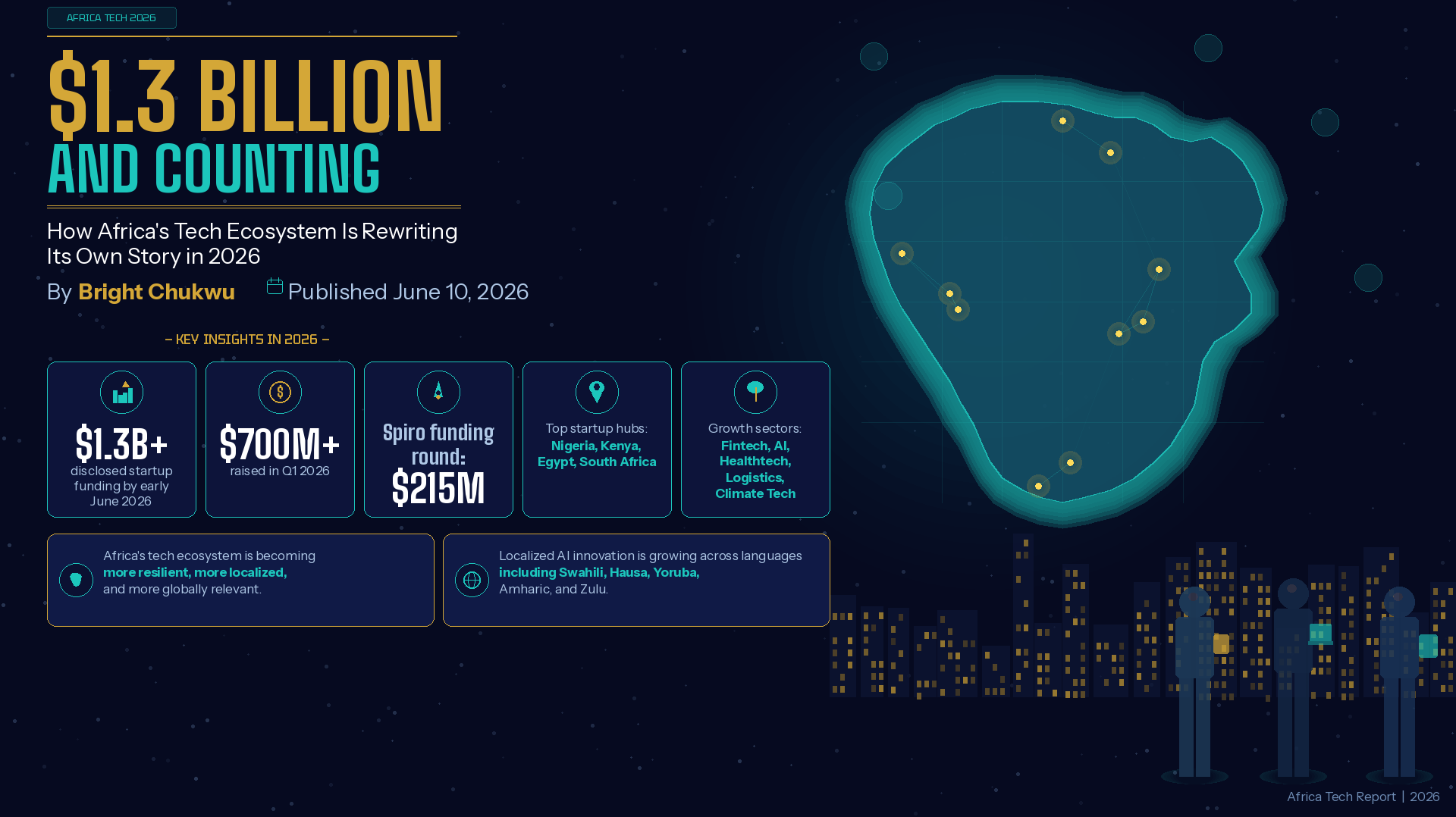
On the first day of June 2026, electric mobility company Spiro announced a $215 million funding round. With that single deal, Africa's startup ecosystem crossed an estimated $1.3 billion in disclosed funding for the year.
While many of these milestones may not receive the same level of global attention as similar developments in larger technology markets, they reflect a growing reality: Africa's technology ecosystem continues to mature, attract investment, and build solutions tailored to local and global challenges.
The Ecosystem Today: Bigger, More Resilient, and More Independent
Africa's startup ecosystem entered 2026 with renewed momentum.
According to industry reports, African startups raised more than $700 million during the first quarter of 2026 alone, with additional major funding rounds pushing total disclosed investments beyond $1.3 billion by early June. These figures suggest a significant recovery from the venture capital slowdown experienced across global markets in 2023 and parts of 2024.
Four countries continue to dominate startup activity across the continent.
Nigeria remains one of Africa's leading startup ecosystems, consistently attracting a significant share of investment activity thanks to its large consumer market, vibrant fintech sector, and growing developer community.
Kenya continues to punch above its weight in startup innovation, particularly in financial technology, digital infrastructure, and mobile-first solutions. The country's influence was further highlighted by its strong representation in several 2026 startup watchlists and accelerator programmes.
Egypt has emerged as one of the continent's fastest-growing startup hubs, benefiting from its strategic position between Africa and the Middle East, a large digital population, and increasing investor interest in Arabic-language markets.
South Africa remains one of the continent's most mature innovation ecosystems, supported by established financial institutions, strong infrastructure, and a regulatory environment that has increasingly embraced fintech and emerging technologies.
Together, these four countries continue to attract the majority of startup investment across Africa, helping shape the continent's innovation landscape.
At the same time, changing global venture capital dynamics are encouraging African founders to diversify their funding sources. As more international capital flows toward frontier AI companies and large technology hubs, startups across Africa are increasingly engaging domestic investors, regional venture funds, development finance institutions, and corporate innovation programmes.
While this presents challenges, it may also contribute to building a more resilient ecosystem rooted in solving local problems and serving regional markets.
AI in Africa: Solving Different Problems
Much of the global conversation around artificial intelligence focuses on improving productivity for existing digital systems. In many African markets, however, AI is being applied to a different set of challenges.
Instead of optimizing processes that already exist, many startups are building tools that expand access to services for people who have historically been excluded from traditional systems.
A commonly cited example is Kenya's M-KOPA, which uses data-driven models to support asset financing for customers with limited formal credit histories. Similarly, Branch International has spent years refining lending and risk assessment systems designed for markets where conventional banking data may be scarce.
These examples illustrate a broader trend: African startups are developing AI-enabled solutions for financial inclusion, healthcare access, agriculture, logistics, education, and mobility.
The growing interest in this space was reflected in the recent Google for Startups Accelerator Africa programme, which reportedly received nearly 2,600 applications from AI-focused startups across the continent. The selected companies represented sectors ranging from fintech and healthtech to agriculture, software infrastructure, and mobility.
Another notable development is the growing focus on localized AI systems. While many global AI models are primarily trained on English-language datasets, African innovators are increasingly exploring solutions designed for languages and contexts that remain underrepresented in global technology platforms.
This includes work involving languages such as Swahili, Hausa, Yoruba, Amharic, and Zulu, alongside efforts to build tools that better reflect local cultures, markets, and user behaviors.
Fintech remains the largest recipient of startup funding across Africa, but emerging sectors such as healthtech, logistics, climate technology, and AI infrastructure continue to attract increasing attention from investors and accelerator programmes.
The People and Programs Driving Growth
Technology ecosystems are ultimately built by people.
Across Africa, founders, developers, investors, mentors, and ecosystem builders continue to create the foundations that enable innovation to flourish.
The latest Google for Startups Accelerator Africa cohort highlighted the depth of entrepreneurial talent emerging from the continent. With thousands of applications submitted, the programme demonstrated the growing number of founders building AI-first companies capable of addressing local and global challenges.
In East Africa, Safaricom remains one of the region's most influential technology and telecommunications companies. Through the continued evolution of M-Pesa and broader digital services, the company plays an important role in supporting innovation, financial inclusion, and digital adoption.
Meanwhile, initiatives such as the Accelerate Africa Startup Programme continue to provide early-stage founders with mentorship, capital access, and opportunities to connect with investors and partners.
On the policy side, regulators are increasingly recognizing the importance of innovation-friendly frameworks. South Africa's Financial Sector Conduct Authority (FSCA), through initiatives such as its Innovation Hub, has been widely regarded as one of the continent's more active regulatory supporters of fintech experimentation and emerging digital services.
These programmes and institutions may not always receive headlines, but they play an essential role in helping startups move from promising ideas to sustainable businesses.
Why This Matters Beyond Africa
One of the most interesting aspects of African innovation is that many of the challenges being addressed are not unique to the continent.
Financial exclusion, limited access to healthcare, fragmented logistics networks, language barriers, and infrastructure gaps affect billions of people across emerging markets worldwide.
As a result, technologies developed in African markets often have applications far beyond national borders.
AI systems built to operate effectively in low-data environments may prove valuable in other underserved regions. Financial technologies designed around mobile-first behavior can offer insights for markets where traditional banking infrastructure remains limited. Local-language AI models may help accelerate digital inclusion for millions of non-English speakers globally.
For this reason, developments taking place in Lagos, Nairobi, Cairo, Cape Town, Kigali, and other innovation hubs deserve attention not merely as regional success stories, but as examples of how technology can be adapted to diverse realities around the world.
The Bottom Line
Crossing the $1.3 billion funding mark before the first week of June is a notable milestone for Africa's startup ecosystem. Yet the most important story may not be the capital itself.
The deeper story is the growing maturity of an ecosystem that continues to build solutions for real-world problems, attract talent, and create opportunities despite global economic uncertainty.
Africa's technology sector is moving beyond the narrative of future potential. Across fintech, artificial intelligence, climate technology, healthcare, and digital infrastructure, founders are increasingly developing solutions that address local realities while contributing to broader global innovation.
Whether this momentum continues at its current pace remains to be seen. What is clear, however, is that 2026 is already shaping up to be a significant year for African technology—and one worth paying attention to.