They exist much situations which, under certain constraints, can be approximated with a statistical distribution: it’s the Normal distribution, also called Gaussian distribution, Gaussian Law or Bell Curve since the shape of the curve resembles a bell. This is possible thanks to the Central Limit Theorem (CLT).
What’s the Gaussian Distribution?
It’s a statistical distribution represented from two parameters: mean (μ) and variance (σ2); the mean can assume all values, while the variance only non-negative values (σ2 ≥ 0). Being a bell-shaped curve, it is symmetrical with respect to the maximum point, which corresponds to the mean; which in turn coincides with the median and the mode (the mode resembles the concept of fashion, what’s very frequent).
What’s the Central Limit Theorem (CLT)?
It’s a theorem which states, in a few words, the following: if we take a data distribution, which does not follow the Normal distribution, and extract from it k samples of equal size n, then the distribution of the k average (or sums) for large numbers can be approximated by the Gaussian distribution.
The essential characteristic is that it does not require any hypothesis on the type of distribution that the phenomenon of examination must assume. However, it's not always worth using the theorem: in fact, some have even criticized it.
The constraints for which the phenomenon in question may require the use of Normal distribution are:
- the phenomenon must be generated from a great numbers of causes
- such causes must act independently and additive
In other words, the phenomenon should present very frequent modes around the average and rare when moving away from the average.
Some examples, situations where such a distribution is used are: weight, height, bolt diameter, finance (equity and bond yields or technical stock market, Beta Coefficient, Value at Risk, etc.), IQ, flipping a coin, fair rolling of dice, income distribution in economy, educational performance and more. We just need to make sure that the phenomenon under consideration reflects the constraints we have in the previous lines. The Normal distribution has been also criticized much times.
To conclude, I report the following characteristic, so-called empirical rule, described from the following image:
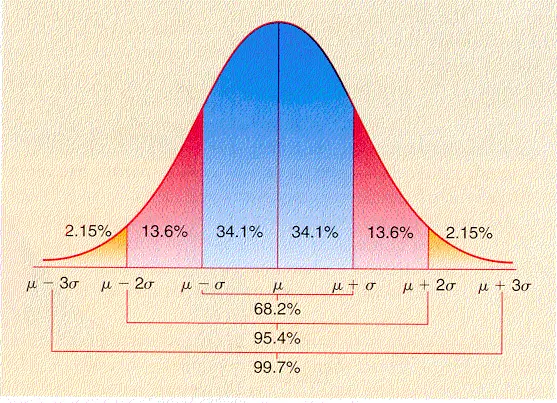
Sources: here
The image states the 68.2% of the data falls in the (μ - σ ; μ + σ) range, about 95% falls in the (μ - 2σ ; μ + 2σ) range and 99.7% falls in the (μ - 3σ ; μ + 3σ) range, where σ means the standard deviation, the square root of variance (σ2), and it's a measure of dispersion.
My Referral Link:
Coinmonster
FreeCardano
Faucet Crypto
FaucetPay
CoinPayU
1xbtc
Eobot.com
ShrinkMe.io
Looking for a good wallet? I recommend Atomic Wallet