
Despite switching the Ethereum blockchain network from a Proof-of-Work (PoW) to a Proof-of-Stake (PoS) system, there has not been a significant decrease in gas fees. Probably, a question is in your head like “What the hell is happening with Ethereum? “ Well, worry not. We’re going to explore in-depth technological details in this article.
Understand Ethereum’s Transition From PoW to PoS:
Ethereum has made an impressive switch from its energy incentive PoW consensus algorithm to an energy-efficient PoS system. Ethereum’s full upgrade consists the different phases like the Beacon Chain, the Merge, and Shard Chains so essentially these steps attempt to address the high energy consumption issues, scalability, and other issues that the previous traditional PoW-based Ethereum blockchain had.
Beacon Chain:
Ethereum’s Beacon Chain was launched in 2020 as the original PoS blockchain which was the main consensus logic for switched Ethereum. Through The Merge, it transitioned Ethereum’s PoW to PoS system with a staking feature enabled. The Beacon Chain handles consensus and its original clients manage transaction execution.
The Merge:
The event of “The Merge” was executed on September 15, 2022, and it was introduced to upgrade Ethereum’s PoW system to the PoS system. Essentially, the event of merging Ethereum’s traditional PoW-based chain into the PoS-based Beacon chain now exists as one chain of the PoS-based Ethereum blockchain network.
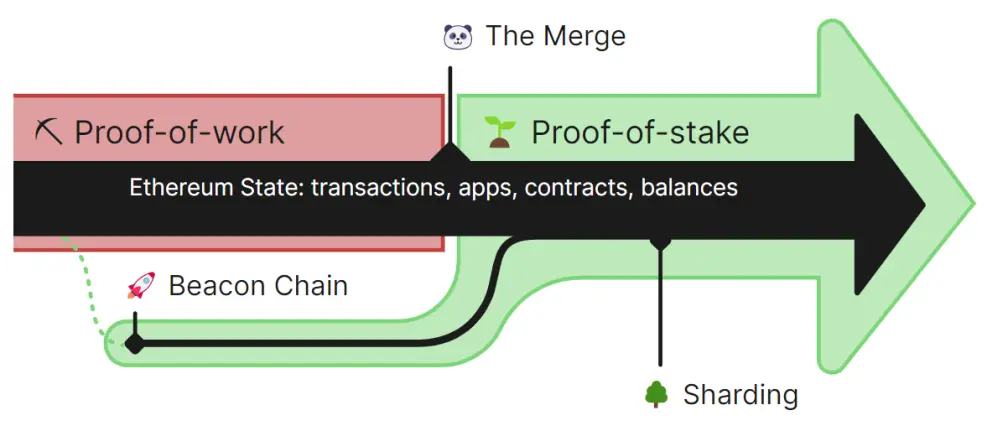
Figure: Available from ethereum.org
So, “The Merge” has addressed Ethereum’s notorious high energy consumption by cutting Ethereum's energy use by about 99.95% which makes the blockchain much more sustainable.
Shard Chains
The safe integration of sharding into the Ethereum ecosystem is possible through the PoS consensus mechanism. As we know, “The Merge” has assisted in staking ETH through its Beacon chain, and the sharding feature will also be introduced after that switch.
There are several stages that Ethereum is going to transit from ETH to ETH 2.0 which can be understood as follows:
Ethereum's journey to version 2.0 is like a well-thought-out adventure that is progressing through different stages as shown in the following diagram. It all started with the launch of the Beacon Chain as already mentioned.
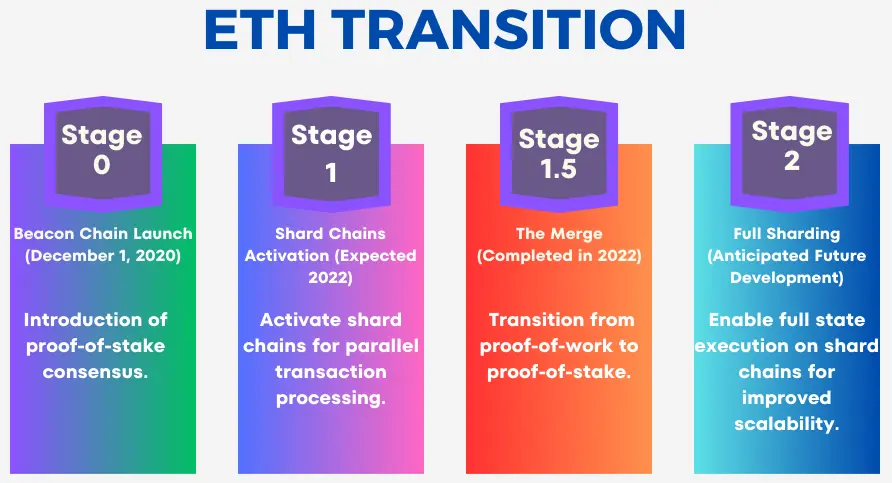
Looking at the future, there is the most anticipated stage 2 which contains the fully developed ecosystem. It update will assist in to flow of transactions smoothly across different chains.
So these are about Ethereum’s progress to get switched into ETH 2.0 but despite several upgrades, the ETH gas fee is still high, and currently, at the time of writing, it costs about 23 gwei ($1.17) for priority: 1 and it takes time ~ 3 mins: 0 secs for processing a single transaction. It takes even more, especially when the network gets congested. What is the reason behind it? Well, let’s get started with the following insights.
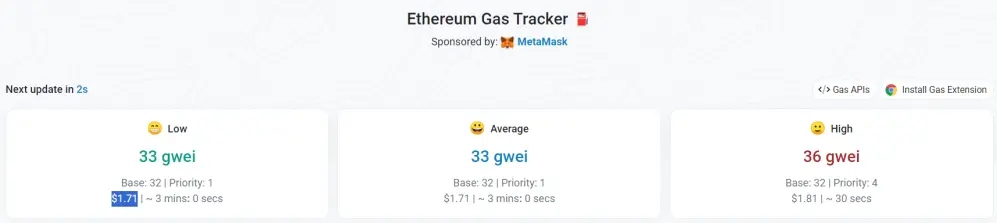
In the upgraded Ethereum blockchain network, Gas fees are needed for Ethereum transactions, and users pay a gas fee in ether to prevent network spam and ensure smooth operation. The fee calculation is based on a combination of the base fee and priority fee (tip), with users specifying the amount they're willing to pay. The gas limit indicates the maximum computational work a transaction can consume, and high gas fees are due to the network’s demand. Initiatives like Ethereum scalability upgrades and Layer 2 scaling aim to address gas fee issues and enhance overall efficiency.
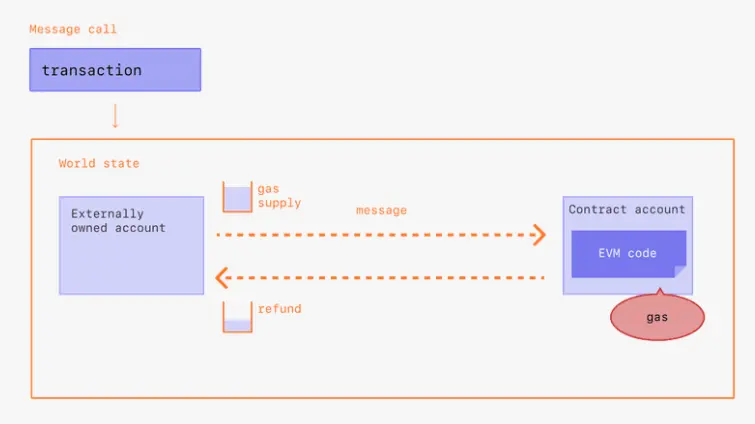
Figure: Available from Ethereum EVM illustrated
The London Upgrade (EIP-1559) introduced variable-sized blocks which makes gas fees more predictable and efficient. Monitoring tools help users stay informed about gas prices for more cost-effective transactions.
Hence, gas fees persist as a reflection of network demand for the network's capacity. The implementation of “The Merge” hasn't altered parameters that directly impact the capacity or throughput of the Ethereum blockchain. In simpler terms, although PoS has enhanced Ethereum's energy efficiency, it hasn't directly resulted in lower gas fees. The fees continue to be dictated by the interplay of supply and demand within the Ethereum network.
It’s also worth noting that sharding which is the most anticipated upgrade in Ethereum’s roadmap, is expected to help reduce gas fees by increasing the network’s capacity. However, as of now, sharding has not been implemented in Ethereum. Before sharding, there will be a Dencun upgrade and it is expected to happen in 2024. This layer is expected to set Ethereum’s journey to becoming a scalable settlement layer.
Conclusion:
Ethereum one of the world’s largest public blockchain networks is making a historical leap by switching its consensus algorithm to PoS but its most anticipated sharding upgrade is yet to be realized so that it assists in reducing the cost of transactions for the various activities in the Ethereum blockchain network. For now, ETH transaction charges are not cheaper than we expected to be. We need to wait.






