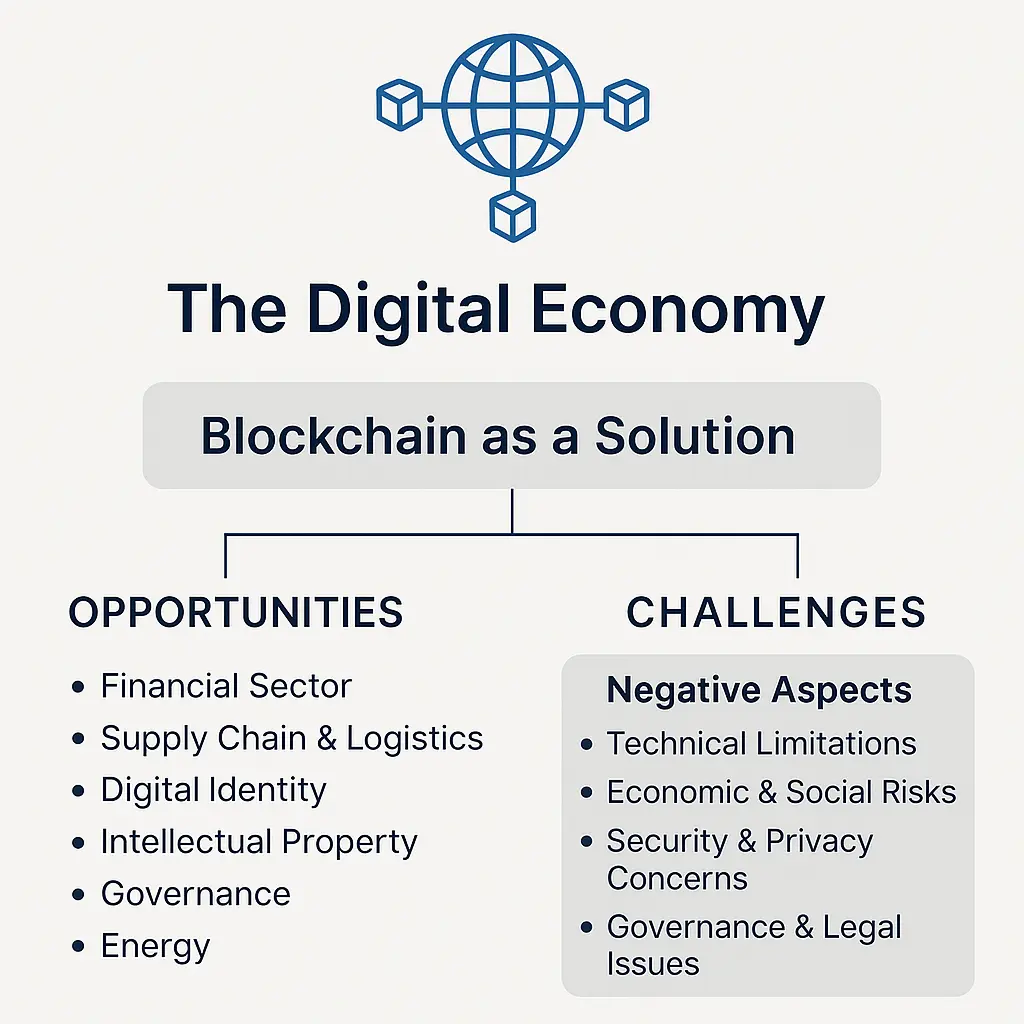
For today's post I literally spent more than 7hrs to put down best of research-based post that can highlight how around the world actually looks like if we can develop or implement global solution based on blockchain based solutions. please support me this has taken efforts to write please don't scroll or simply go through atleast encourage efforts.
Abstract
The digital economy—encompassing all economic activities driven by digital technologies—is redefining global trade, finance, governance, and consumer interaction. With rapid technological advancement, blockchain has emerged as a transformative force, offering decentralized, transparent, and secure frameworks for data exchange and transactions. This article examines the state of the global digital economy, explores blockchain’s potential applications across sectors, outlines the transformative changes required for integration, and critically assesses the limitations and potential risks of blockchain-based solutions.
1. Introduction
The digital economy now accounts for an estimated 15% of global GDP, with projections indicating continued exponential growth. It encompasses e-commerce, digital payments, digital services, fintech, Industry 4.0, IoT, and emerging metaverse ecosystems. As the backbone of this economy, data flows, digital platforms, and algorithmic decision-making drive efficiency—but also raise concerns over monopolization, data privacy, and systemic vulnerabilities.
Blockchain technology, introduced in 2008 with Bitcoin, presents a paradigm shift: decentralized consensus, cryptographic security, and immutable records. Its integration into the digital economy promises enhanced transparency, efficiency, and inclusion, yet requires overcoming technical, regulatory, and societal barriers.
2. Global Digital Economy: Current Landscape
2.1 Major Components
-
Digital Trade & E-commerce – Cross-border transactions, online marketplaces.
-
Digital Finance & Payments – Mobile banking, cryptocurrencies, CBDCs.
-
Digital Infrastructure – Cloud computing, 5G, edge computing.
-
Industry 4.0 – Automation, robotics, AI, IoT integration.
-
Digital Services – Streaming, online education, telemedicine.
-
Data Economy – Big data analytics, targeted marketing, digital identity systems.
2.2 Driving Forces
-
Ubiquitous internet connectivity.
-
Proliferation of smart devices.
-
AI-driven personalization.
-
Globalization of digital trade.
3. Blockchain as a Transformational Force in the Digital Economy
3.1 Key Advantages
-
Decentralization – Eliminates need for central authorities.
-
Transparency – Immutable, auditable records.
-
Security – Cryptographic protection against tampering.
-
Efficiency – Reduction in intermediaries and delays.
3.2 Blockchain Use Cases Across Sectors
A. Financial Sector
-
Cross-border Payments – Faster, cheaper remittances.
-
Decentralized Finance (DeFi) – Lending, borrowing, and insurance without banks.
-
Central Bank Digital Currencies (CBDCs) – State-backed blockchain currencies.
B. Supply Chain & Logistics
-
Traceability – Real-time monitoring of goods from origin to destination.
-
Fraud Reduction – Verification of product authenticity.
C. Digital Identity & Data Privacy
-
Self-sovereign Identity (SSI) – Individuals control their own data.
-
KYC/AML Compliance – Secure, reusable digital IDs for finance.
D. Intellectual Property & Creative Industries
-
NFTs for Rights Management – Transparent licensing and royalty payments.
-
Content Provenance – Verification of authenticity in art, journalism, and media.
E. Governance & Public Services
-
E-voting Systems – Tamper-resistant election processes.
-
Public Records Management – Land registry, business licenses on blockchain.
F. Energy & Environmental Management
-
Carbon Credit Trading – Transparent carbon offset marketplaces.
-
P2P Energy Trading – Decentralized energy exchange between producers and consumers.
4. Major Transformations Needed for Blockchain Integration
-
Regulatory Harmonization
-
Cross-border legal frameworks for smart contracts, digital currencies, and data privacy.
-
-
Interoperability Standards
-
Common protocols for blockchain networks to communicate with legacy systems.
-
-
Scalability Improvements
-
Solutions like sharding, layer-2 protocols, and consensus optimization.
-
-
Digital Literacy & Workforce Upskilling
-
Education for citizens, regulators, and businesses on blockchain potential.
-
-
Cybersecurity & Risk Management
-
Integration of blockchain with advanced encryption, AI monitoring, and quantum-resistant protocols.
-
5. Potential Negative Aspects of Blockchain Integration
5.1 Technical Limitations
-
Energy Consumption – Proof-of-Work systems consume significant electricity.
-
Scalability Issues – Transaction bottlenecks in high-demand networks.
5.2 Economic & Social Risks
-
Job Displacement – Automation of middleman roles in finance, logistics, and legal services.
-
Wealth Concentration – Token ownership often remains in the hands of a few large players.
5.3 Security & Privacy Concerns
-
Irreversibility – Mistaken or fraudulent transactions cannot be easily undone.
-
Smart Contract Bugs – Code vulnerabilities can lead to large-scale losses.
5.4 Governance & Legal Issues
-
Regulatory Uncertainty – Varying national stances on blockchain and crypto.
-
Jurisdictional Conflicts – Decentralized systems challenge traditional legal authority.
6. Conclusion
The digital economy’s future will be deeply shaped by blockchain’s trajectory. While the technology can democratize finance, enhance trust in data systems, and streamline global trade, its widespread adoption requires addressing scalability, regulation, and social impacts. A balanced approach—leveraging blockchain’s strengths while mitigating risks—will be essential to ensure that its integration strengthens, rather than destabilizes, the global digital ecosystem.