
All cryptocurrencies are characterized by a very high volatility that prevents the expansion of the technology on a large scale; to try to overcome this inconvenient feature, stable-coins have been established.
Stable coins are nothing more than cryptocurrencies and their value is anchored to fiat currencies; “El Petro” is an exception, as its value is anchored to the price of a barrel of oil.
These cryptocurrencies should be called digital currencies, since being anchored to a fiat currency makes decentralization longer valid. You could bet it: any fiat currency belongs to a bank (or State), which can decide its fate.
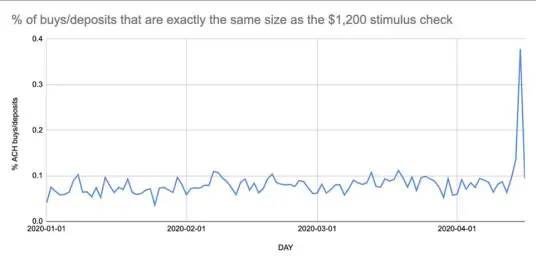
These fates can also be doubtful if we consider the Helicopter Money of a few months ago which was renamed stimulus to make the pill sweeter. A stimulus to growth that many American citizens have misrepresented. 8 times more than usual, Americans turned their stimulus into Cryptocurrencies, from what we understand from the graph below.
The concept of the Neutrino protocol is to be able to keep the price stable in an algorithmic form, using a native token on a public blockchain, which could be Eth, Waves, Atom; as a reserve blocked on a Smart-contract.
In this way there can be a multitude of Neutrino stable-coins, as they are named after the token used for the underlying and the Neutrino suffix. For example USD-Neutrino, Eur-Neutrino, BTC-Neutrino, S&P500-Neutrino.
Apparently it could be a contradiction: to maintain decentralization we place one token on another equally volatile one.
Absurd.
If we have market downturns, it could even reach a point where the underlying assets could not cover the token based on the Neutrino protocol. To prevent this scenario, a particular token has been integrated, the Neutrino System Base Token (NSBT) which trigger a smart contract that sells those native tokens in order to restore the hedging reserves, when this situation occurs.
With this system two very important advantages are obtained:
1- The reserves are never compromised, so the underlying assets are guaranteed;
2- This is a system that can be used as a deflationary mechanism, then implemented in those defi-oriented blockchains such as, for example, Ethereum, Eos, Cosmos or Wawes.
In order to understand how it works, let's analyze the neutrino protocol implemented on the Waves blockchain, which is known for its DeFi technology and Staking.
Let's see in detail the tokens that take part in this protocol:
WAVES: Native Token of the Waves public blockchain, based on the consensus mechanism of LPoS (Leased Proof of Stake). It is used for the payment of transaction fees on the Blockchain and generates profit for the nodes that generate blocks. The price of this token is defined by the classic free market rules of offer and demand.
USDN: US Dollar Neutrino is a Stable-coin Token on the Waves platform, the price is linked to the US dollar. The capitalization and the maximum offer are closely linked to the capitalization of Waves, of course.
The token originates from suitable smart contracts that can be manually executed by users.
The USDN was neither allocated nor pre-financed. The offer of these tokens is also managed by any user, in fact any account on waves BC can become a neutrino user.
The price of the stablecoin is around US $ 1, the variations up or down are managed by special arbitration mechanisms that we will see later in the discussion.
NSBT (Neutrino System Base Token) is the Utility token of the protocol, I would say the protocol regulator. This token is produced only and exclusively through smart contracts, according to the USDN reserve deficit
Again through a smart contract, the NSBTs can be liquidated in the event of a significant growth in the capitalization of Waves, or as a reserve fund.
These tokens are also used as a payment currency in the Neutrino ecosystem and give holders the right to vote.
The price of the token is defined by the classic cryptocurrency market laws and can be purchased at a minimum value of 1 USD equivalent in Wave tokens, but only under certain conditions, such as surplus.
Let's get to the heart of the protocol and its functioning.
We start from the assumption that the Waves token is, in relation to any asset greater than 0; in this case, for convenience, we take USD as the reference asset. We can block a certain number of Waves tokens for an amount X of USD. At this point the smart contract will be able to coin, being the ratio of 1: 1, X USD-Neutrino tokens.
If the supply of USDN is equal to that of Waves, then we have an equilibrium. To get updated rates, we use decentralized oracles that collect data from the most liquid exchanges of OTC (Over-The-Counter)
Obviously this would be the ideal situation, but as we know, volatility prevents the equilibrium phase from lasting for a long time, therefore two distinct scenarios can be outlined.
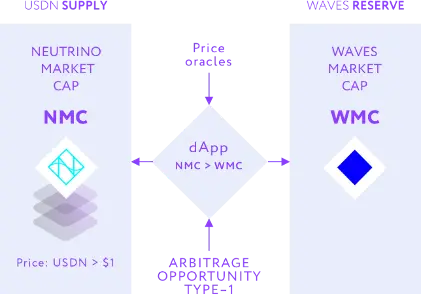
Scenario 1: Price of USDN quoted above 1 USD.
The ideal scenario for traders: through dApp, with the Neutrino protocol, Waves tokens are exchanged for USDN tokens, after which the USDN is sold at a clearly higher price. In this way, the price increase is compensated by increasing the offer.
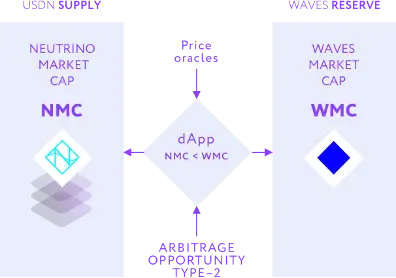
Scenario 2: Price of USDN quoted at less than 1USD
In this case we proceed in the opposite direction, so we buy USDN tokens at a lower price and then exchange them through dApp and the smart contract of the Neutrino protocol, in Waves tokens.
Price stability mechanism
In the event that the capitalization of Waves exceeds that of USDN, the algorithm starts the smart contract that generates USDN for the purchase of NSBT tokens in liquidation, if there were none, a situation remains in which the offer of Waves is greater than USDN.
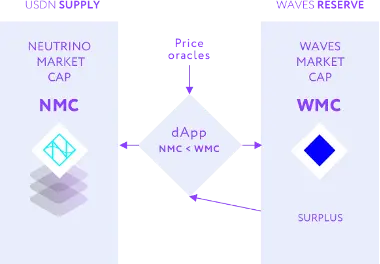
Let's see how the smart contract reacts if Waves' supply is lower than Neutrino's supply.
Having detected the capitalization deficit, the smart contract proceeds with the auctioning of the NSBT tokens. The purchase can only be made through Waves tokens.
For traders this could be a fairly profitable operation, let's take a numerical example, let's assume:
Supply USDN $ 100,000;
Supply Waves $ 90,000 => Waves price drop by 10%
To compensate for the $ 10,000 gap, the smart contract is auctioning NSBT tokens, clearly the price depends on the orderbook and discounts.
For convenience let's say that only one trader buys NSBT tokens at a 15% discount. That means he buys 11,576 NSBT for $ 10,000. Attention, the purchase can only be made through Waves tokens.
At this point, when the market starts to rise again, the trader can liquidate the NSBT tokens, with a profit of 15% (which is clearly the discount applied to the purchase).
Because this protocol subverts stable coins
The characteristics that make this protocol extremely innovative are mainly 2
1 - The decentralization of the system through the use of smart contracts that rely on certain oracles for tracking the discounted price of the dollar, therefore the data is not provided by a centralized institution;
2 - The possibility of taking advantage of staking with a stable coin; this function is innovative in the stable coin field, as it is a real staking function
Staking is possible as a smart contract transforms USDN into Waves native tokens and carries out the staking procedure. Clearly when the staker decides to withdraw the blocked USDN, the same smart contract provides for the conversion of the Waves tokens, including those deriving from staking, into USDN tokens.
What is your opinion on it? Have you already had experience with this environment?






